The first Simplilearn classroom had no walls, no whiteboard and no admissions office. It was a blog about project management, written by an engineer who had sold one company and was trying to decide what ought to come next. Krishna Kumar knew the subject. More usefully, he discovered that strangers wanted him to keep explaining it. Within roughly nine months, about 3,000 people were following. Some began asking for structured help with professional certification. A readership was quietly submitting a business plan.
Founder biographies often polish such moments until the opportunity seems to have arrived wearing a name badge. This one was humbler. Kumar had notes, experience and an audience with practical questions. He turned those questions into training, first around the Project Management Professional exam, then across a wider catalog. Simplilearn grew because the blog did the oldest trick in commerce: it made itself useful before it made itself large.
The origin also explains Kumar’s persistent idea about education. Information is plentiful. Progress is harder. A working professional does not merely need another folder of material; she needs a route through it, a reason to continue after work, and someone credible enough to say whether the work is any good. The company would change formats repeatedly, but it kept returning to that compact problem.
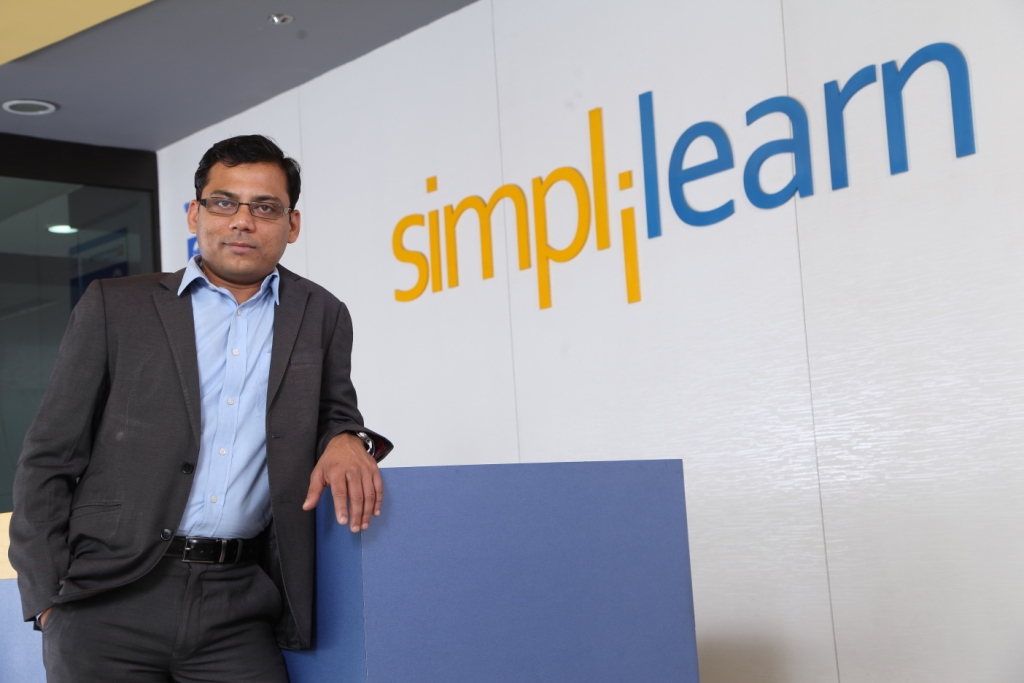
An engineer discovers the editable career
Kumar graduated from the National Institute of Technology Karnataka, Surathkal, in 1999 with a degree in electronics and communication engineering. Campus recruitment took him to Infosys as a software engineer. The respectable path had been secured. He left it within about a year.
In 2000, he co-founded TechUnified with three partners and became its chief operating officer. The company built enterprise software for mobile banking, the sort of work that taught a young operator how exacting large customers can be and how much unglamorous coordination sits beneath a clean interface. ORG Informatics, a listed company, acquired TechUnified in 2007. Kumar had completed the founder’s cycle once before the education business existed.
After the sale, he looked for an internet business with global potential and enough flexibility to travel farther than a conventional operation. The project-management blog occupied the interval. It also supplied the answer. By 2009 the experiment was taking form; in 2010 Simplilearn was established as a company. Free explanations led to paid instruction. Certification preparation widened into technology and management training. The accidental syllabus acquired payroll.
NIT Surathkal graduate joins Infosys as a software engineer.
Co-founds banking-software company TechUnified and serves as COO.
TechUnified is acquired by ORG Informatics.
A project-management blog becomes Simplilearn.
A severe classroom retreat forces an online-first reinvention.
Blackstone agrees to acquire a controlling stake.
The expensive education of 2015
Growth made the company more complicated. Simplilearn combined online materials with live teaching and, for a time, physical classroom programs spread across 100 cities. The footprint looked impressive. It also consumed cash. In 2015 Kumar and his team closed those classroom operations and concentrated on online classes. The decision removed 75 percent of revenue. At one point, Kumar later recalled, the business had enough cash for only six more months.
of revenue disappeared when classroom programs across 100 cities closed. The company focused on online instruction and reached break-even in the same fiscal year.
There are easier ways to describe a pivot than to live through one. The company had to exchange visible scale for a model it could sustain. It reached break-even in the same fiscal year. By the 2018 financial year, reported revenue had reached ₹150 crore. The point is not that retreat guarantees recovery. It is that Kumar was prepared to invalidate a large part of his own operation while there was still time to preserve the rest.
“Things may take more time than expected…one needs to have patience to re-invent the business model multiple times.”Krishna Kumar on perseverance
His three stated entrepreneurial lessons are almost suspiciously plain: perseverance, team and customer centricity. The language belongs on a conference lanyard; the 2015 episode gives it teeth. Perseverance meant closing a hundred classrooms. Customer centricity meant retaining the outcome learners wanted while changing the machinery that delivered it. Team meant having enough collective nerve to make the arithmetic survivable.
Scale arrives, wearing sensible shoes
Simplilearn’s later chapters brought the recognizable apparatus of a mature education company: courses in cloud computing, cybersecurity, data science and artificial intelligence; partnerships with universities and technology companies; training for both individuals and enterprises. Kumar appeared in Fortune India’s 40 Under 40 selections in 2015, 2016 and 2017 and received an Economic Times 40 Under 40 recognition. These are tidy milestones. His company’s untidy habit of changing with the labor market matters more.
In 2020, Simplilearn launched SkillUp, offering free courses and certificates. There is a pleasing loop here. The company that began with free project-management notes returned to free entry-level learning at much greater scale. In 2021, Blackstone agreed to acquire a controlling stake. A year later, a consortium led by GSV Ventures invested $45 million, and Simplilearn acquired Fullstack Academy. Capital enlarged the classroom; it did not settle the curriculum.
The company kept editing its boundaries. It later closed fresher-upskilling and study-abroad units, focused again on professional reskilling and enterprise customers, and reduced its EBITDA loss sharply in fiscal 2024. Kumar’s explanation was direct: spending can create numbers when the product is weak, but those numbers are not sustainable. For an executive in education technology, he has learned to be wary of growth that has not passed its exams.
His awards arrived during this long transition, including CEO of the Year recognition in 2016. They mattered, though Kumar’s own definition of success was broader when the Economic Times asked him in 2017. He pointed to the impact a successful business or individual can leave on colleagues, families and society. It is an operator’s answer with a teacher’s radius: achievement travels through other people. The connection helps explain why he talks about employability and confidence as often as course completion.
The machine enters the classroom
Artificial intelligence has now rearranged both the subjects Simplilearn teaches and the way lessons can be made. Kumar’s answer is characteristically mixed. He embraces AI as a category of professional demand while arguing that a human expert still offers motivation and direction that a machine does not yet provide. The platform’s blend of self-paced study, live instruction and applied projects reflects that view. Technology handles reach. Teachers create consequence.
The distinction is personal as well as commercial. Kumar has written that his father was a teacher and that, growing up, he saw teaching treated as a responsibility rather than merely an occupation. His own public biography lists reading, athletics, teaching and learning among his interests. In September 2026, discussing a partnership to train India’s government workforce in AI and other digital skills, he framed the goal in terms of capability rather than gadgetry: better judgment, processes and public outcomes.
“A good ‘human’ expert offers motivation with direction. AI has some way to go.”Krishna Kumar on learning with machines
By July 2026, Kumar said Simplilearn served more than 15 million learners across 50 countries and drew 65 percent of its revenue from AI-related courses. Numbers that large tempt a company to speak as if the future has already been conquered. Kumar’s own career argues for a cooler interpretation. AI is the present revision. Another will follow.
He has also resisted treating every learner as a technologist. In 2026 he said roughly half of the platform’s learners came from outside technology, including banking, manufacturing, retail and consulting. This changes the assignment. Teaching AI to a developer can begin with code; teaching it across an economy must begin with work. The useful question becomes less “What can the model do?” and more “What should this particular person be able to do on Monday?”
The useful art of remaining teachable
There is a comic imbalance at the heart of professional education. Everyone arrives because the world has changed, then hopes for a certificate proving it will stop. Kumar has built his second company around the opposite proposition. Skills expire. Delivery models become cumbersome. A fine business line may become an indulgence. The learner and the institution must both keep moving.
That makes Simplilearn less a monument to one inspired idea than a record of successive corrections. The Infosys engineer learned to operate a startup. The banking-software founder learned to teach online. The classroom company learned to live without classrooms. The certification platform learned to work with universities, enterprises and free learners. Now the AI educator is insisting that experts still matter.
Kumar’s ambition has been global, but his method remains close to the first blog: explain a difficult thing, notice who responds, and revise the offering around a real need. The lesson plan keeps changing because the world of work refuses to sit still. His peculiar advantage is that he no longer seems surprised when it does.