A child draws a creature with three legs, purple ears and the constitutional confidence of a mayor. A parent supplies a lesson about sharing. A few minutes later, the creature is moving through its own cartoon. This is the compact magic trick at the center of Pixley AI, and Krish Iyengar has arranged the props so the child is not merely watching. The child is directing.
Iyengar, Pixley’s co-founder and CEO, has been rehearsing for this role longer than his age might suggest. Before leaving Purdue University, where he studied computer science, he had developed and launched five mobile apps. Before Y Combinator, there were weekend deadlines, demo stages and four hackathon wins alongside Pranit Agrawal, Pixley’s co-founder and CTO. Before any of that, the two were friends in second grade.
Startup biographies often compress themselves into an immaculate arrow: school, insight, company, success. Iyengar’s route has more scribbles in it. He and Agrawal tried three startup ideas that did not work. They built legal-tech prototypes, consumer utilities and experiments under hackathon clocks. The useful part of those detours is not a grand lesson about failure. It is the less glamorous accumulation of taste: what can be built in a weekend, what deserves another week, and what a stranger can understand without a guided tour.
The oldest piece of infrastructure
The friendship is not decorative lore. Iyengar and Agrawal have known each other since elementary school and were entering college hackathons while still teenagers. At 15, they were already learning the peculiar choreography of building together: decide quickly, divide the problem, return with pieces that fit, and stand in front of judges before anyone has slept enough.
Their projects moved freely between categories. TherapyTrak, submitted at LA Hacks in 2022, joined an iOS app to a web interface. VerdictVantage, which took third place at Stanford Law CodeX in 2023, applied language models to help defendants examine the choice between a plea and a trial. Discovery AI, another third-place finish at a Cambridge law hackathon in 2024, organized case material for small businesses. Iyengar also built a person-tracking drone and consumer apps including SnapNotes+, Go Paddle and FITimer.
The recurring trait is less “serial entrepreneur” than inveterate finisher. Go Paddle had multiplayer matches and an iMessage mode. SnapNotes+ synchronized documents through iCloud. FITimer reached both iPhone and Apple Watch. These are small clues with sharp edges. An idea became a product with screens, states, distribution and users. The work left the laptop.
“After several hackathons and failed startup ideas, we’re now building Pixley.”Krish Iyengar, announcing Pixley’s YC batch
When Iyengar left Purdue and Agrawal left UCLA, both were 19. Y Combinator’s Fall 2025 batch provided a new clock and a larger room. The premise they brought in was plain enough to fit on a crayon box: children make characters, parents shape the lesson, and Pixley turns both into an animated story.
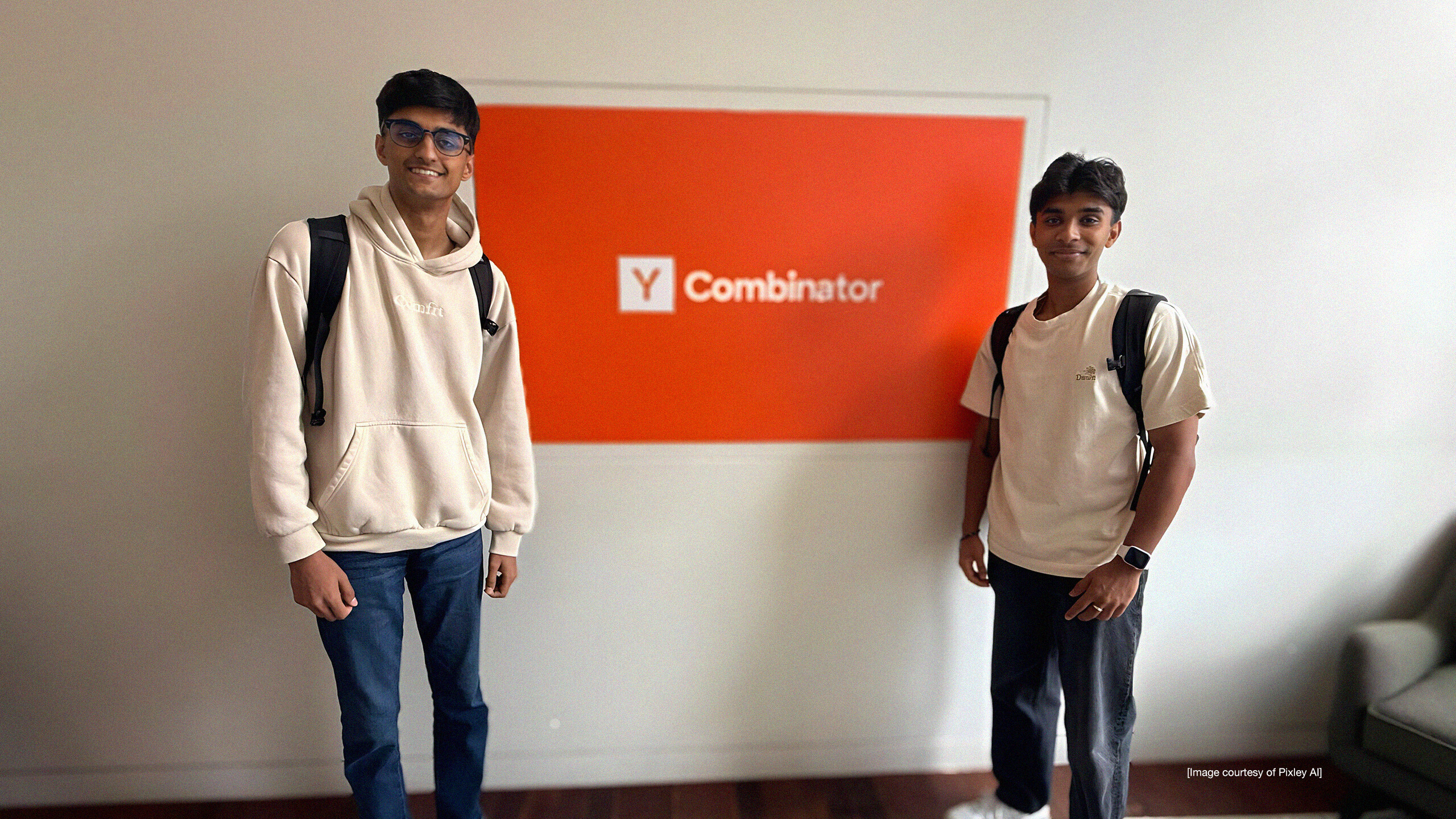
Two customers enter a cartoon
Children’s products carry a built-in comic complication: the user and the buyer are often different people. The child needs delight. The parent needs confidence, control and a reason to feel good about another glowing rectangle in the house. Win only the adult and the product feels like homework wearing a party hat. Win only the child and the parent may remove it before episode two.
Pixley’s answer is to give each side a different kind of authorship. A child can draw directly on screen or upload a picture of a toy, a friend or a creature invented at breakfast. A parent can ask for a story about fractions, honesty or table manners. The software animates the character and builds the requested idea into an episode. A “character calling” feature lets children talk with their creations. The arrangement is neither a conventional streaming catalog nor a blank prompt box. It is a small family production meeting, mercifully without a meeting.
The family-sized production line
The key product move is continuity: creations can live beyond a single generated clip.
By April 2026, more than 10,000 families had used Pixley to create content. The number is notable, but Iyengar’s more interesting public argument concerns what happens after the first generation. One-off novelty is easy to admire and easy to abandon. Children, he wrote, “want the same character back tomorrow.” Pixley’s memory layer therefore remembers characters, stories and interests so later episodes can belong to the same small universe.
That turns personalization away from the familiar machinery of recommendation. A conventional feed studies a child in order to select the next video. Pixley aims to remember what the child made so the next story can continue it. One system refines consumption. The other tries to compound authorship. Whether families keep returning will decide if that distinction becomes a habit rather than a handsome diagram.
The studio hiding inside the storybook
The technology underneath Pixley soon suggested a second business. Pixley Studios applies the company’s AI-video machinery to marketers, educators, filmmakers, creators and brands. A user can begin with an idea, then move through research, script, storyboard and generation in one workflow. The pitch is consolidation: fewer tabs, fewer handoffs, less of the digital cutlery drawer that creative software can become.
Iyengar first introduced Studios to a small group of design partners, then opened it publicly in the summer of 2026. By April, six companies were already using it to make professional content. The system can generate videos up to ten minutes long, with agents assigned to the jobs of research, writing, scene direction and production. A newer feature begins with a company URL, examines the brand and its audience, and proposes ad concepts before making the video.
At first glance, personalized cartoons for children and ads for consumer brands look like neighbors who wave but never visit. Their underlying product logic is close. In both cases, the user supplies direction rather than operating every instrument. One starts with a doodle and a lesson. The other starts with an idea or a website. The software assembles a temporary crew around the prompt.
“Research → script → storyboard → generate. All in one flow.”Krish Iyengar on Pixley Studios
This is also where Iyengar’s earlier work comes back into view. Mobile apps taught him to place complicated behavior behind a small interface. Hackathons taught him to make the demonstration legible before the clock expired. Pixley’s products ask for the same compression at a more ambitious scale: hide a production pipeline without hiding the user’s intent.
A founder still in the first act
There is an appealing temptation to turn early biographies into destiny. Resist it. Pixley was founded in 2025. Its consumer product and professional studio are still discovering their borders. The company must keep children interested without turning personalization into noise, earn parental trust through repeated use, and make a broad video workflow dependable for professional customers. Those are operating problems, not slogan problems.
Iyengar’s public posture is correspondingly product-first. His brief LinkedIn biography reads “revolutionizing entertainment,” but his longer posts spend their time on mechanics: persistent characters, waitlists, generation speed, languages, storybooks and the sequence from research to finished video. Even his argument with a larger competitor’s product centers on what the product does not remember. The personality visible through that writing is competitive, certainly, but competition expressed as a feature list.
The release cadence supplies its own character sketch. During 2026, Pixley added storybooks, longer stories, vertical video and six more languages while reporting generation that was as much as 70 percent faster. Studios moved from a closed circle of design partners to an open product. This is a founder learning in public through launches rather than manifestos. Each announcement adjusts a practical constraint: how long a story can run, where it can be watched, who can understand it, and how much waiting interrupts the spell. The improvements sound technical because they are. Together, they determine whether a child experiences a world or a loading screen.
The deeper aspiration is to change a verb. Children watch cartoons. Iyengar would like them to direct cartoons, talk to their characters, read along and make choices inside stories that remember them. Professional creators edit video. He would like them to begin with direction and let a coordinated system handle more of the assembly.
That ambition may travel far beyond the first cheerful panda, or it may find its best form inside the family room. For now, the clearest artifact is the unlikely operating history behind it: two second-graders became teenage hackathon partners, two college students became dropouts, and a trail of small finished apps became a company. The purple three-legged mayor has entered production. Tomorrow, if Pixley works as intended, the child can invite it back.