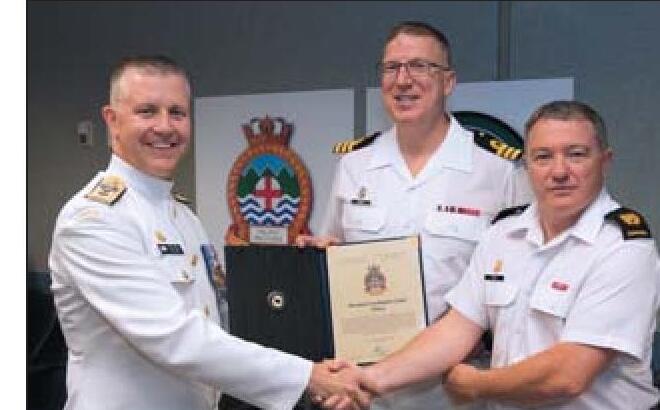
Kirk Peck appears at the right side of a promotion photograph from February 2016, standing in a dark naval uniform beside Rear Admiral Gilles Couturier. Between them is a framed insignia. The setting is formal, the handshake exact, the caption economical: Peck has been promoted to Chief Petty Officer 2nd Class. A ceremony like this lasts a few minutes. The career behind it had already lasted nearly a quarter-century.
Peck entered the Canadian Armed Forces in March 1991. The public outline of what followed is made of compact labels rather than memoir: various positions, operations department chief, chief tasker, Department of National Defence staff, MSOC CMO DND representative. Each title compresses a complicated world into a line that fits on a resume. Read together, however, the lines form a pattern. His work has repeatedly sat near the point where institutional intent must become organized action.
That is not the part of military life that typically dominates a movie screen. Coordination is quieter. It is schedules, dependencies, personnel, priorities and the clean transfer of information. When it works, other people can do their jobs. When it fails, everyone notices. Peck's career has unfolded in that practical middle, where readiness depends less on a grand speech than on whether the right person understands the next task.
The weight behind the rank
By April 2016, Peck was serving as an Operations Department Chief. The timing matters. His promotion and the operations role appear in the same year, a visible marker of advancement followed by a job built around responsibility. In a naval setting, a chief is not simply an experienced technician. The role sits between plans and execution, officers and sailors, the written direction and the conditions on the day.
The available record does not catalogue Peck's deployments or daily duties, and there is no reason to fill those spaces with borrowed drama. What can be said is more useful: he stayed. Long service has its own cumulative intelligence. Systems that look opaque to a newcomer become legible after years of seeing where they strain, where a handoff breaks and which details turn into larger problems.
A promotion photograph records the new rank. It cannot record the thousands of ordinary decisions that made the rank possible.The long view
Peck's next listed role was Chief Tasker, from July 2017 to February 2019. The plainness of the title is almost revealing. Tasking is the act of converting priorities into assignments and then following the work through. It demands enough context to understand what matters, enough discipline to track it and enough judgment to recognize when a request collides with reality. The tasker is rarely the centre of the finished picture. The tasker helps the pieces arrive there.
Selected coordinates
Begins service with the Canadian Armed Forces.
Promoted to Chief Petty Officer 2nd Class and moves into an operations chief role.
Becomes Chief Tasker with the Canadian Armed Forces.
Accepts unit recognition for Personnel Coordination Center (West).
Moves into a Department of National Defence staff role.
Begins the listed MSOC CMO DND representative role.
The award belongs to the unit
On June 22, 2018, Maritime Forces Pacific and Joint Task Force (Pacific) held a Bravo Zulu ceremony. The naval expression means well done. In one photograph, Commander Scott Godin stands in the centre and Peck stands at the right. Together they accept an award on behalf of Personnel Coordination Center (West).
The phrase “on behalf of” does important work. The recognition is attached to a unit. The people in the image are representatives of a collective result. That is a fitting public milestone for a career rooted in coordination: an individual appears in the frame precisely because a group performed well.
Personnel coordination is an infrastructure of availability. It means matching requirements with human capacity, adjusting when plans change and keeping the institution from treating people as interchangeable entries in a spreadsheet. The public caption offers no operational case study, but the award confirms that the unit's contribution was noticed at command level. For Peck, it also creates a line between the title of chief tasker and the substance of team recognition.
Promotion to CPO2 recognized accumulated responsibility and professional progression.
The 2018 Bravo Zulu recognized the work of Personnel Coordination Center (West).
A second rink
Running beside the defence timeline is another one. Peck worked as a hockey scout from 2013 to early 2019. In the winter of 2018-19, he served through Hockey Canada as Team Sweden's host at the World Junior Championship. Years later, from October 2022 through June 2023, he scouted for the Coquitlam Express, a British Columbia Hockey League club.
It is tempting to treat hockey as the colourful side note. It may be more revealing to treat it as a second setting for the same fundamental habits. A scout watches without controlling the play. He separates a repeatable pattern from a lucky bounce, considers a player's choices away from the puck and turns observation into information someone else can use. The value is not simply seeing. It is seeing in context.
A team host has a different assignment, but it also lives in the space between plan and experience. International tournaments are compressed, logistical and unfamiliar. A visiting team needs a local point of connection who can help the surrounding machinery make sense. The role is not coaching, and it is not playing. It is another form of operational hospitality: reduce friction so the team can focus on the event.
The rink and the operations desk both reward a person who can watch closely, understand the team and make the next handoff useful.Two settings, one habit
The overlap should not be exaggerated. Naval operations and junior hockey carry different stakes and require different knowledge. But a long military career can sharpen an appreciation for preparation, role clarity and group performance. Scouting can sharpen the patience to observe before reaching a conclusion. Peck's resume places those practices next to each other for six years, then reconnects them during his season with Coquitlam.
Service after service
In February 2019, Peck moved from his Canadian Armed Forces tasking role into a staff position at the Department of National Defence. In October 2023, his listed title changed to MSOC CMO DND Representative. The acronyms preserve the institution's preference for compression. The underlying continuity is clearer: after uniformed roles in operations and coordination, he continued inside the civilian department that supports Canada's defence enterprise.
A transition like this can look like a break on paper. In practice, it often carries knowledge across an organizational seam. Someone who has lived the operating side understands how a headquarters request lands, how timing changes the usefulness of an answer and why a clean instruction can save hours downstream. Institutional memory is not nostalgia. Properly used, it is a tool for making the present work better.
Peck's public footprint remains functional rather than performative. There is a professional profile, a handful of dated career entries and two naval newspaper photographs. There are no published manifestos to turn into easy lessons, no stream of quotations to decorate the page. The absence of a personal media machine leaves the work itself as the main material.
That changes the shape of a profile. Instead of asking what Kirk Peck says about leadership, the documented moments invite a narrower question: what kinds of responsibility kept finding him? Operations. Tasking. Personnel coordination. Departmental representation. Scouting. Hosting. Different nouns, similar position. He is repeatedly placed where information, people and timing have to meet.
The career between the captions
Two photographs provide the cleanest public brackets. In 2016, Peck receives a rank. In 2018, he accepts recognition for a unit. One image is about individual progression; the other is about collective performance. Together they capture a useful tension in any serious career. Experience accumulates in a person, but its value is usually measured by what a group can do with it.
The rest of the timeline is less photogenic. A chief tasker closes loops. A staff member absorbs detail. A representative carries information across boundaries. A scout takes notes in a rink and tries to distinguish signal from noise. None of these activities needs a spotlight to matter. They need consistency.
A career that began in 1991 now reaches across more than three decades of changing titles and institutions. The temptation is to summarize that span with endurance alone. Endurance matters, but repetition without learning is merely time served. Peck's movement from varied military positions into operational leadership, task coordination and defence representation suggests something more specific: accumulated familiarity put to use at successive layers of the system.
The hockey work supplies a final, grounded image. A scout sits outside the action but is fully engaged with it, tracking what develops shift by shift. The most useful observation may concern the player who makes space, covers for a teammate or sends the puck where the play will be rather than where it was. Coordination has always had this quality. Its effect appears one step later, in someone else's successful move.
Kirk Peck's public story is not a catalogue of dramatic claims. It is a sequence of assignments that point toward the same craft: keeping people and priorities connected long enough for the work to move. The ceremony captures the handshake. The team photo captures the award. The career lives in everything that had to happen before the camera arrived.