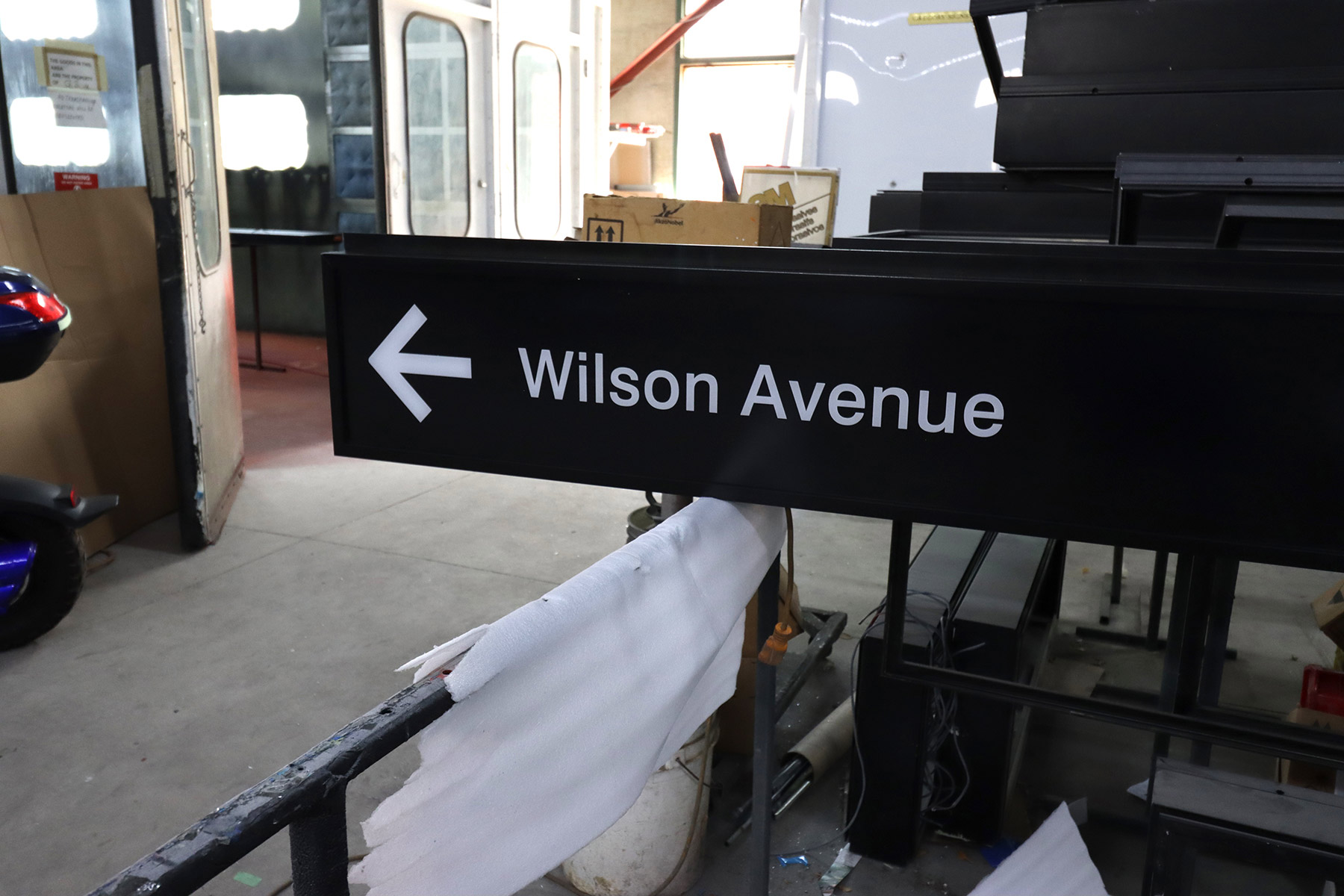
An arrow points left. Beside it, two words: Wilson Avenue. In a photograph from Gregory Signs' transit portfolio, the black panel rests among workshop equipment, waiting to become something most passengers will read without a second thought. The photograph catches signage at its least glamorous and most revealing. Before a direction becomes obvious, somebody has to make it.
That is the business at the end of the whatcanitbe trail. Public LinkedIn posts now bearing that name sit under a Gregory Signs URL and discuss the company's work. The matching phone number leads to the Ontario sign maker. This profile follows that documented connection and the Gregory Signs operation, whose projects put graphic design into metal, illumination, walls and streets.
The name invites a guessing game. The work supplies a practical answer: custom signage for organizations that need to be found, recognized or navigated. Gregory's portfolio moves from the Toronto Transit Commission to Puma, DSV and Oracle. Its place in the market is where a brand's visual rules meet the requirements of a real building.
The order book met the walls
The company's most telling expansion story involves square footage. In an April 2022 account of its acquisition by Steel Art Signs, Boris Kaminsky, then Gregory's vice president of sales and marketing, described orders arriving through reputation and word of mouth. Growth had put pressure on production space. A larger factory was becoming part of the next decision.
“We needed a factory that was double or even triple the size of the one we were operating in.”Boris Kaminsky · April 2022
Steel Art had expressed interest in buying the business. Kaminsky described choosing that route as a way to expand and give his father, founder Gregory Kaminsky, an opportunity to retire. The account, published as partner content, said the Gregory name and separate operation would continue. Steel Art brought experience in national programs; Gregory brought infrastructure and architectural work. These were the participants' stated reasons for the deal.
The useful lesson is about diagnosing a constraint. If production space is the problem, another sales push does little to solve it. A manufacturer can add premises, change how work moves through the shop, or join an operation with complementary resources. Each choice asks something different of its owners. Gregory's decision made capacity and succession part of the same conversation.
A business that kept changing addresses
There had been smaller versions of that space question before. Gregory Signs dates its beginnings to Gregory Kaminsky engraving as a hobby in his basement in 1980, followed by the business's establishment in 1981. Its own history records an expanded product line and a move to Petrolia Road in 1990. By 2006, demand for volume and larger projects prompted a move to a freestanding manufacturing facility on Buttermill Avenue.
In 2019, the company recorded more manufacturing space, a Pippin Road head office and a Barrie location combining sales, a showroom and production. A Toronto showroom followed in 2020. Read together, those moves suggest a business repeatedly adjusting its premises to the work customers wanted. The historical Concord address belongs to Ontario; the current Gregory contact page places the head office in Richmond Hill.
The founder's skills help explain the early product. A 2023 industry obituary describes Kaminsky's background in engineering and hands-on mechanical work, followed by engraving nameplates and equipment tags. Those objects carry an unusually strict brief: identify this person, this pipe, this piece of machinery. His later business would make much larger messages, but the value of getting a small message right was there at the beginning.
One shop, several kinds of attention
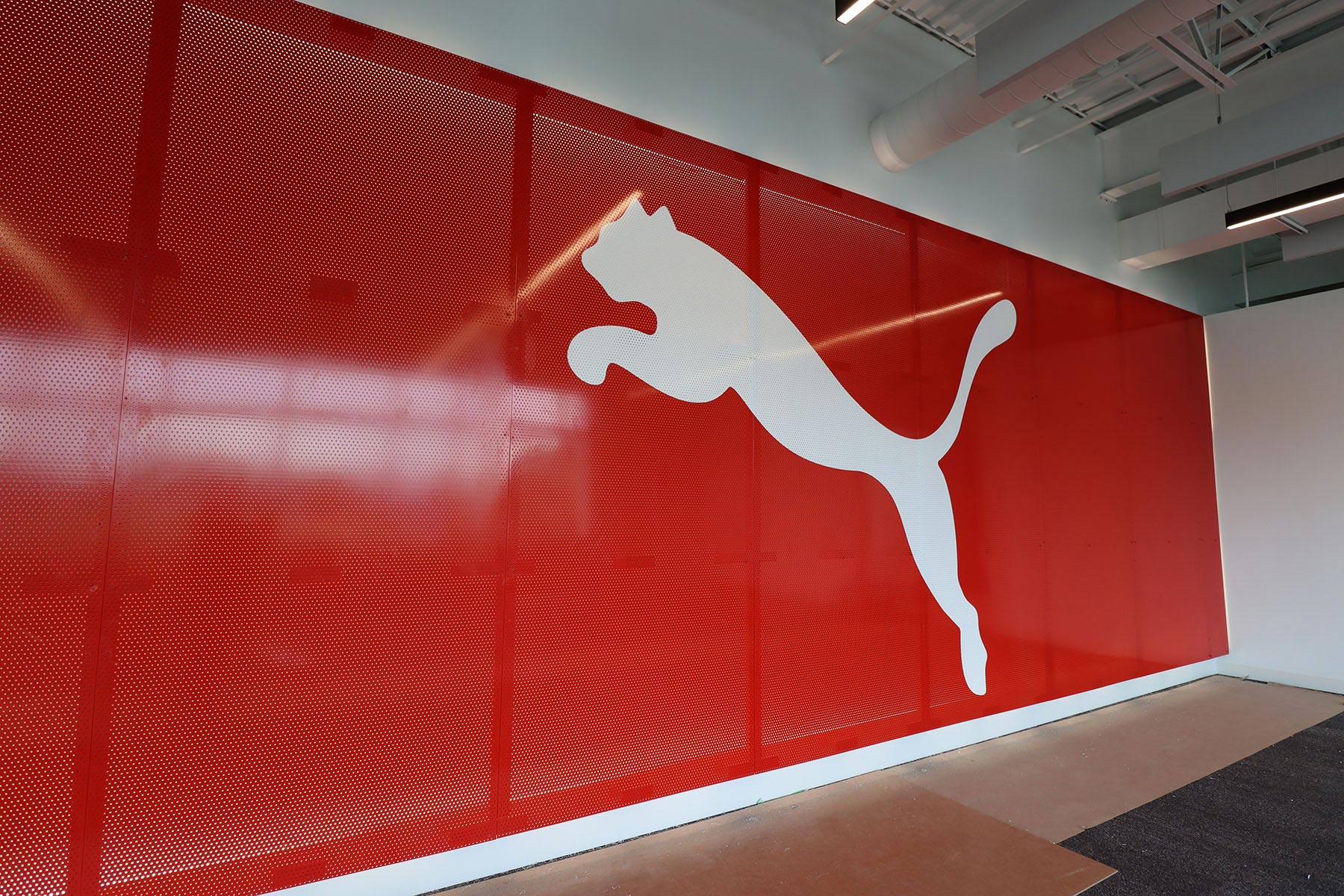
A transit sign asks for a quick decision. A branded interior can invite a much longer look. Gregory's Puma gallery includes an oversized white cat stretched across a red feature wall. The familiar silhouette supplies the recognition; the wall supplies the scale. This is a useful view of the company's range because both that display and a plain directional panel belong in its portfolio.
Its exterior offering includes channel letters, pylons, cut-out logos, fleet graphics, plaques and canopies. Those are different answers to different viewing conditions. A tall roadside sign announces a destination before someone reaches it. Raised letters turn a name into a physical feature. Vehicle graphics put a business identity on something that moves. The choice starts with where the message needs to work.
Inside, the product mix extends to directories, vinyl graphics and architectural metalwork. Gregory describes work with architects, designers, engineers and contractors, which places it in a wider construction process. It also offers digital displays for promotions and customer information. A property owner replacing a directory and a retailer building a branded interior may approach the same supplier with very different briefs.
The company's wayfinding posts emphasize landmarks, visible routes and orientation cues. That approach treats an arrow as one part of a visitor's experience. A useful reading of the offering is that the sign and its surroundings need to cooperate. Adding more panels is not automatically the answer when the information itself, or the point at which it appears, needs attention.
The job continues after the drawing
Gregory markets design, structural design, manufacturing, project management and installation together. It describes an in-house shop authorized for CSA/UL electrical signage and a project team that can include senior and assistant project managers plus a coordinator. For a buyer, the appeal is having those tasks organized around the same deliverable. The design needs to arrive on the building as intended.
This puts Gregory between several familiar supplier categories. A graphic design studio can establish a visual identity. A fabricator can make its physical components. An installer can put them in place. Gregory offers those connected stages within its sign business. Buyers still need to establish the exact scope: a list of capabilities is the start of a project discussion, rather than a substitute for one.
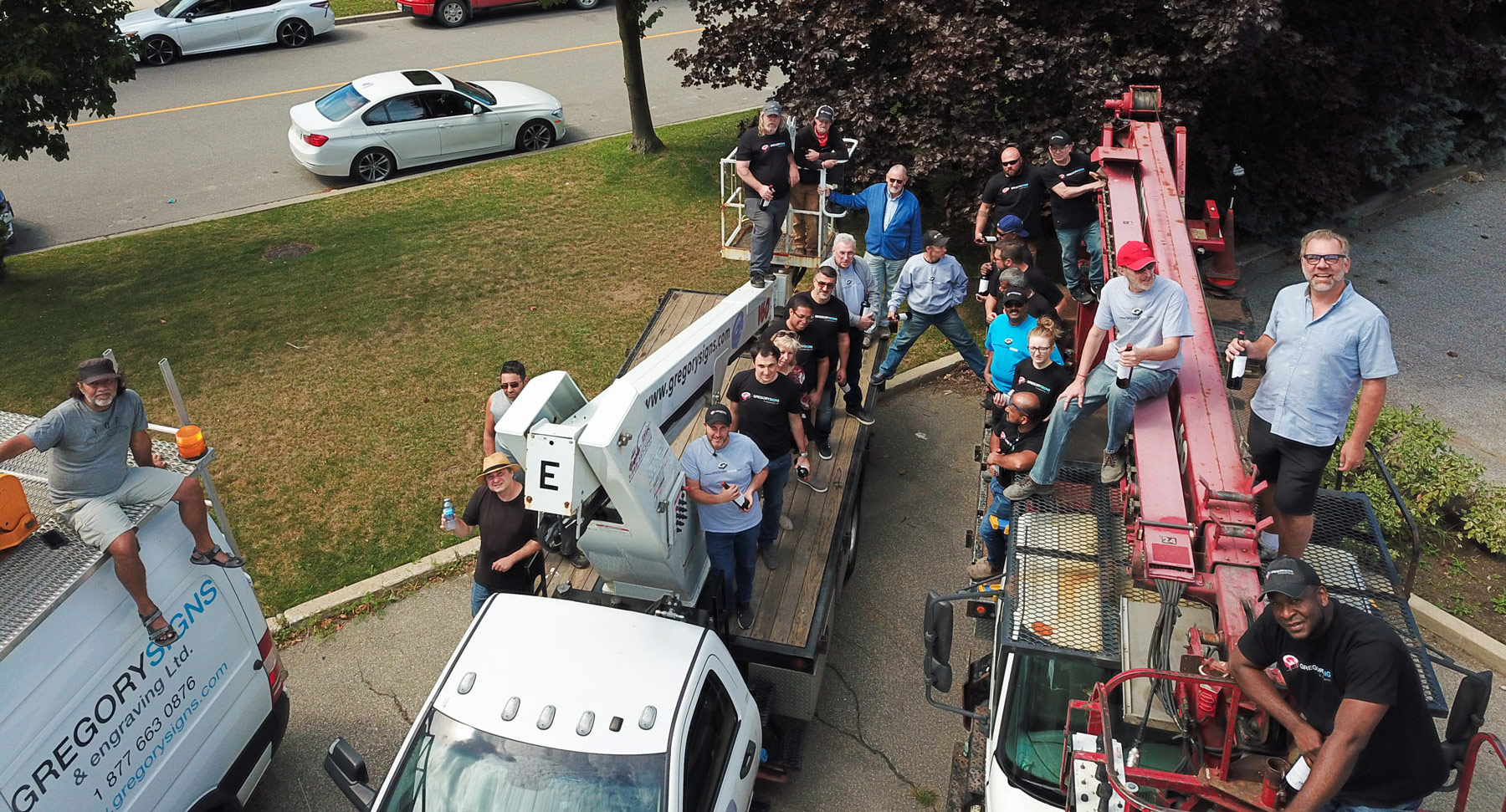
Installation adds another set of decisions. Gregory's installation offering explicitly discusses placement, municipal requirements and the crew and vehicles used to do the work. Its workshop photograph makes that progression tangible: a finished-looking panel can still have a journey ahead. Delivery and mounting are part of turning the manufactured object into something a visitor can actually use.
The commercial relationship can continue afterward. The company offers maintenance, re-lamping and service contracts, and advertises service in Canada and the United States. This is a business selling projects as well as ongoing care. For the owner of an illuminated sign, knowing who handles the next repair belongs in the initial buying conversation.
The useful number is in the brief
Gregory presents custom work around the client's requirements and budget. Its canopy quote instructions are revealingly specific: supply a dimensioned building layout, indicate positions and projection, choose gutter and face options, and identify additional locations. That is a more useful starting point than asking what a sign costs without describing the building it will occupy.
For a prospective customer, the practical exercise is to write down the job before choosing the object. Is the priority attracting a driver, identifying an entrance, directing a visitor or creating an interior focal point? Then bring dimensions, the proposed location and the desired appearance into the discussion. These are editorial buying suggestions drawn from the company's published scope and quote requirements.
Materials and installation requirements should be part of that comparison. Two proposals can look similar on a sketch while covering different amounts of work. Ask which stages are included, who coordinates the installation and what happens when the sign needs attention. Gregory's broad offering makes those questions especially relevant: buying a connected service is useful only when the connections are clear.
The same reasoning identifies where the approach offers less value. A buyer who already has design, fabrication and installation organized may need only one stage. A simple temporary message may not call for an extensive custom program. The sensible choice depends on the job, the site and the responsibilities the buyer wants the supplier to take on.
The arrow still has to point somewhere
The business has also explored other ways of expanding production. A June 2008 release announced a manufacturing joint venture with Star Orbit Beijing and Beijing SinSign. Its stated aims included serving China and reducing manufacturing costs for North American programs. That historical announcement shows cost and production capacity appearing in the company's strategy well before the Steel Art transaction.
In April 2024, Sign Media Canada's anniversary feature on Steel Art returned to the relationship with Gregory Signs. The combined story sits in the practical trade of making signs for places people visit. For the reader looking at whatcanitbe, the most useful evidence remains the work itself: a retail wall, an illuminated name, a direction ready to leave the shop. Each begins as a commission. Each succeeds when somebody understands it.