Before the batteries, the wind farms and the financing agreements, Matt Jamieson made a decision about home. In 2008, after years away from Six Nations of the Grand River, he returned. Part of the reason was his children: he wanted them immersed in their culture, with a clearer understanding of who they were. He also took on the job of Economic Development Director under the Elected Council. Family and work had arrived at the same address.
Today, Jamieson is President & CEO of Six Nations Group, the operating name of Six Nations of the Grand River Development Corporation. The job involves investment strategy, operations and partnerships. Its purpose remains rooted in a particular place. He is a member of the Tuscarora Nation and a resident of the community whose economic interests he helps manage.
His career offers a useful way into a complicated subject: what happens when a community becomes an investor in the infrastructure around it? The answer involves electricity, certainly. It also involves ownership, construction work and the rather less photogenic business of deciding who is accountable to whom.
A different kind of return
Jamieson brought a commercial career back with him. His earlier experience included 15 years in the gaming sector in Canada and the United States. He had founded three start-up ventures and conducted business in jurisdictions including China, South Korea and the Caribbean. Returning to Six Nations gave that experience a different destination.
A business can keep an executive moving from one opportunity to the next. Community economic development asks the executive to stay with the consequences. The people affected by a decision are neighbours, and the institution has to explain what it is doing in terms that matter beyond the boardroom.
Jamieson’s transition is interesting for that reason. Commercial experience can help with a contract or an investment. It does not, by itself, settle the questions a community will ask about trust, authority or where the proceeds belong. Those questions needed their own work.
The corporation had to earn its welcome
The development corporation launched in May 2015 with a mandate to pursue economic self-sufficiency while preserving Six Nations’ cultural values and integrity. Jamieson was its founding CEO and a principal architect of its governance model. Before the institution could make investments, its structure had to make sense to the people who would own it.
The community engagement process, called We Gather Our Voices, included conversations over coffee and tea in living rooms, community dinners and engagement sessions. Jamieson’s description of the process was plain: “We listened and learned.” There is something reassuringly unglamorous about a corporate structure beginning with a kettle.
The corporation’s current model includes an independent board of community members with a mandate for transparency and accountability. The Economic Development Trust provides a route for surplus profits to be invested back into the community. A successful transaction therefore has a destination beyond the company’s own accounts.
ownership↓Investments &
business activity↓Surplus profits↓Community
reinvestment
A simplified view of the purpose behind the corporate structure.
An ownership stake has a second life
Renewable energy gave that structure something substantial to hold. In the 2018 Clean50 award cohort, Jamieson’s work encompassed Six Nations’ participation in wind, solar and hydroelectric projects. The award recognition reflected an economic development strategy built around assets that could generate revenue over time.
There is a difference between having a project nearby and holding an interest in it. An equity position gives a community a financial relationship with the asset. The development corporation’s purpose is to connect that relationship to collective benefit, through the way it invests and the way profits are returned.
By 2023, Jamieson’s work included negotiated equity positions ranging from 10 to 50 per cent across developments. His responsibilities also included raising debt and equity financing. The ownership percentages were only part of the job; arranging the money and the agreements made those positions possible.
The current Six Nations Group website reports $334 million in cumulative direct economic community impact. That figure describes a community outcome across the organization’s work. It is a useful reminder that the point of a balance sheet here extends to the place around it.
Direct economic community impact reported by Six Nations Group on its current website.
Organization-wide measure, viewed October 2026. Not annual revenue.The battery needed a partnership
Oneida brought a different kind of asset into the picture. The project began as a partnership between the Six Nations corporation and NRStor, led by Annette Verschuren. It would store electricity for later use, adding flexibility to an energy system that has to match supply with demand.
Jamieson and Verschuren worked for years to bring the proposal through government and industry processes. In 2023, with construction taking shape, Jamieson acknowledged the wait: “It took us longer than I would have liked.” A candid photograph from the site shows the two in high-visibility vests, standing beneath a wide sky beside transmission towers. The eventual facility still had to catch up with the idea.
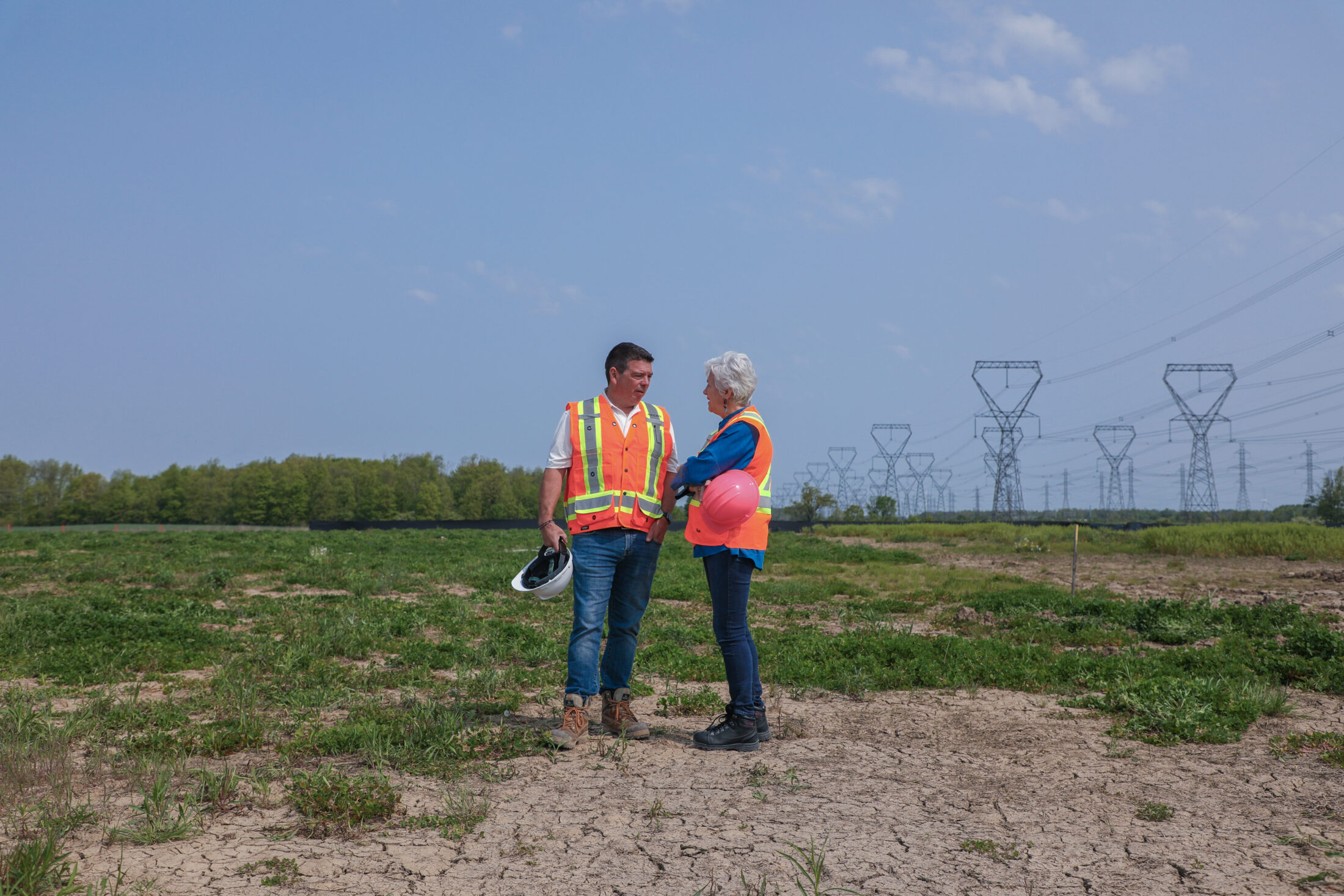
Jamieson helped negotiate a 22-year provincial contract, secure debt financing from the Canada Infrastructure Bank and source an equity investor. Those tasks connect the public ambition of a project to the agreements that let it get built. They are also where the word partnership acquires some useful paperwork.
In May 2025, the partners announced commercial operation. Oneida’s ownership included Northland Power, Six Nations’ development corporation, NRStor, Aecon Concessions and the Mississaugas of the Credit Business Corporation. A proposal that had required years of explanation was now an operating part of Ontario’s electricity system.
The numbers have units for a reason
Oneida has a power capacity of 250 megawatts and an energy capacity of 1,000 megawatt-hours. The first figure describes the rate at which the system can deliver power; the second describes the energy it can store. At that full rated output, the two numbers correspond to four hours.
It is a simple distinction, but it matters. A battery gives the grid another way to manage the timing of electricity. For the Six Nations corporation, it also adds another kind of investment alongside the generation projects already in its portfolio.
Hagersville followed. On February 27, 2026, Boralex and the corporation announced commercial commissioning of their jointly developed facility: 300 megawatts and 1,200 megawatt-hours. Its construction included civil works delivered by A6N, the majority Indigenous-owned partnership with Aecon. Investment and employment were connected in the same project.
Whole-facility power capacity. Energy capacity: Oneida 1,000 MWh; Hagersville 1,200 MWh. These are project sizes, not ownership-weighted shares.
More than one way to build
A6N helps explain why Jamieson’s work extends beyond an investment portfolio. The partnership’s activities have included fibre optic connections, water and sewer infrastructure, directional drilling and civil construction. In 2019, it completed and electrified the Niagara Reinforcement Line, a previously dormant transmission asset. Six Nations held a 25 per cent equity stake in the line.
That arrangement links two kinds of participation. There is the business of doing the work, and there is the continuing interest in the infrastructure once the work is finished. A community can have a relationship with both the construction phase and the operating life.
“We started with a shared sense of potential and goodwill.”
Matt Jamieson, on the Aecon partnership, 2020
In September 2025, the corporation announced a further joint venture with Brock Canada, focused on specialty services for development projects in Southern Ontario. The ownership split was 50.1 per cent for SNGRDC and 49.9 per cent for Brock. That small decimal carries a clear statement about which partner holds the majority.
Taking the experience into the classroom
Jamieson’s formal business education includes a Post-Bachelor’s in Management and an MBA from Athabasca University. He also studied business at Mohawk College and completed the ICD-Rotman Directors Education Program, earning the ICD.D designation. His work brings those qualifications into the practical setting of community-owned investment.
In July 2023, the University of Toronto’s Rotman School of Management appointed him an Executive-in-Residence, alongside Indigenous business leader Sara Wolfe. He also serves as an Executive Fellow at Ivey’s Energy Policy and Management Centre. These roles put operating experience into institutions where business and energy decisions are studied.
His recognition includes the 2021 Hedley Palmer award and the 2018 and 2026 Clean50 and Clean16 cohorts. The 2026 honours were announced in October 2025. The dates trace a continuing career, with new projects adding to work that began well before battery storage reached commercial operation.
The next contract, the next generation
In April 2026, Boralex and the corporation announced $202 million in financing for Oxford, a planned 125-megawatt, 500-megawatt-hour battery project. The package included a construction loan, a bridge loan tied to investment tax credits and a letter of credit facility. Commercial operation was scheduled for 2027.
Oxford gives the story a next chapter with a specific timetable. Meanwhile, the smaller scale remains part of the work. The 2026 Clean50 profile points to electric vehicle chargers, solar panels on local businesses and solar-powered accommodation. Energy investment can appear in a large facility or in the daily workings of a community.
The community connection also appears in the corporation’s 2026 Community Collaborators program. In his message to partners, Jamieson described inclusive, family-oriented events and invited businesses to contribute through sponsorships, information booths and promotional items. The previous year’s program had raised more than $8,500 for Six Nations non-profit organizations. It is a smaller number than a battery financing package, but it describes another part of the organization’s relationship with home: partners contributing to occasions where residents can gather. Alongside the long contracts and construction schedules, that work keeps a place for the ordinary community calendar. The economic relationships have somewhere local to show up.
Jamieson’s return home remains a useful place to end. He wanted his children closer to their culture, then took a role concerned with the community’s economic future. The projects have grown in size and complexity. The question underneath them is still recognizably personal: what can the work done today leave for the people who come after?