Walk into a hotel lobby at 11 p.m. with a broken key card, and you have two options. You can find the front desk, wait, explain, and hope. Or you can text the number on the little placard and have a real person fix it before you reach the elevator. The second version is the one Kipsu has spent fifteen years building - and quietly selling to the places you pass through every day.
Kipsu is a Minneapolis software company, founded in 2010, that gives front-line service teams a single place to text, chat, and message the people in front of them. The pitch is almost stubbornly unglamorous. It does not promise to replace your staff with a chatbot. It does not promise a prettier feedback dashboard. It promises something narrower and more useful: a two-way conversation that happens while the customer is still standing there, so the problem gets solved instead of just recorded.
That distinction - fixing now versus measuring later - is the whole company.
01 / The ideaA text you answer beats a survey nobody reads
The customer-experience software world spent the 2010s building instruments to measure satisfaction. Net Promoter Scores. Star ratings. Post-stay emails that land in your inbox the day after you have already left and forgotten. Kipsu's founders looked at that and asked a blunter question: what if you just talked to the guest while they were still a guest?
Real-time engagement is the term Kipsu uses for it. In practice, it means unifying the messy channels people actually use - SMS texting, in-app messages, live web chat, social messaging - into one inbox that a front-desk or guest-services team can work from. A request comes in as a text. Staff answer it, route it, and track it to done. The consumer never installs anything or learns a new system. They just send a message, the way they already message everyone else in their life.
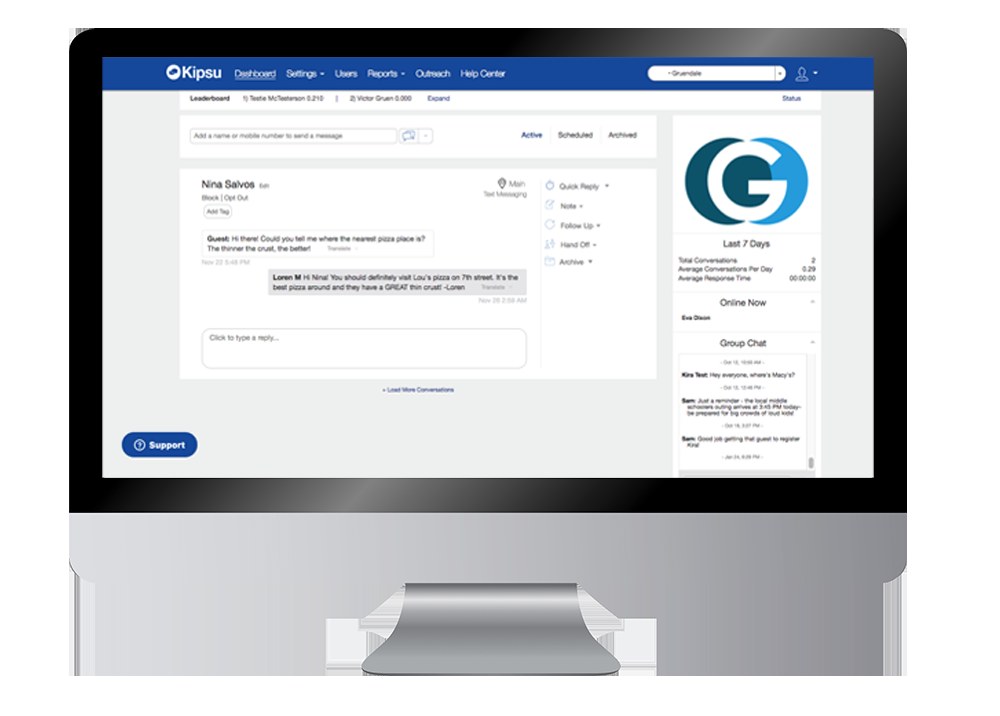
It is a subtle reframing with big operational consequences. Feedback tools optimize for the report. Kipsu optimizes for the recovery - the moment where an annoyed customer becomes a loyal one because someone actually did something. That is a harder thing to build and a stickier thing to sell.
02 / The originCustomer number one was the Mall of America
Kipsu began the way a lot of durable businesses do - small, self-funded, and unfashionable. Chris Smith, a former venture capitalist at Coral Group with an MBA from Berkeley's Haas School, teamed up with co-founders Geoff Dutton, Joseph Rueter, and Doug Ramler. There was no big raise, no blitzscale plan. It was, by the company's own telling, a bootstrapped project.
Then, in that same founding year, they landed the Mall of America - the largest shopping mall in the United States - as their first customer. It is the kind of anchor account most startups spend years chasing. Kipsu got it out of the gate, and it set the template: a big, operationally complex place with a lot of people moving through it and a service team that needed a faster way to talk to them.
There is a small irony in the founding story worth savoring: Smith spent years as an investor deciding which founders to back, then had to walk into rooms and be the one pitching. He was later recognized in EY's Entrepreneur Of The Year programming for the Upper Midwest - a nod from the same institutional world he had once represented.
03 / The customersOne tool, six very different worlds
Kipsu started in hospitality, and hotels are still the heart of it - Marriott, Hilton, DoubleTree, Holiday Inn, and Hampton properties among them. But the same core problem - a service team that needs to reach the people passing through its door - turned out to exist almost everywhere. So the tool went wide.
In healthcare, the same messaging thread becomes HIPAA-compliant patient communication - a surgery center texting a patient before and after a procedure. In multifamily and senior living, it becomes proactive resident outreach from a leasing or care office. In higher education, it is a way for a university office to reach students who will answer a text but never a phone call. At airports, it is a live line to travelers in motion. The plumbing is the same; the context changes.
That breadth is a quiet strength. A company that only sold to hotels would live and die with the travel cycle. Kipsu's spread across industries that rarely rise and fall together gives it a steadier base - and a lot of expansion room inside every account.
04 / The productsEngage, Exceed, and an engine underneath
Underneath the marketing names, Kipsu is one real-time engagement engine with different jackets on. Kipsu Engage FCX is the front-line messaging layer - the shared inbox where teams hold two-way conversations, read sentiment, and pull response analytics. Kipsu Exceed FCX adds the operations layer for hotels, turning a guest's text into a trackable service ticket that someone owns until it is closed. For regulated settings, the platform runs in a HIPAA-compliant configuration.
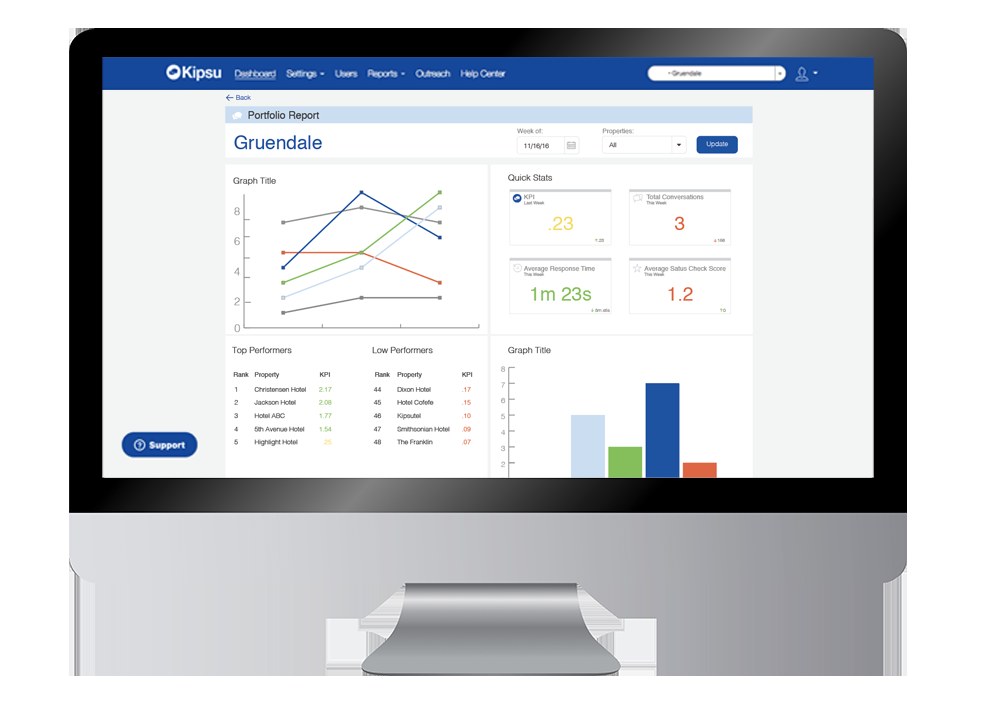
What a team can actually do with it
Send and receive messages across SMS, in-app, and web chat from one screen. Turn a request into an assigned task and watch it to completion. Message internally between staff without leaving the thread. And read the room - sentiment signals and response metrics that tell a manager whether the front line is keeping up. It is less a chatbot and more a cockpit for the humans doing the work.
05 / The differenceWhy not just use a chatbot or a survey tool?
Kipsu sits in a crowded neighborhood. Guest-messaging and customer-experience vendors - Medallia's Zingle, Whistle, Akia, HelloShift, Duve - all circle the same territory. What separates Kipsu is less a single feature than a posture: it is built around the front-line human as the hero, and around the live moment as the thing that matters.
| Approach | Optimizes for | When it acts |
|---|---|---|
| Survey / NPS tools | The report | After the visit |
| Pure chatbots | Deflection | Instead of staff |
| Kipsu | The recovery | During the visit, with staff |
The company's five stated values line up with that same temperament: Better Together, Roll Up Our Sleeves, We Are Partners, Grow Responsibly, and Believe in Excellence. "Grow Responsibly" is the tell. This is a company that stayed largely bootstrapped - reported funding is modest, around $1.44M total, plus a $660,000 debt round in 2017, with early backing from Matchstick Ventures and Beta.MN. In a decade that worshipped the mega-round, Kipsu grew mostly on revenue. In 2018 it landed at #536 on the Inc. 5000 list of fastest-growing private companies in America.
06 / The market fitBoring, essential, and quietly everywhere
The most useful way to place Kipsu in the market is this: it owns an unglamorous category that turns out to be load-bearing. Nobody brags at dinner about running the software behind hotel-lobby text threads. But that is exactly the kind of tool that becomes hard to rip out once a front desk builds its day around it.

Business model, for the record, is textbook B2B SaaS: subscription access priced by property or location, with room to expand as customers add sites and channels. Public revenue estimates for a private company like this vary and should be read as approximate.
Where it would not work
Kipsu is not a fit for everyone, and it is honest about that in its shape. If you have no front-line team - if your model is pure self-service with nobody on the other end - there is no human for Kipsu to make better, and the value evaporates. It thrives precisely where there are staff who care and customers in motion. Take away either side of that conversation and the whole premise falls apart.
Which is, in the end, the most interesting thing about Kipsu. In a software era racing to remove people from the loop, it built a fifteen-year business on the opposite bet - that the person at the desk is the point, and the job of the software is just to hand them a better way to say "I've got it."