Before a startup has customers, it has a peculiar staffing problem. Someone must decide what to build, who should build it, and whether the idea deserves a company at all. There may be no product to demonstrate. There may be no team to introduce. For Kindred Ventures, this awkward interval is part of the investment opportunity.
- Kindred sometimes helps assemble a company before writing its first check.
- Its June 2026 announcement added $355 million across two funds.
- Its expanding AI thesis now reaches speech models, compute and robots.
The San Francisco firm calls this work formation. Its own description is refreshingly practical: help entrepreneurs sharpen ideas and form initial teams, then fund them. That changes the opening conversation. An entrepreneur can arrive with an unresolved question rather than a polished answer. The investor has offered to spend time in the uncertainty.
01 / The music came first
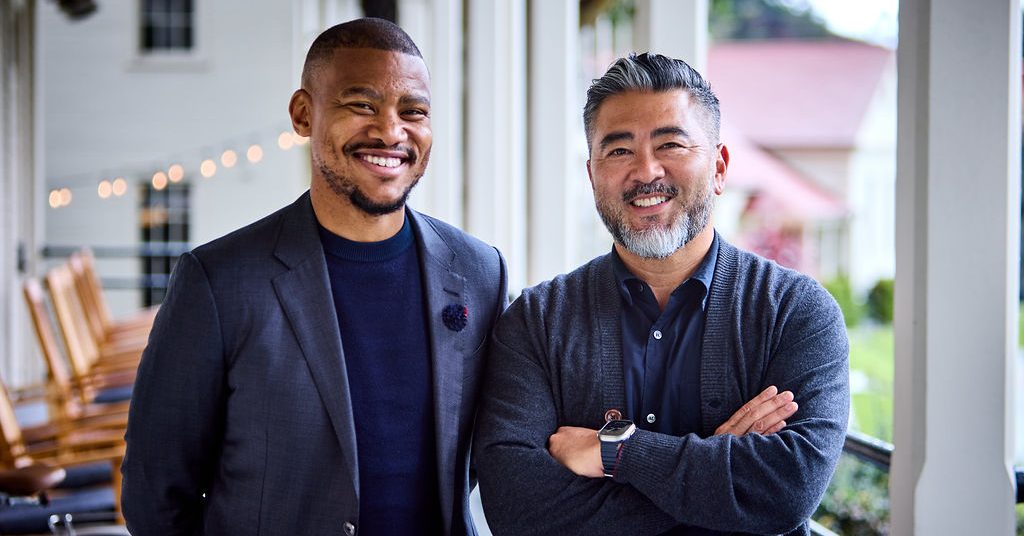
Steve Jang’s route into investing ran through products people actually used. His earlier ventures included imeem and SoundTracking, music services that eventually found buyers. He also advised Uber early and invested as an angel. In 2014, investments in friends’ side projects became Kindred, initially an angel fund. The beginning was closer to a network of builders than an institutional fundraising machine.
Kanyi Maqubela brought a different operating history: Doostang, solar company One Block Off the Grid, and investing at Collaborative Fund. He also co-founded Heartbeat Health. Their institutional partnership emerged publicly in 2019. The useful connection between their biographies is experience with the decisions that precede a financing announcement: recruiting people, choosing a product and getting something into customers’ hands.
02 / An investor with an earlier start
Kindred’s service combines money with company-building judgment. Its core stages are formation, pre-seed and seed. Founders get help with the initial team, product direction and introductions through the partners’ networks. The portfolio crosses software and physical technology, with themes spanning financial services, health, crypto, climate and transportation. The common denominator is how early the relationship can begin.
That puts Kindred among seed investors while giving it some overlap with company builders. A founder weighing the options should ask about involvement: who will help recruit, how often will a partner work on the product, and what decisions remain unresolved? An accelerator, a startup studio and a seed fund can all supply early support. Their ownership arrangements and working relationships can differ substantially.
“We often help form and fund”Kindred Ventures · its stated approach
There are two constituencies here. Founders receive capital and support; limited partners supply the pooled investment money. Kindred’s 2023 announcement thanked groups including endowments, charitable foundations and teachers’ retirement funds. Like the venture model generally, the economic aim is to turn startup ownership into investment returns. For entrepreneurs, the cost of equity financing is dilution and negotiated rights over a business they hope will become much more valuable.
03 / Read the money carefully
In its 2023 announcement, Kindred described intended checks of $250,000 to $3 million. Those figures give a founder a historical sense of scale. The same announcement introduced an opportunity fund alongside the core vehicle, extending the capital available as companies grow. June 2026 brought another pair: Kindred Ventures IV and Kindred Selector II, together totaling $355 million.
Separate announcements. Neither figure measures revenue or investment returns.
The distinction matters. Fund commitments are money entrusted to investment vehicles. Revenue belongs to the management business. Portfolio market value belongs to the underlying companies. A collection of valuable startups can advertise an investor’s reach, but it cannot tell you how much ownership the investor retained or how much cash reached its limited partners.
04 / Follow the research into the robot
Kindred’s 2026 fund letter explains its growing AI emphasis through a research history. Early encounters with autonomous vehicles led into investments in AI hardware, video avatars and computer vision. The partners describe their 2022-2025 funds as their first AI-focused funds. They advocate reading technical papers and examining imperfect demos, sometimes years before a theme becomes commercially compelling.
Recent deals show that argument spreading across the technology stack. In June 2026, Kindred announced that it was leading Kotoba’s $10 million seed round alongside Salesforce Ventures and Sony Ventures. Kotoba develops speech technology with a focus on Asian languages. The investor’s rationale centers on a concrete problem: building language systems around English can leave important needs in other markets poorly served.
In October, Kindred announced participation in Dream Labs’ $90 million seed round, led by B Capital, with Jang joining the board. Dream Labs offers an API intended to turn camera input and instructions into robot actions. Here, the investment question reaches beyond a compelling research result: can developers use the result reliably enough to build products around it?
The same pattern appears underneath the applications. Kindred co-led Parasail’s $32 million Series A in April 2026 with Touring Capital. Parasail supplies an inference cloud for running AI models. The problem is operational: developers need to control cost, capacity and performance without assembling a specialist infrastructure team. For Kindred, the investment connects what its application companies need with another company built to supply it.
05 / The future still has to work
Humane supplies a sobering counterpoint. Kindred named the company among its generative AI investments in 2023. In February 2025, Humane discontinued the consumer Ai Pin and announced that server-dependent features would stop functioning. Calling, messaging and AI responses depended on services that were going away. A promising category had produced a product whose useful life could end with a server shutdown.
For a founder, that is a test worth borrowing. Identify the dependency that would make the product useless if it disappeared. Test demand before treating technical possibility as a market. An investor’s introductions cannot settle those questions, and an ambitious thesis cannot remove them. Formation help is most useful when a team can turn that help into observable progress. A business seeking predictable loan repayments, limited dilution or hands-off financing would need to weigh a different set of trade-offs. Early venture capital ties the partnership to uncertain growth and an eventual investment outcome.
Kindred’s approach asks investors to enter before the company is easy to explain. The discipline readers can copy costs less than a fund: read the original work, ask what changed technically, and watch someone try the product. That sequence gives an unfinished idea something more useful than a confident pitch. It gives it a test.