Kevin Kramer had a job in Iowa and a reason to leave it. In 2019, he accepted the Kansas City market CEO position at Mobank, part of BOK Financial. The appointment brought him back to a place where he had already spent much of his banking career. His explanation included the usual enthusiasm for a new employer. Then came the part that gave the move its meaning: Kansas City was home for his family, and he wanted to reconnect with people there.
A return can be an unusually revealing career decision. The title tells you what someone will do next. The destination tells you where he thinks the work belongs. Kramer had been chief operating officer of MidWestOne Financial Group in Iowa City. He was returning with experience of running a bank’s operations, joining a market where his history already included commercial clients, a college board and civic organizations. The new business card arrived with an existing address book.
He took the role on July 1, 2019. For a banker whose work had repeatedly involved business development and customer relationships, coming back carried a practical logic as well as a personal one. Relationships were part of the work he had learned to do. Kansas City supplied the setting in which he had learned much of it.
Sixteen years before the detour
Kramer’s education began this regional connection well before the BOK appointment. He attended Benedictine College from 1985 to 1989, studying business administration with a finance minor. The college is in Atchison, Kansas. Years later, he returned in a different capacity, serving on its board from 2008 to 2016. Student and director are different jobs, separated here by almost two decades. The institution remained part of his life across both.
At UMB Financial Corporation in Kansas City, he spent 16 years, eventually working as senior vice president and director of commercial strategy. His responsibilities included commercial strategy and customer acquisition across business client segments. It was a lengthy education in how a bank finds business and organizes itself to serve it. A sixteen-year stretch also gives the word “local” some substance. It allows time for a city’s businesses to become familiar beyond their logos.
In 2011, he moved to Bank Midwest and Hillcrest Bank, subsidiaries of National Bank Holdings. As executive vice president and director of commercial banking, he oversaw business development and client relationship management. Hillcrest’s presence in Dallas gave the assignment another geography, while Bank Midwest kept Kansas City central to his work. The recurring subject across these roles was the commercial customer: how to attract one, understand the business and keep the relationship useful.
- 16 yearsUMB Financial
Kansas City - 2011Bank Midwest
& Hillcrest Bank - 2016MidWestOne
Iowa City - 2019BOK Financial
Back to Kansas City
Iowa widened the assignment
MidWestOne announced Kramer’s appointment as chief operating officer in October 2016. His start date was October 25. The assignment covered both the holding company and MidWestOne Bank, taking him from commercial banking leadership into a broader operating role. He and his wife, Pam, were to relocate to the Iowa City area with their youngest daughter. The relocation took his family to a new city as well as taking him to a new office.
By the following year, Kramer was describing an institution trying to keep its culture intact while expanding its products and improving the way it reached customers. In his contribution to the 2017 annual report, he placed culture alongside operating principles, shareholder value and evolving technology. He described recruiting leaders from larger, more complex institutions who wanted an organization whose culture they could support. These were the concerns of someone thinking about how the whole enterprise worked.
The practical ambition was to reach customers in person and online, anticipate their needs and improve their experience. That is a useful bridge between Kramer’s commercial background and the Kansas City role that followed. Sales, operations and customer service can sit in separate boxes on an organizational chart. A customer encounters them as one bank. His Iowa assignment put him closer to the work of making those boxes cooperate.
A crowded market rewards a clear choice
On returning to Kansas City, Kramer entered a market with plenty of competing invitations to open an account. At a banking discussion in 2019, he recalled that the area had once had about 120 bank brands. The discussion put the remaining number at roughly 100. Those were observations from that period, rather than a census of today’s competitors. Even with that qualification, the picture is busy enough to make a banker’s advertising budget feel rather small.
Kramer’s response was to emphasize defining a strategy and concentrating on it. He also described Kansas City as receptive to banking newcomers. The same openness could help attract employees: younger people, he said, were increasingly considering the city as a place to build a career. His view of competition included the labor market as well as the loan market. A bank needs people who want to live where its customers do.
His current responsibilities at BOK Financial span the coordination of commercial banking, wealth management, commercial real estate and consumer services in Kansas and Missouri. That breadth makes the market CEO job a task of connection. A business owner’s needs can cross those service lines, while the institution has to present a coherent experience. Kramer’s background offers several approaches to that problem: commercial strategy, relationship management and the operating experience acquired in Iowa.
“It’s a very accepting community.”Kevin Kramer on Kansas City, 2019
An address becomes a statement
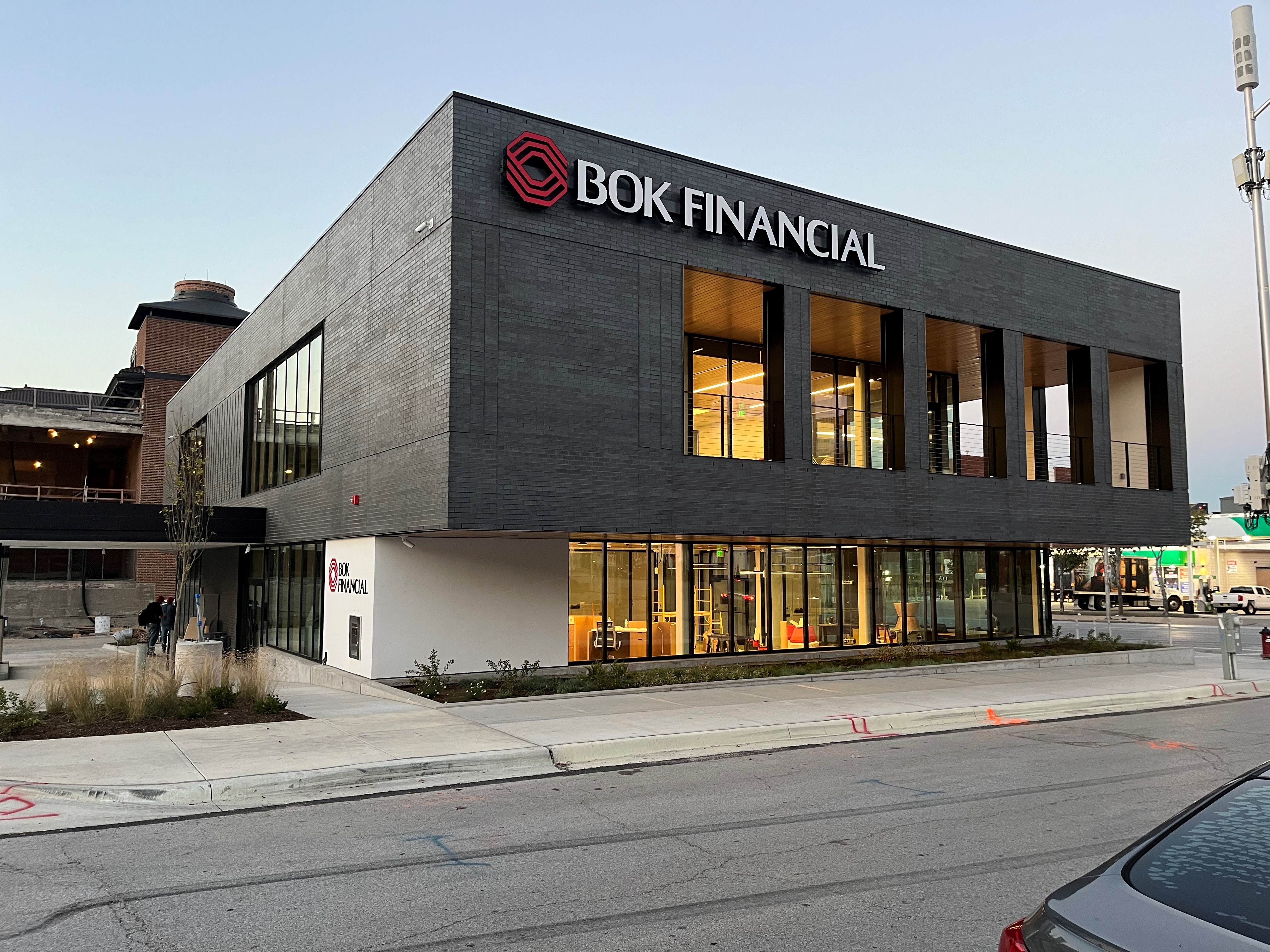
In April 2022, BOK Financial’s plans for a new banking center at 17th and Grand put its Kansas City commitment into physical form. The planned 10,000-square-foot building would occupy part of the Grand Place campus, the redevelopment associated with the former Kansas City Star headquarters. Kramer connected the investment to the bank’s commitment to downtown. It was a way to make a familiar corporate promise visible from the sidewalk.
The plans included a full-service banking center, corporate trust offices and a presentation room with access to outdoor space. The building was designed by BNIM, with McCownGordon identified as general contractor. Its setting mattered to Kramer: he spoke about respecting the surrounding historic structures while accommodating the company’s future. A bank choosing an address is also choosing which part of a city’s daily life it intends to join.
Grand Place’s developer presents the campus as a new use for a piece of Kansas City’s newspaper history. Kramer’s explanation of the fit focused on the company’s identity and where its customers were headed. The old newspaper property offers a pleasing setting for that thought. Both a local newsroom and a local banking office depend on knowing what is happening around them. Their paperwork differs considerably; their need to pay attention is shared.
Sugar, Wi-Fi and the neighbors
In February 2024, when the Royals announced a proposed downtown ballpark site, Kramer greeted the news on LinkedIn from the perspective of a nearby business. He welcomed the team as neighbors of BOK Financial Grand Place and offered a small domestic courtesy, followed by a restriction: “borrow a cup of sugar but please don’t steal our WiFi.” It was a neighborhood joke delivered in the vocabulary of an office.
The post belongs to that announcement and its moment. What it reveals about Kramer is the ease with which he joined a civic development story to a joke about being next door. Banking executives are permitted a sense of humor, though their formal announcements rarely encourage anyone to test the theory. Here, the prospect of a baseball neighbor briefly turned the bank into a house on the block.
The city outside the banking center
Kramer’s civic connections reach back before his return. He chaired the Greater Kansas City Chamber of Commerce’s Centurions program in 2000-2001 and received its achievement award in 2001. Ingram’s included him in its 40 Under Forty recognition in 2003. The Chamber’s 2025 annual report also lists him on its board of directors. Together, those dates show a connection to civic leadership extending across different stages of his career.
In March 2024, he spoke for BOK Financial as it helped launch a Union Station initiative to expand access to Science City, with particular attention to underserved Hispanic and Latino young people. The bank provided a lead gift to the designated education fund. Union Station also committed a portion of Science City spring-break admission revenue to it. The mechanism was specific: contributions and ticket proceeds would help more children take part in STEM experiences.
Kramer’s invitation was for other members of the community to support the fund. It is a concrete example of the community engagement that runs through his professional biography. Outside work, his interests include golf, travel with his family and supporting the Kansas City Chiefs. He and Pam have two daughters, Claire and Libby. In this part of his life, too, Kansas City appears as a place to participate rather than merely an area to manage.
A local voice on a national question
By September 2026, Kramer was applying that local perspective to monetary policy. In a published opinion piece about the Jackson Hole Economic Symposium, he examined the Federal Reserve’s use of forward guidance. His argument favored decisions grounded in business fundamentals and a realistic price for risk. The examples he chose were recognizable business decisions: buying equipment, expanding facilities and planning payroll growth.
He acknowledged the appeal of lower borrowing costs while arguing that disciplined allocation of capital and stable prices provide a stronger basis for growth. This was his economic argument, with the trade-offs stated openly. It also brought his career’s central customer back into view. Monetary policy travels through markets and models before arriving at someone’s decision about a building, a purchase or another employee.
Kramer’s story keeps returning to that scale. A long stretch at UMB. Commercial relationships at Bank Midwest and Hillcrest. An operating role in Iowa. A return to Kansas City, followed by a downtown investment and continuing civic work. The ambitions are expressed through places and institutions he can name. For someone responsible for a market, there is considerable sense in knowing which corner of it feels like home.