An electric racing boat is an unusually candid business proposition. It has to move. The water offers no courtesy marks for ambition. In 2026, Kerem Ozmen’s Sierra Racing Club joined the E1 championship, putting an investor better known for industrial technology into a setting where the machinery, the competition and the audience occupy the same frame.
There is a family resemblance between that boat and his day job. Ozmen is co-founder and CEO of 8090 Industries, based in New York. His interests run through energy, manufacturing, computing infrastructure, aerospace and defense. These are businesses in which an elegant presentation eventually encounters something considerably less accommodating: a physical system that must perform.
The racing venture makes a useful entrance to his story. It places him beside a machine rather than behind a fund announcement. It also raises the question running through his career: how does a young company get from having a good idea to becoming a business that other people can depend on?
A beginning in Reno
Ozmen’s early investing work had a local address. In his account of those years, he helped develop programs at the Ozmen Entrepreneurship Center at the University of Nevada, Reno, and took part in pitch events. His family had committed capital to the center. He subsequently established Ozmen Ventures to invest in founders and other opportunities.
That beginning matters because it puts community-building before the wider industrial portfolio. A startup ecosystem consists of repeated encounters: a founder meets an investor, gets advice, finds a collaborator and returns with a better version of the proposal. The money matters. So does having somewhere to bring the next question.
His route continued to Kairos in New York, where he became a founding partner and managing director of its K50 early-stage fund. The work involved selecting young companies and helping founders with the practical demands of getting started. He holds a B.A. from the University of Nevada, Reno. The geography changed; the proximity to entrepreneurs remained.
Changing the room
By 2020, Ozmen was building 8090 Partners. Contemporary reporting describes its formation that June with Jasper Lau, around a community of families and entrepreneurs interested in investing together. That is a particular kind of starting point. Family capital carries relationships and experience as well as a balance sheet, especially when a family’s business operates in the industries a startup hopes to enter.
In 2022, Ozmen announced the formal launch of 8090 Industries with Rayyan Islam. His announcement said the earlier partnership would cease to be active as the new industrial focus took precedence. The first flagship initiative centered on decarbonization. The companies he named included Cemvita, Oklo, Infinium, Quaise Energy and Circ.
The decision gave the firm a more specific problem to solve. Industrial founders need people who understand the existing system: its purchasing habits, equipment, supply chains and ways of working. An investor who can introduce those people offers a different form of assistance from one whose contribution ends when the financing closes.
There is a dry comedy to investing in the future through people who know how the present actually works. The established industrial operator, so easily cast as yesterday’s character, may be exactly the person a new founder needs to meet. Experience becomes useful when it can cross that generational table.
An outline of the firm’s approach. Each step still needs execution.
The family connection has a job
Ozmen’s relationship with established industry is concrete. He sits on the board of Sierra Nevada Corporation and chairs its Innovation Committee. That gives his profile an aerospace and defense dimension alongside his venture work. His official investment record includes Exowatt, Armada, AIP, Nscale, PDW and Oklo.
Those responsibilities connect two kinds of organization that can approach change at different speeds. A startup wants an opening. An established industrial business has obligations to customers and operations already running. The interesting work happens where a new technology can satisfy the demands of that existing operation.
Ozmen also appears in the public conversations around this crossover. He led a discussion involving Armada CEO Dan Wright, Sierra Nevada Corporation CEO Fatih Ozmen and Steve Butow of the Defense Innovation Unit. The subject of getting technology into regulated industries belongs naturally in that company.
It is tempting to treat a network as a trophy cabinet of names. Here, its usefulness can be judged more practically. Does someone understand the buyer? Can a founder reach the relevant operator? Does the conversation expose a requirement the team had overlooked? A network becomes commercially interesting when it answers questions like these.
Computing comes with luggage
Armada gives the approach a tangible shape. When the company announced more than $55 million in funding in December 2023, 8090 Industries was among the firms leading its financing. Armada also announced Ozmen’s addition to its board alongside Trae Stephens and founding chief technology officer Pradeep Nair.
The company works on computing and connectivity for places beyond the familiar data-center setting. Its platform combines infrastructure with software to manage data. This is a corner of technology where location is part of the problem. Data may be generated far from the systems needed to make it useful.
Such a business changes the scenery of an AI conversation. There are models and applications, but also equipment that has to arrive, connect and operate. The distance between a remote operation and a computing resource is a business problem before it becomes a neat diagram on a conference slide.
Nscale expands that infrastructure story. On March 9, 2026, it announced a $2 billion Series C led by Aker ASA and 8090 Industries, valuing the company at $14.6 billion. Its planned deployment spans Europe, North America and Asia. The work covers computing, networking, data services and orchestration, within a broader infrastructure business.
For Ozmen’s profile, the connection is revealing. His industrial focus now includes the physical demands of AI. Computers require a place to run and a supply of power. An investment thesis can follow those dependencies from one industry into another without leaving the material world behind.
A vehicle between categories
Another investment sits at an intersection Ozmen has described directly. In 2023, 8090 Industries co-led REGENT’s $60 million Series A. REGENT was developing electric seagliders for coastal transportation, with a vehicle concept that moves through floating, hydrofoiling and flying close to the water.
The attraction brought together sustainable transportation, aerospace and defense. A vehicle operating between familiar categories also asks its investors to think across them. Commercial customers, manufacturing capability and the route to certification belong in the same conversation as the performance of the machine.
At the time of that round, the company described financing the construction and testing of a crewed prototype. That distinction is worth keeping in view. Funding an engineering program finances work still to be done. A prototype, a production vehicle and an operating transport service are different stages, each with its own demands.
Ozmen’s role belongs to that middle territory, where a technically interesting company is trying to acquire the resources to move forward. The headline figure tells readers how much the round raised. The more revealing question is what the money and the participating investors enable the team to attempt next.
Now put it on the water
Sierra Racing Club adds a sporting version of the industrial ambition. Ozmen co-founded the team with Dominik Madani. Its introduction to E1 connected the Ozmen family’s industrial background with the championship’s electric marine platform. The launch livery took inspiration from Sierra Space’s Dream Chaser spaceplane.
That visual connection is memorable because the two vehicles inhabit such different worlds. A spaceplane and a racing hydrofoil share no ordinary commute. Yet the team uses the aerospace association to explain the direction it wants to take: advanced engineering presented through competition on the water.
“Building this team is about pioneering industrial solutions”Kerem Ozmen, on the E1 venture
In April 2026, Real Madrid goalkeeper Thibaut Courtois joined the club’s ownership through NXTPLAY Capital. NBA player Kyle Kuzma also joined the ownership group. Catie Munnings and Erik Stark are the team’s pilots. Ozmen’s public work now connects an investor’s network with a sporting cast capable of bringing a different audience to electric technology.
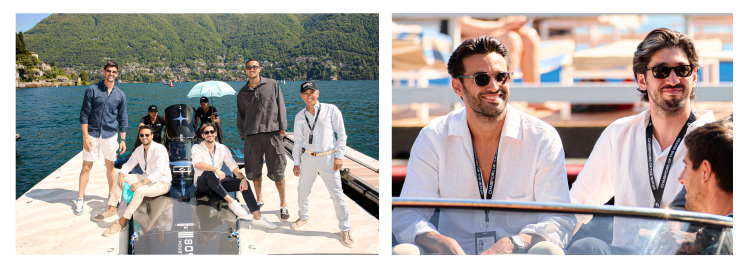
Celebrity ownership can attract attention. The pilots and engineers still have to deliver the racing. That division of labor makes the team an interesting addition to his career: the public story and the operating result remain visible together, with neither able to do the other’s job.
The scale changes; the work continues
The investment firm has grown. As of August 2026, 8090 disclosed $1.382 billion in total assets under management. Its breakdown matters: $775 million in primary discretionary advisory assets and $607 million in discretionary sub-advised assets. These are assets managed by the firm, with distinct advisory categories.
Total assets under management
There is also a smaller-scale glimpse of how the network operates. In April 2025, Ozmen joined Garuth Acharya and Wes Mendenhall in hosting an evening for founders, investors and industrialists in New York. The invitation promised conversation and camaraderie. Even a business devoted to industrial systems has a use for getting people into the same room.
Across these chapters, the continuity is more interesting than the assortment. Reno’s startup community, an early-stage fund, industrial investing and a racing team each involve organizing people around something they hope to build. The responsibilities become larger; the next practical obstacle still needs someone’s attention.
Ozmen’s career now runs across ventures with very different machines. Their demands keep the story grounded. Power has to be supplied. Computing has to reach the operation. A vehicle has to work. On the racing course, at least, the next test is easy to recognize: the boat leaves the dock.