In 2011, an Ohio high-school student watched a video of a young entrepreneur receiving an award. Then he sent him a Facebook friend request. The student was Jasper Lau. The entrepreneur was Tim Hwang, who would go on to found FiscalNote. They began talking, kept in touch, and eventually became part of one another’s business lives. An introduction that cost nothing acquired a rather long shelf life.
Years later, Hwang introduced Lau to Kerem Ozmen. Lau and Ozmen would co-found 8090 Partners in 2020. Today, Lau is the founder and CEO of Era, a New York investment firm built around family capital and technology. The distance between a teenager clicking a button and an investor assembling a partnership is considerable. Yet the first step has a pleasing lack of ceremony. No conference badge. No application portal. Just a message.
That small beginning offers a useful way into Lau’s career. He has repeatedly worked at the meeting point between people who have something valuable and people who could use it. The valuable thing might be money, an introduction, industrial experience or a chance to learn. His business has grown by putting those things within reach of one another.
A business education before the business school
Lau grew up in Ohio, the only child of parents who had immigrated from China and Hong Kong. He helped them navigate everyday transactions in English, including returning a broken vacuum and translating a drive-through menu. Later came a DJ business, serving weddings and bar mitzvahs. Before venture capital, there was the more immediate problem of giving a room what it wanted.
He graduated from Northeastern’s D’Amore-McKim School of Business in 2019. His route into investing included UBS, Lumia Capital and Class 5 Global. Lumia initially rejected his co-op application; after working at UBS, he went to Silicon Valley and persuaded Lumia to take him as an intern. A refusal proved to be a point on the itinerary.
“My varsity sport was business.”Jasper Lau
It is a funny line because it fits the teenage DJ as well as the adult investor. Both occupations require attention to an audience. A wedding crowd has an opinion about the next song. A founder has an opinion about the next investor. You can have excellent equipment and still misunderstand the room.
The comparison has limits, of course. Investing involves other people’s capital and decisions whose consequences take years to emerge. But Lau’s early work helps explain the emphasis on connecting people in his later ventures. His career began with practical encounters, then acquired institutions, titles and funds. The instinct to make himself useful came first.
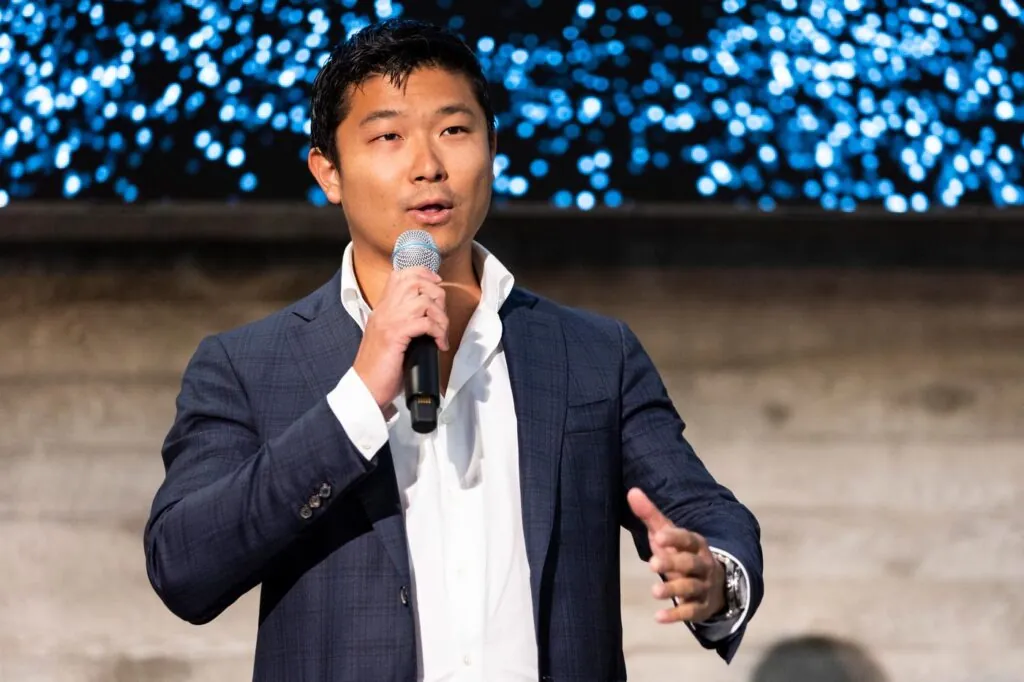
The people behind the money
8090 Partners took its name from the birth decades of many of its backers: the 1980s and 1990s. By October 2022, it had about $200 million in assets and backing from almost two dozen billionaire families. Its investors included people connected to established businesses in food, property and aerospace. Lau was working with a younger generation whose family businesses had already spent decades accumulating experience.
“They lacked access,” he said of some next-generation family members he had met. Wealth could put them in a private-bank conference room. Getting them into a particular technology investment required a different set of relationships. Lau offered to source opportunities and help them begin.
The arrangement has a practical logic. An established family enterprise may understand distribution, procurement or operating across borders. A technology founder may understand a new product and have little experience with any of those things. Bringing them together creates the possibility of more than a financial transaction. Whether it does so depends on the work after the introduction.
That last distinction matters when reading Lau’s story. Contact lists look impressive from a distance. Their value is harder to establish close up. A useful connection must survive the unglamorous questions: who answers, who follows through, and who can help when something goes wrong? The introduction opens a conversation. It cannot conduct the conversation for you.
- 2011A message to Tim Hwang
- 2019Northeastern graduate
- 20208090 Partners
- 2022Era
Backing the problem inside the inbox
Founded in 2022, Era carries Lau’s partnership approach into a firm that describes its work as both backing and building technology companies. Its website lists New York, Palo Alto and Taipei. The geography suits a business organized around connections between capital and industry, although a list of cities alone tells us little about what an investor actually does.
For that, consider Jericho Security. In August 2023, the New York startup announced a $3 million pre-seed round led by Lau’s Era. Its subject was a particularly unpleasant side effect of generative AI: more convincing phishing. Software that can write a persuasive email can also write a persuasive fraudulent email. The inbox, already an imperfect place to exercise judgment, had acquired a new complication.
Jericho’s approach uses simulations and employee education to help organizations recognize social engineering. That makes the investment an instructive example of Lau’s interests. AI produces opportunities to build new tools; it also produces problems that require other new tools. In this case, the customer’s difficulty is ordinary and recognizable. Someone has to decide whether to trust a message.
A later announcement described a $15 million Series A led by Lau through The Era Fund LP, with the money intended for product development and expansion. These are company financing amounts, rather than disclosures of Lau’s individual contribution. The distinction keeps the scale clear. His role was leading the rounds, while other investors participated alongside him.
Following a company into a later round makes the investor-founder relationship more interesting than a single announcement. The questions change as the business develops. An early idea needs room to be tested. A growing product needs customers, people and distribution. Lau’s model puts a premium on partners who might assist with those transitions, alongside the capital itself.
When the conversation turns to compute
By 2026, Lau was publicly emphasizing AI infrastructure. Era hosted its fourth Family Office Symposium at NVIDIA’s GTC, with Jensen Huang and NVIDIA leadership. Lau thanked Vlad Tenev and Chase Lochmiller for contributing perspectives on finance and AI infrastructure. The gathering brought the family-capital audience into the same conversation as people building and financing the technology.
The word “compute” can sound pleasantly weightless. The work behind it is anything but. Lau’s emphasis on infrastructure shifts attention toward the capacity that AI systems require and the people willing to finance it. For an investor accustomed to families with established operating businesses, that creates a natural subject for discussion: how a technological opportunity becomes a durable business commitment.
There is also a precise financial milestone. A May 5, 2026 filing for Era Compute Investment Fund LP listed a $250 million offering and named Lau as managing member of its general partner. At filing, it reported no sales and no investors. The number describes the proposed offering. It supplies a measure of ambition, while leaving the outcome to subsequent fundraising.
Proposed offering for Era Compute Investment Fund LP. Reported sold at filing: $0.
That is a useful moment to pause in a story that began with a free Facebook request. Relationships can create an opening; assembling a fund makes the obligations explicit. The paperwork requires names, amounts and roles. Lau appears there as someone responsible for the vehicle, a more exact description than the airy language that often surrounds networking.
Another kind of opening
Lau’s connection to Northeastern continued after graduation. The university’s philanthropy report described gifts totaling over $500,000, support for unpaid and underpaid business co-ops, and support for the DMSB F1RST Scholars Program. It also identified him as a first-generation college student. Those commitments direct resources toward the point at which students are trying to obtain experience.
An internship can be an opening with a price attached. Getting the offer is one hurdle; being able to afford taking it is another. Supporting placements addresses that second hurdle directly. It is a concrete use of money in a career story otherwise concerned with access, introductions and opportunity.
In October 2024, Lau was listed among the vice chairs of Northeastern’s New York City/Tri-State Executive Leadership Council. In October 2025, winners at the business school’s faculty pitch event received $5,000 cash prizes courtesy of Lau. The event asked professors to put their ideas before alumni judges. For once, the people accustomed to setting assignments had to deliver the pitch.
These activities give his university connection several forms: funding student experience, taking part in an alumni leadership group, and backing an occasion for faculty ideas. They also make the story less tidy than a simple progression from student to financier. The earlier institution keeps reappearing in the later career.
Lau was also among the speakers acknowledged at Deutsche Bank’s 2025 entrepreneurship gathering on innovation and AI. Tim Hwang appeared on that speaker list too. Their names on the same program are a small reminder of how long a connection can remain relevant, even as the setting and subject change around it.
There is no need to turn that into a rule about sending messages to strangers. Most messages remain messages. What gives Lau’s first introduction its interest is the work that followed: learning investing, forming partnerships, founding Era and directing money toward new companies and students. A friend request was the beginning. Keeping the relationship useful was the longer undertaking.