The most revealing document in Kelmar Associates’ business is an invoice. For July 2025, Idaho’s unclaimed property office received a bill for $22,401.24. It included software, a website, document imaging, identity checks, fraud-related transactions, and translation. Somewhere on the other side of that machinery was a person looking for money they already owned.
That person could search for free. This is the small economic puzzle at the heart of Kelmar: returning forgotten money is a public service with a private back office. The search box is the pleasant part. Establishing that the person clicking it deserves the money is where the work begins.
- Kelmar sells software and specialist services to government unclaimed property programs.
- Its KAPS system has 44 government program contracts, according to the company.
- Kelmar hosts MissingMoney.com, a free search service endorsed by NAUPA.
- The useful lesson: fix the handoffs between discovery, evidence, review, and payment.
01 / Money loses its forwarding address
Unclaimed property is a wonderfully misleading name. Much of it is money: an uncashed payroll check, a dormant account, a dividend, or an insurance benefit. Businesses hold assets that belong to someone else. When contact with the owner disappears for the applicable dormancy period, state unclaimed property rules enter the picture.
The resulting problem has several participants and remarkably little glamour. A business must identify and report the property. A government must preserve the records and administer claims. An owner must find the record and establish entitlement. Each participant sees a different piece of the transaction. Nobody is helped by a beautifully designed search page attached to a disorderly filing cabinet.
Kelmar occupies that junction. Its customers are government agencies administering unclaimed property, rather than individuals purchasing a recovery service. Businesses and claimants encounter the public interfaces; administrators buy the machinery behind them. The distinction explains why a company that touches personal finances looks, commercially, like a mixture of government technology supplier and specialist professional services firm.
- 01Holder reports
- 02State records
- 03Owner claims
- 04Evidence checked
- 05Payment sent
A simplified process. State rules determine reporting, proof, and approval.
02 / The auditors built a system
Kelmar began in October 2001 by examining corporate records to identify unclaimed property for government clients. Its founder and longstanding chief executive, Mark McQuillen, had previously led PwC’s abandoned property consulting practice. Before consulting, he spent twelve years serving Massachusetts, including work in revenue administration and taxpayer service.
That background helps explain the company’s shape. McQuillen had worked with corporate liabilities and government operations. The two perspectives meet in unclaimed property: one side must account for what it owes, while the other must administer what it receives. General counsel David Kennedy likewise brought experience from PwC and Massachusetts government. Kelmar’s expertise was assembled around a subject, rather than a fashionable technology.
The software came later. Development of KAPS, the Kelmar Associates Property System, began in 2013; its first implementation followed in June 2014. Kelmar describes it as proprietary software as a service built specifically for unclaimed property administration. The sequence is instructive: years of examination work preceded the first deployment. This is a company that learned the paperwork before giving it a screen.
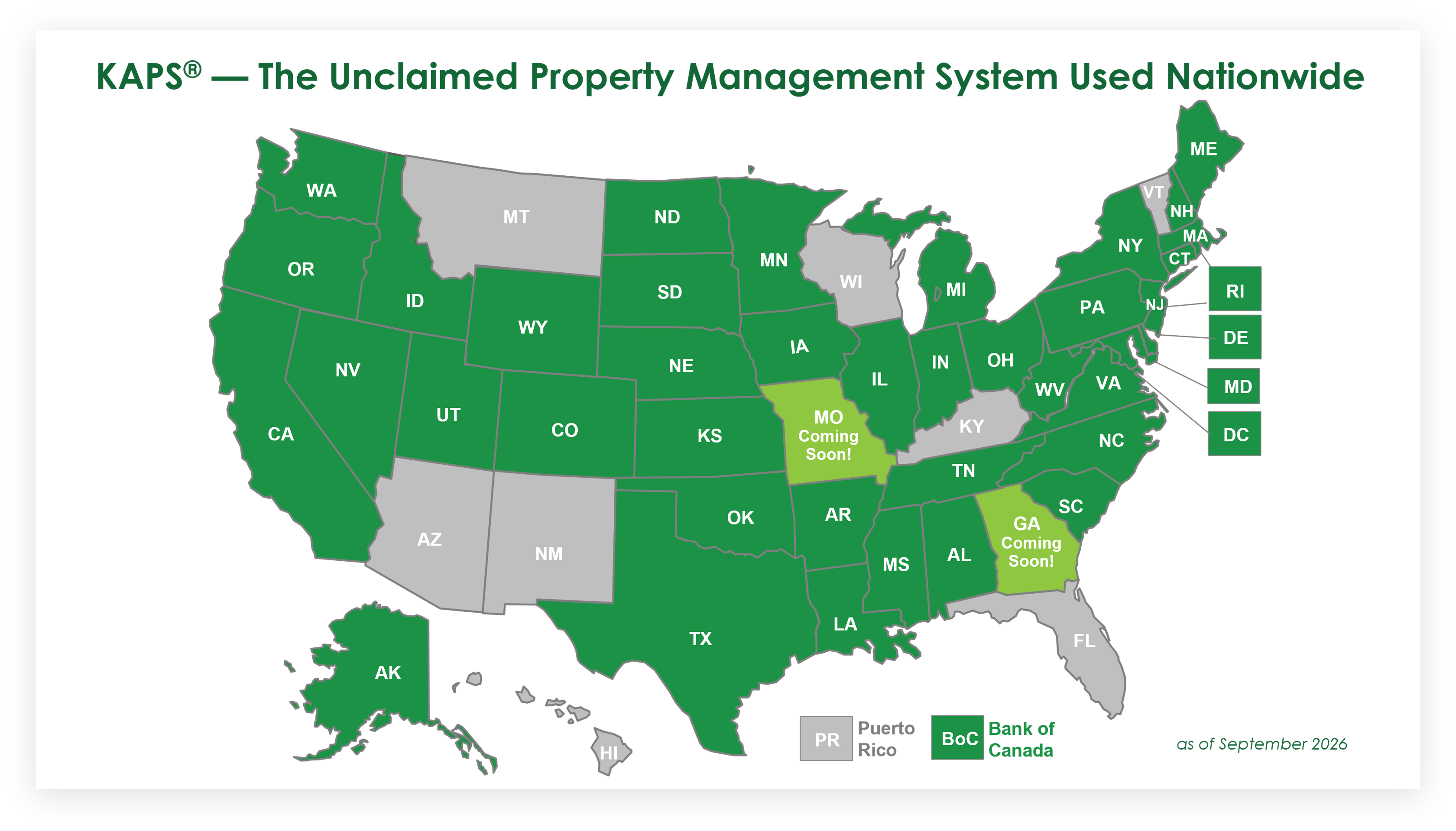
The commercial proposition extends beyond a database. Kelmar combines system tools with compliance work, training, and operational support. A government can obtain services for a particular project or busy period, or arrange broader outsourcing. That range matters because buying software does not automatically create enough experienced people to clear a queue.
03 / Free at the front, itemized at the back
Idaho’s public budget materials offer a rare, concrete view of the economics. The invoice separates recurring infrastructure from services charged by use. The software fee alone was $14,952.66 for July 2025. The full bill was higher because the operating service included several other components.
Grouped from the published invoice. This is a historical bill, not a price quote or an estimate of Kelmar’s revenue.
For a prospective buyer, the lesson is to inspect the complete workflow and its charges. A base software price says little about the cost of authenticating claimants or managing their documents. Volumes matter. Service choices matter. The invoice makes those variables visible without pretending one state’s bill can stand in for everyone else’s.
At the public entrance, Kelmar hosts MissingMoney.com. Kelmar says the service has 53 participating government programs, including Alberta, and charges users nothing to search or claim. NAUPA endorses the website. Those 53 participants and the 44 KAPS contracts describe different things: a search network and an administrative software customer base.
A reader can use that entrance immediately. Search for a name, follow the participating government program’s instructions, and provide the evidence it requires. A result is the beginning of a claim, with ownership still to establish. The pleasant possibility of an unexpected payment deserves a little patience with the less pleasant business of documentation.
04 / A claim needs both welcome and suspicion
Kelmar’s operational services include claims processing, call centers, report processing, and securities reconciliation. Through a custody partnership with Wells Fargo Advisors, it also helps governments manage unclaimed securities. Shares are particularly good at making a simple-looking record complicated: corporate actions and custodial holdings must remain consistent with the property records used to pay claims.
The same system must be accessible to rightful owners and cautious about impostors. KAPS incorporates identity verification through LexisNexis services. Kelmar describes its Fraud Index as using proprietary AI to profile claim risk and flag high-risk claims for additional scrutiny. In procurement terms, that is a feature to examine: which claims get delayed, how the flag is reviewed, and what evidence resolves it?
Kelmar reports ISO 27001:2022 certification, annual SOC reviews, and KAPS GovRAMP authorization achieved in 2024. Its unusually brisk formulation is, “We have receipts.” The certificates and reports are available on request. A buyer should read them alongside the actual service scope. Security credentials are useful evidence; the daily handling of records is where their value must show up.
“We have receipts.”
Kelmar, on its security certification and assessment reports
05 / Recovery has legal limits
The examination side has faced serious scrutiny. In the 2016 Temple-Inland v. Cook decision, a federal court considered a Delaware unclaimed property audit for which Kelmar served as contract auditor. The examination reached back 22 years. Older records were incomplete, and the state used estimates to assess liability.
The court found that Delaware’s combined actions violated substantive due process, citing issues including retroactivity, notice, estimation, and exposure to multiple liability. The ruling concerned the state defendants’ conduct. It is a concrete reminder that identifying more liabilities is not, by itself, proof of a sound examination.
The business lesson is about evidence and boundaries. A more efficient process cannot cure an unsound legal basis. Historical records, defensible methods, and clear rules belong in the design of the service. A system that produces a bigger number still has to explain why that number is owed.
06 / Copy the attention to handoffs
Kelmar has an identifiable alternative in Neumo, the successor brand to Avenu, which offers government unclaimed property management and claims services. Internal systems and separate contractors are other options. Kelmar’s distinguishing proposition is its sustained focus on government unclaimed property and the combination of software, examination expertise, and operating support. That combination gives buyers a coherent offering to assess; it does not establish superiority on every task.
The human knowledge is part of the product. Kelmar draws on people with government, accounting, finance, information systems, and legal backgrounds. Its stated workplace priorities include career development, an open-door philosophy, and employee assistance. In a specialty where interpreting an old record may matter as much as opening a new one, retaining expertise has a practical purpose.
What can another organization copy? Map the journey past the attractive first click. Identify who supplies the record, who verifies it, who resolves exceptions, and who authorizes the final action. Measure the completed outcome. For unclaimed property, a successful search is encouraging; a properly supported payment is the point.
That approach depends on usable records, lawful authority, suitable verification, and enough capacity to handle exceptions. Where those conditions are weak, automation can move uncertainty around faster. Kelmar’s story is interesting because the ordinary details remain unavoidable. Forgotten money may be a happy surprise. Getting it home is a profession.
Find your money. Inspect the machinery.
Start with MissingMoney.com or NAUPA’s state program directory. Government buyers can explore KAPS and its integrations or request a system demonstration.
More from Kelmar: website, LinkedIn, industry resources, and company updates and awards.