Government lives in nouns that make most people reach for another tab: procurement, appropriation, compliance, solicitation. Kamran Saddique built a company by treating those nouns as verbs. A budget is assembled, a requirement is negotiated, a contract is reviewed, a grant is tracked. Each action leaves a document behind, and each document can either carry knowledge forward or turn it into sediment.
Saddique is the co-founder and co-CEO of Authorium, the San Francisco software company formerly called City Innovate. Its territory is the administrative middle of government - the workflows between a public need and a public result. The platform covers procurement, contracts, grants, budgets and legislative analysis. It is a decidedly uncinematic corner of technology. No one has made a summer blockbuster about a statement of work. Yet a statement of work can decide what gets bought, who can bid and how success will be judged.
This is the useful tension in his career. Saddique describes himself as a change agent, but his company sells into institutions where change must arrive with permissions, citations and an audit trail. The appetite is impatient. The product has to be patient.
01 / Before the formsA computer scientist learns the price of everything
Saddique began with computer science. He earned a B.Sc. with honors and started his career at Sun Microsystems, the company whose workstations and servers helped define networked computing before cloud became an everyday word. His next chapter moved through professional services and market research, then into international finance. At Aston Business School, he completed a master’s in international finance with distinction, placing in the top three of his class.
The route then bent toward Dubai. As vice president of private equity at Convergence Capital in the Dubai International Financial Centre, he worked across a portfolio that reads less like a specialization than a tour of modern infrastructure: real estate, aviation, mining, water desalination, carbon credits, education and media. In Abu Dhabi, he later led investments for a company owned by a member of the royal family, focusing on new technology ventures and smart-city initiatives.
There is a kind of education available only when the assets refuse to resemble one another. A mine and a media company do not share a business model, but both force an investor to inspect risk, incentives, timelines and information. Water desalination is physical infrastructure; carbon credits are an accounting architecture built around physical consequences. Saddique’s eventual work in government software would demand the same habit: find the system beneath the category.
02 / The turnSan Francisco, where a process became a company
In 2014, Saddique founded City Innovate with the aim of helping governments solve problems through collaboration with the private sector. He eventually led it alongside Jay Nath, San Francisco’s former chief innovation officer. The pairing joined two views of the same border: Saddique had crossed technology, capital and international business; Nath had worked inside city government. One knew how private markets package ambition. The other knew where public institutions absorb it.
City Innovate grew out of the civic-technology mood of the early 2010s, when cities were testing ways to work with startups without pretending procurement rules did not exist. Its work included the Startup in Residence program and challenge-based procurement. The premise was simple enough to fit on a whiteboard: describe the outcome a government needs, invite possible solutions, and create a fair way to evaluate them. The execution, naturally, required many more boxes.
The product hidden inside the paperwork
becomes a requirement
becomes a decision
becomes a record
The lesson was not that government needed fewer responsibilities. It needed better instruments for carrying them. Procurement must remain open. Spending must remain visible. Rules must be followed consistently. A startup can celebrate skipping steps; a public agency may be legally required to show every one of them. Authorium’s product thesis formed inside that distinction.
03 / The renameAuthorium finds the thing it had been building
A decade after City Innovate began, the company changed its name to Authorium. The word joins “author” to a suffix that suggests a place: an environment for creating and managing official work. It was a name with a small wink and a serious job. Government employees author requests, policies, analyses, grants and contracts all day. The valuable facts inside them often remain trapped in files, repeated by hand and rediscovered at considerable expense.
The new brand made the product easier to see. Authorium turns document-heavy processes into configurable workflows, structures data that used to sit inside prose, and connects it to the systems agencies already use. Saddique framed the goal through ownership, visibility, collaboration and compliance - words with more practical weight than the usual cloud of “disruption.”
The company said the value of government acquisitions processed on its platform doubled from $25 billion in spring 2024 to $50 billion by April 2025. The measure is not revenue, and it is not money Authorium controls. It is a scale marker for the public buying workflows running through the system. In this business, the interesting number belongs to the work passing underneath.
04 / A fair shotProcurement becomes personal in Annapolis
In February 2025, Saddique went to the Maryland General Assembly to speak in support of the state’s Procurement Reform Act. After his oral testimony, he stood outside the State House in Annapolis and recorded a short account of the argument. Modernization, he said, could save time and give more people visibility into the process. Then he moved from efficiency to access.
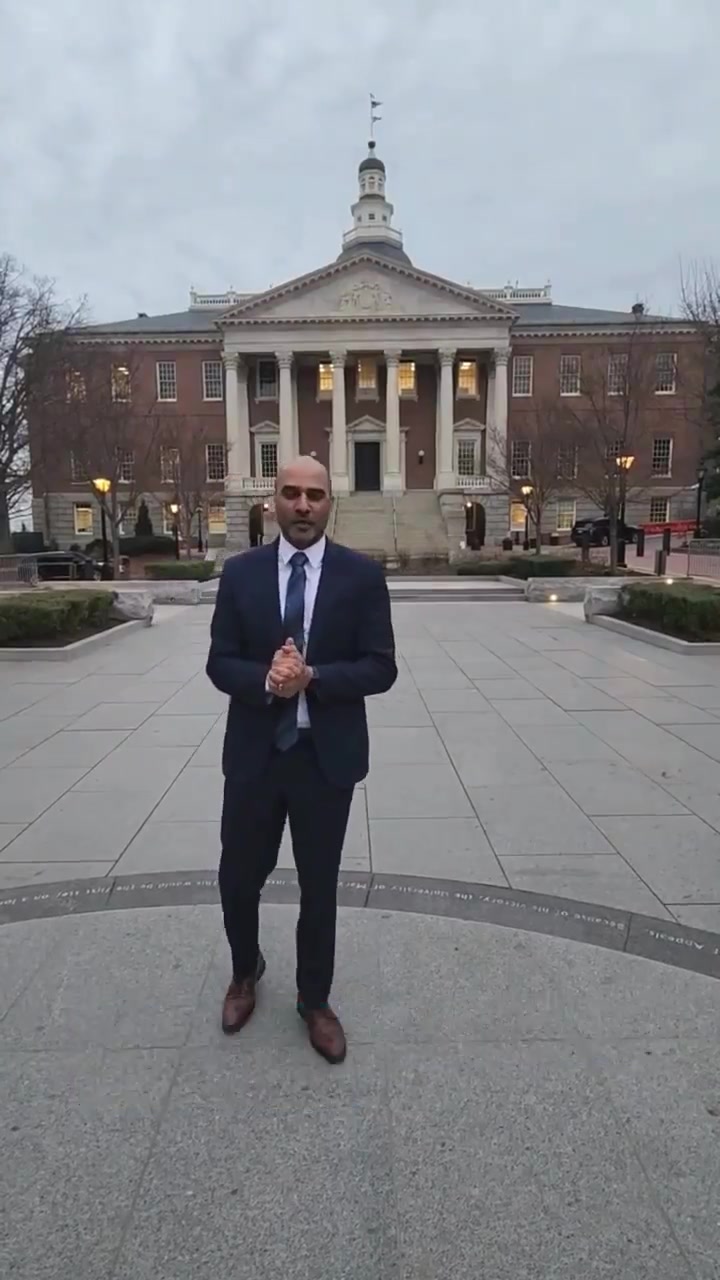
He wanted young businesses, small businesses, disabled-veteran businesses, minority-owned businesses and women-owned businesses to receive “a fair shot” at responding to bids. The phrase reveals why workflow design matters. A clumsy process is not equally clumsy for everyone. Large incumbents may have teams built to navigate duplicate forms and shifting requirements. A smaller supplier experiences each extra step as a tax on entry.
Good procurement software therefore has two obligations that can look opposed until they are designed together: reduce the burden and preserve the evidence. Lower the barrier without lowering the standard. Make the work quicker while leaving a clean trail. Saddique’s finance background feels close at hand here. Efficiency without accountability is merely haste wearing a nice shirt.
05 / The AI chapterGuardrails are part of the product
April 2025 compressed several company milestones into one announcement. Authorium raised an $8 million Series A extension led by SJF Ventures with Govtech Fund participating. It opened a Washington, DC office. It also launched AuthorAI, a tool for drafting government statements of work. The company says the model was trained on 15 million procurement documents and produces drafts with citations back to original material.
The citations are not a footnote. In public administration, a fluent answer without provenance can be more nuisance than help. The employee still has to defend the work, colleagues still have to revise it, and a future reviewer may need to reconstruct the decision. Saddique’s public description of responsible AI centers on helping teams work faster, smarter and “with more confidence.” Confidence here is architectural: the system should show its work.
A month later, California’s Department of Finance announced an agreement with Authorium for a generative-AI project supporting legislative analysis. The department reviews more than a thousand bills and proposals each year, assessing fiscal effects and policy implications. The pilot was designed to assist with tasks such as summarization, research and draft analysis while keeping people responsible for the judgment.
06 / The operating philosophyAmbition, dressed for the meeting
Saddique’s language is revealingly operational. He talks about meeting government teams where they are, solving needs quickly, making meaningful changes, increasing visibility and improving compliance. The verbs move; the nouns remain sober. It is the rhetoric of a founder who must sell tomorrow without insulting today.
His 2015 essay “Are you a change agent?” offered a more personal register. He defined himself as passionate, committed and “strident (in a good way).” That self-portrait fits the long arc. It takes some stridency to move from engineering to finance, from Britain to the Gulf to California, and then choose public procurement as the place to spend a decade. It takes commitment to learn that change in government advances through records as much as revelations.
Authorium now reaches beyond acquisition into contracts, grants, budgets and legislative analysis. The categories vary, but the underlying problem repeats: consequential work lives in documents; the data is fragmented; the approvals cross departments; and the public expects both speed and proof. Saddique’s company turns that repetition into a platform.
There is an old temptation in technology to treat paperwork as the enemy. Paperwork is often the memory of an institution. It records who asked, who agreed, what was promised and where the money went. The enemy is paperwork that cannot remember itself. Saddique’s wager is that software can make those records active - able to route, compare, reveal and explain. If it works, the form remains. The fog does not.