Imagine a finance official looking at a bank account. There is money in it. Plenty, perhaps. But somewhere else sit a purchase order, a payroll obligation, and a contract for a road. The balance is real; the freedom to spend it is another matter. This is an illustrative predicament, but it explains an actual company. FreeBalance takes its name from the amount left after commitments and actual spending are deducted from a budget. A rather severe name for a software business. Also a useful one.
- Government financial software, with implementation and training attached.
- Controls for money promised as well as money spent.
- A modular rollout that can grow with a public institution’s capacity.
The promise before the payment
The distinction matters because governments organize spending around authorized budgets. Recording an invoice answers one question: what did we spend? Recording a commitment answers an earlier one: what have we agreed to spend? Without that earlier view, an apparently healthy balance can encourage promises the budget cannot accommodate. The purchase order deserves attention before the cheque gets its moment of glory.
FreeBalance began in Canada in 1984 as Linktek, working with government departments and agencies on fiscal controls. Its product’s accounting calculation eventually became its corporate identity. Today, the Ottawa company sells government resource planning, or GRP. Think of it as the financial machinery behind ministries, agencies and treasuries: the place where a spending decision meets a rule, a record and, eventually, a report.
A specialist among generalists
Its market sits within enterprise financial software, with a particular buyer: government. Customers include Canadian public organizations, Antigua and Barbuda, Costa Rica and Micronesia. FreeBalance reports operations in 30 countries and says its systems manage more than $400 billion in budget dollars. That is money managed through the software, rather than revenue earned by the company. Confusing the two would produce a very flattering income statement.
The flagship Accountability Suite covers six areas: performance, financials, expenditure, treasury, receipts and civil service management. In practical terms, officials can prepare budgets, control spending, handle procurement, monitor cash, collect revenue and run payroll. Transparency portals and dashboards give fiscal information another audience beyond the staff who enter it. A citizen’s interest in the accounts begins where a ministry’s internal workflow ends.
The suite sits on a web-based, Java-powered platform with shared components and configurable processes. On-premises and cloud deployments are supported. FreeBalance’s case against general-purpose ERP and bespoke systems is that government requirements belong inside the product from the start. Its own staff also participate in implementation. That offers buyers a direct connection between the people delivering the project and the people responsible for the software.
The $4.19 million question
In July 2025, the Autonomous Bougainville Government signed a three-year, US$4.19 million contract for the Accountability Suite. The published package included installation and implementation, capacity building through FreeBalance Academy, one year of Hypercare support, and participation in the company’s Lead, Assist, and Guide programme. The project was scheduled to begin in August. The agreement establishes the purchase and intended work; signing a contract does not establish its eventual results.
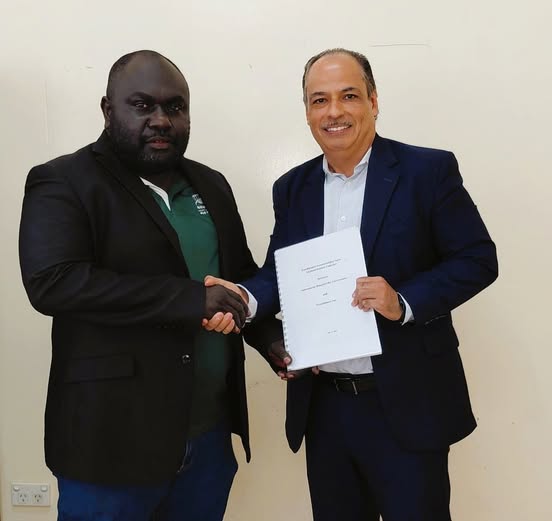
The figure is useful precisely because it buys more than an application. It buys the effort required to make the application usable within a public administration. FreeBalance’s business includes commercial software, advisory work, implementation, maintenance, support and training. A buyer comparing proposals should therefore compare the full work and ongoing obligations. This particular contract is a project price, not a price tag every government can borrow.
The accounts that stayed late
Antigua and Barbuda supplies the complication a tidy sales presentation might prefer to omit. The company’s case study reproduces a passage from the country’s 2014 Public Expenditure and Financial Accountability assessment. Past accounting problems and limited use of FreeBalance had undermined reliable, timely financial information. Having a system available had not made the accounts dependable.
“Past accounting problems, and limited use of FreeBalance”2014 Antigua and Barbuda PEFA assessment, excerpt reproduced in FreeBalance’s case study
The same assessment describes improvement after 2010: reworked accounting processes and better bank reconciliation helped clear the year-end reporting backlog. The lesson is uncomfortable and transferable. An institution has to use its controls, reconcile its records and organize the work around them. Software can support those habits; it cannot supply the willingness to follow them. The useful question after installation is who changes the daily routine.
Add complexity when people can carry it
FreeBalance calls its sequencing approach “progressive activation.” Governments introduce functions as needs and institutional capacity develop, rather than requiring every reform to arrive at once. Configuration can evolve as fiscal rules and processes change. For a buyer, the copyable practice is straightforward: choose an initial scope the team can operate, fund training, and decide what capability must exist before the next stage begins.
Micronesia makes the organizational scale visible. Announced in June 2024, its cloud-based financial management project covers the national government and four state governments: Chuuk, Kosrae, Pohnpei and Yap. The proposed scope ranges from accounts and budgets to payroll, assets and reporting. FreeBalance also committed specialists within the country, backed by regional and global experts. Cloud delivery still has a distinctly terrestrial requirement: people who understand the institutions using it.
The next promise needs good records
The customer relationship also reaches into product decisions. At the FreeBalance International Steering Committee, government delegates set priorities and vote on roadmap features. In its June 2026 announcement, the company proposed November meetings in Trinidad and Tobago and planned demonstrations of AI for budget forecasting, fraud detection and decision support. Those are announced plans, not evidence that every customer already uses those capabilities.
FreeBalance’s January 2026 writing argues that AI-era reform starts with the fiscal core. That is a sensible test for its own ambitions. Forecasts need dependable records; suspicious transactions need interpretable context. Buyers should ask what data and staff capacity each new function requires. The company’s most useful idea remains the older one: make the promises visible before the money leaves. It gives a finance official a chance to say no while no can still save something.