Breaking
Keep Company raises $1.4M seed round led with Techstars & TEDCO Members reportedly resign 5x less than the industry average 94% report improved connection & belonging 87% of coaching groups keep meeting after the program ends Care Census counts caregivers on staff - anonymously Zvi Band (ex-Contactually) joins as CTO Keep Company raises $1.4M seed round led with Techstars & TEDCO Members reportedly resign 5x less than the industry average 94% report improved connection & belonging 87% of coaching groups keep meeting after the program ends Care Census counts caregivers on staff - anonymously Zvi Band (ex-Contactually) joins as CTO
Company Dossier · Bethesda, Maryland · Est. 2022

Keep
Company.

The platform for meaningful connection at work.

A coaching company for the exhausted majority - the working parents and caregivers quietly holding your org together. It started inside law firms. It is trying to make belonging something you can put on a dashboard.

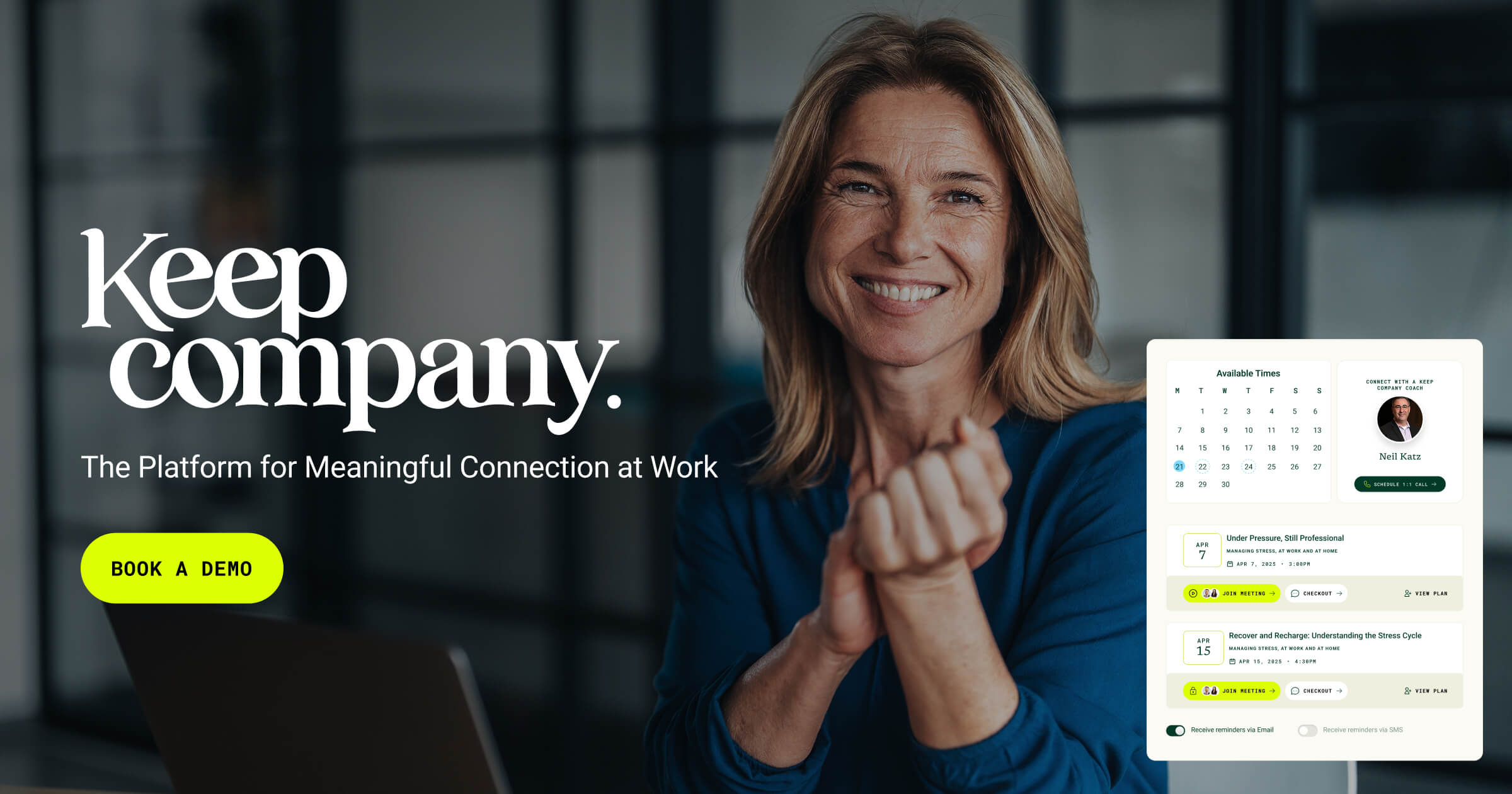
Keep Company brand image with the keep company wordmark and product interface
She is smiling at a laptop, hands clasped, mid-morning light off the glass behind her. To the right, the software: available times, a coach named Neil, a session called "Under Pressure, Still Professional." The whole pitch of Keep Company sits in one frame - a person, and the quiet machinery that keeps her from quitting.
73%
Of a workforce can be parents / caregivers
5x
Lower reported resignation rate
$1.4M
Seed round, April 2024
~33
Employees
The Business Of Staying

A company that sells the thing HR keeps saying it wants

Here is a fact that companies find awkward: the single most expensive employee is the one who leaves. Recruiting is costly, onboarding is costly, and the institutional knowledge that walks out the door is the kind of cost nobody puts on a slide because you cannot easily invoice for it. So companies do the thing companies do, which is announce that they care about mental health, put a fruit bowl in the break room, and schedule a wellness webinar for 4pm on a Thursday that roughly no one attends.

Keep Company, founded in 2022 in Bethesda, Maryland, is a bet that you can do something more specific than a fruit bowl. The bet is narrow and, once you say it out loud, fairly obvious: the people most likely to burn out and quit are the ones running a second full-time operation at home - the working parents and the caregivers. That group is not a rounding error. Depending on how you count, it can be something like 73% of a workforce. It is, in other words, most of the company.

The product is group coaching. Certified coaches run small, matched cohorts of employees through multi-week programs, with a year of dedicated support, on the theory that human connection - actual people, talking to actual people, about the stress of managing work and home - is the thing that makes someone stay. There is also 1:1 coaching, peer pods for distributed or newly merged teams, and mentoring. Underneath all of it is software that does the unglamorous work: a patented matching algorithm to build compatible groups, automated scheduling so no one plays calendar Tetris, and dashboards so an employer can actually see whether any of this is working.

That last part is the quietly clever bit. Wellbeing programs have historically had a measurement problem, which is that they are hard to measure, which means they are hard to justify in a budget meeting, which means they get cut first in a downturn. Keep Company's move is to turn connection into numbers a CFO can look at without rolling their eyes: engagement rates, participation, and outcomes on a real-time dashboard. If you can put belonging on a chart, you can defend it in a budget - and that, more than any single coaching session, may be the actual innovation here.

The metrics the company reports are the kind you would want if you were selling this: 94% of participants report improved connection and belonging, 87% of coaching groups keep meeting even after the formal program ends, and members reportedly resign at rates roughly five times lower than the industry average. The usual caveat applies - these are company-reported figures, and "five times lower than average" is doing some heavy lifting depending on which average you pick. But the direction is the point, and the direction is: fewer people quit.

What is genuinely interesting about Keep Company is not that it invented coaching, which is old, or connection, which is older. It is the packaging. The company took something soft and hard to price - people feeling less alone at work - and wrapped it in matching technology, automated logistics, and reporting, so that a benefits leader at a law firm can buy it the way they buy any other line item. It is behavioral science sold as infrastructure.
"They weren't transformative like this. My experience was transformative."
- Am Law 100 Partner, on a Keep Company program
The Founders

A lawyer who left, and a brand exec who joined her

Keep Company was built by two people who did not need to guess at the problem. One had lived the burnout; the other had built brands at startups. Then they hired a technical founder with a real exit.

Co-Founder & CEO

Adrienne Belyea Prentice

A former partner-track lawyer who walked away from the firm to build the thing she wished had existed. She frames the caregiving crisis as "devastatingly universal" - a problem almost every employee eventually meets, and almost no employer counts.

Co-Founder & COO / President

Claudia Naim-Burt

Previously Head of Communications at Framebridge, with a career spent building brands inside venture-backed startups. She speaks on behavioral health technology and runs the operating side of the company.

Chief Technology Officer

Zvi Band

A well-known DC-area entrepreneur who founded Contactually, a real-estate CRM acquired by Compass in 2019. He joined in 2024 to build out the matching engine, the Care Census, and the reporting stack.

What You Can Actually Do With It

Five products, one job: keep people connected

Program

Group Coaching

Cohort-based, behavioral-science-backed programs led by certified coaches - built around the many seasons of an employee's work and life.

Program

1:1 Coaching

One-on-one engagements with admin-free management, automated scheduling, and reporting that surfaces what's actually landing.

Program

Peer Pods

Unstructured, peer-matched groups that build connection across distributed, remote, or freshly merged teams.

Program

Mentoring

1:1 and pod-based mentoring powered by a patented smart-matching algorithm for high-compatibility pairings.

Tool

Care Census

Lets an employer anonymously count the working parents and caregivers on staff - turning an invisible population into a number you can plan around.

Platform

Dashboards & Matching

Smart matching, automated reminders, and real-time engagement reporting so you can run many programs without adding admin headcount.

By The Numbers

What the company says the coaching does

Self-reported figures from Keep Company. Read them the way you read any vendor's outcome data - as a claim to test, not a law of physics.

Reported program outcomes

Source: Keep Company · participant & program metrics
Improved connection & belonging94%
Groups still meeting after the program ends87%
Participant rating4.9 / 5.0 (98%)
Workforce that are parents / caregivers~73%
The Money

Seed-stage, and deliberately so

Keep Company has raised a modest, focused amount of capital for a company still proving that connection converts into retention. The April 2024 round is the anchor.

RoundAmountDateNotable Investors
Seed$1.4MApr 2024Techstars, TEDCO, Idea Fund Partners, VEST Her Ventures, 100KM, Pixel Perfect Ventures
Seed (add'l, reported)~$500K2025Undisclosed

Total reported funding to date: roughly $2.2M-$3.1M across seed rounds. Estimated annual revenue ~$3M (third-party estimate, unverified).

The Timeline

From law-firm pilot to funded platform

2022

Formally launched in Bethesda, MD by Adrienne Prentice and Claudia Naim-Burt, following successful pilot programs inside global law firms.

April 2024

Closes a $1.4M seed round; hires Zvi Band as CTO; launches the Care Census and additional products.

2025

Publishes a national caregiving report in partnership with NAMI; reports additional seed capital.

Now

Positioned as a platform for meaningful connection across the whole employee lifecycle - not just working parents.

The Margins

Details that amuse and inform

The company grew out of pilot programs run inside global law firms before it was ever a formal startup. The customer came before the company.
CTO Zvi Band's last company, Contactually, was a CRM built entirely around remembering to stay in touch with people. His new company is, in a sense, the same idea for coworkers.
The Care Census exists because caregivers are largely invisible at work - people don't advertise it. You can't support a population you refuse to count.
There are several unrelated brands called "Keep Company," including an LA vegan-footwear label. This one lives at keep-company.com and coaches humans, not shoes.
The Field

Who else is in this room

Keep Company competes in a crowded workplace-wellbeing market against better-funded platforms - and against the incumbent nobody loves: the traditional Employee Assistance Program (EAP), which employees famously almost never use. Named alternatives include Spring Health, Lyra Health, BetterUp, Headspace for Work, Cleo, and Torch. Keep Company's wedge is the specificity: it started with the caregiver, and it measures connection rather than just offering access to it.

Share & Explore

Pass it on