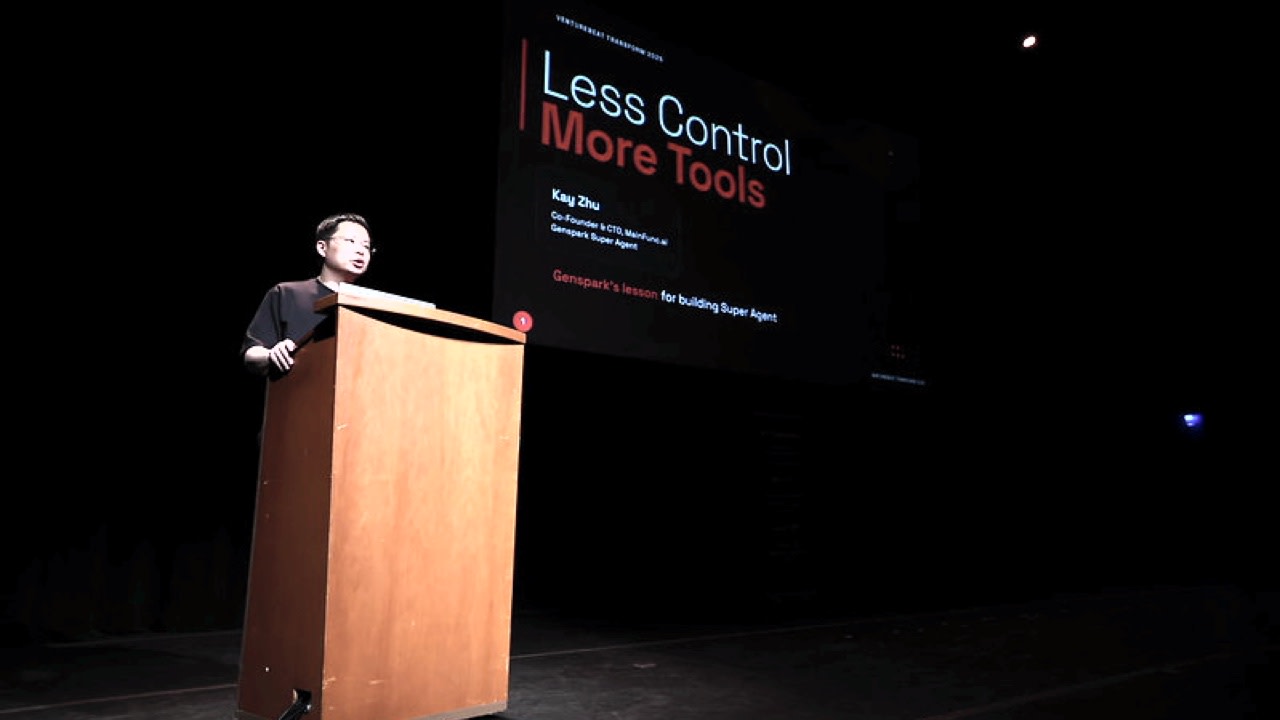
The phone call was a joke with a working number. Onstage at VentureBeat Transform in June 2025, Kay Zhu asked Genspark's Super Agent to ring an event organizer and inquire, half seriously, whether he could speak before Andrew Ng. The room had just watched the software research the conference speakers and draft slides. Calling someone who might answer was a different sort of test. It took the demonstration out of the comfortable territory of text on a screen and into the mildly awkward world where people have calendars, interruptions and opinions about their running order.
Zhu, Genspark's co-founder and chief technology officer, had chosen an apt prop. He has spent much of his professional life in search, where the measure of success is often the answer nearest the top of a page. A phone call has no ranked list to admire. It either happens or it does not. That gap between finding information and finishing a task has become the central concern of his current work.
The stage moment also hints at his style as a public engineer. He likes a demonstration with a little risk in it. The same talk showed an agent making a Nikola Tesla website, analyzing a marketing spreadsheet in Jupyter, and working through email and application files. The phone call was the one with the possibility of an actual human saying no. It gave his phrase for Genspark's approach, “Less Control, More Tools,” a small comic edge.
The search engineer
Before the agents and the onstage calls, Zhu worked on a more familiar internet problem: which page should appear first. At Google, he worked in core search ranking and web quality. He helped develop Panda, the 2011 change to Google's search quality system. Search ranking can look invisible from the outside; from inside, a small change in what gets promoted or pushed down can reshape what millions of people read.
He later held senior search roles at Baidu. As chief architect of Baidu Search, he brought a deep neural ranking model into production in 2013. He also became CTO of Xiaodu Technology, the Baidu business associated with conversational AI and smart devices. The career line is unusually tidy in retrospect: web pages, machine-learned ranking, voice interaction, then software expected to take action. At the time, each was a separate engineering problem with its own stubborn constraints.
There is a temptation to describe every new AI product as a break with what came before. Zhu's account sounds more like an extension. Zhu still sees Genspark's agent as a kind of search, though a more technically advanced one. The user begins with a question or an instruction. The system must locate information, judge its quality and choose a route through the task. What changes is the stopping point. A list of links is no longer the promised result.
“In workflows, errors accumulate. In agents, errors are recoverable.”Kay Zhu, VentureBeat Transform talk, 2025
That line is less mystical than it first appears. A fixed workflow has a sequence: do A, then B, then C. When B fails, the script may stall or push a bad result into C. Zhu's preferred agent can inspect what happened, try another tool and revise the plan. In his talk, he described an agent as a model in a loop: plan, execute, observe and backtrack. Those verbs are ordinary enough to describe a competent coworker having a mildly difficult afternoon.
Five million users, and a change of direction
Genspark started in Palo Alto in 2023 and launched an AI search product in 2024. The first idea had an appealing shape. Search for something and receive a generated “Sparkpage” that brought together text, images and video. The company reached more than five million users with that approach. Many founders would have kept polishing it. Zhu and his colleagues decided the product's very format imposed a limit.
Zhu has explained the constraint in terms any search user knows intuitively: people will wait only a few seconds for a result. Five or ten seconds can produce a useful answer, but many jobs worth doing take longer. The team first attached an agent that could spend about fifteen minutes researching and organizing a response. That experiment led toward a more ambitious product. In April 2025, Genspark launched Super Agent and began presenting itself as an AI workspace.
The pivot was rooted, Zhu recalled, in a rough holiday experiment. Around the New Year at the start of 2025, he tried a then-current Anthropic model with tools and a minimal execution system. Earlier versions had not reliably managed a task on their own. This one could plan, act, look at the result and decide what to do next. It was an engineer's sort of holiday revelation: less a flash of inspiration than a prototype that finally kept working when allowed to make its own next move.
Commercial response followed quickly. Genspark reported $10 million in annual recurring revenue nine days after the Super Agent launch and $36 million after 45 days. Those are company figures, not a personal scorecard for Zhu, but they explain why a search company could commit so decisively to a different interface. In roughly ten weeks, the team added a browser, a secretary, personal calls, downloads, drive, sheets and slides alongside the agent. The product began to look less like a place to ask and more like a place to delegate.
The small team became part of Zhu's public account of the company. In 2025, he described roughly 20 people using AI to write much of the code, while insisting on a strict review process. That last detail matters. “Vibe working” is an inviting phrase, but software still has to survive contact with an actual user. He described each employee as managing a group of agents and shipping a feature through to the end. He had previously managed organizations of more than a thousand people; the comparison gave him a concrete interest in what a smaller team could do with different tools.
Coffee, context and the next task
By March 2026, Zhu was demonstrating a longer chain of action at NVIDIA GTC. During his presentation, he asked Genspark Claw to post a greeting in ten languages on LinkedIn and order five lattes for teammates back at the office. He later wrote that the coffee arrived before his session ended. The latte is an unusually good demo object: humble, countable and impossible to mistake for an elegantly worded promise. It still leaves the important engineering questions open. Can the system keep going when a service changes, a payment fails or the task lasts days instead of minutes?
His GTC talk described four stages: AI search, asynchronous workflows, agents and long-horizon agents. Each stage gives the software a little more time and responsibility. A search box answers now. An agent can return later with a completed file. A long-running agent might work through an extended assignment, checking its own progress and recovering from a wrong turn. Reliability starts to matter more than theatrical fluency once nobody is standing beside the screen to rescue the demo.
Then comes memory. At AI Summit Seoul in August 2026, Zhu argued that newer models alone would not solve the drag in ordinary work. The missing material is often the context scattered across emails, meetings, files and yesterday's decisions. Genspark's Second Brain is his team's attempt to carry that context forward. In his image, an agent needs something like a hard disk so it can return to the work rather than begin every new request as a stranger.
There is an old search problem hiding inside that idea. A system has to retrieve the right thing at the right moment, separate useful context from clutter and use it without inventing a connection. Zhu's years in ranking do not make that problem easy. They do explain why he would recognize it as central. An assistant that remembers everything but retrieves the wrong detail is only a more elaborate way to be confused.
Zhu also talks about mixing models instead of pledging allegiance to one. In his 2025 technical presentation, Genspark used models of different sizes with specialized tools, and chose among them for different parts of a job. In 2026, he described a grading system that scores completed work and helps decide which model is appropriate. This is the less photogenic side of the product: routing, evaluation, cost and the patient accounting of mistakes. A phone call gets applause. A system that chooses a cheaper model without spoiling the result gets a better operating margin.
His trajectory now has an odd symmetry. At Google, Zhu helped decide which information deserved attention. At Genspark, he is trying to decide which information an agent needs in order to act. The unit of work has expanded from a page to a task, and then from a task to an ongoing relationship with a user's work. It is a considerable ambition for software, and one that can be tested in small, unromantic ways.
The next answer may be a slide deck that needs no rescue, a research note that cites the correct file, or a set of lattes arriving at the correct office. Zhu's best demos make room for that practical standard. After twenty years near the search box, he seems most interested in the moment after someone closes it and says: now do the job.
Follow the work
Talks, profiles and public accounts connected to Kay Zhu.