Kathryn Finney was lending money to her older brother before most children have worked out what an interest rate is. Her capital came from friendship bracelets. In fourth grade in Minneapolis, she built a bracelet business that, she later recalled, brought in as much as $50 a week. The family credit market had acquired a small, well-informed lender.
It is a cheerful beginning for a career spent examining who gets money, who has to ask for it, and who is believed when they ask. Finney went on to build The Budget Fashionista, found digitalundivided, publish research on Black women’s access to startup investment, and establish the venture firm Genius Guild. The products changed. The question of who gets to own something stayed close.
Her early example was her father, Robert. After working in a Milwaukee brewery, he retrained in computing and eventually became a senior engineer at Microsoft. In her account, a programmer who taught displaced workers on Saturdays helped make that change possible. Opportunity had a person attached to it, and that person had given up a weekend.
Finney was born in Milwaukee and grew up in Minneapolis. She studied at Rutgers, then Yale. But the family lesson had already supplied something a university could only reinforce: a person’s current job tells you remarkably little about what that person might build next. She had watched a career become larger than the expectations surrounding it.
The bargain shopper had an audience
In 2003, Finney started The Budget Fashionista, an early fashion blog devoted to looking good without spending extravagantly. It eventually became a media business, with advertising, brand relationships, television appearances and a book. In 2006, Random House published How to Be a Budget Fashionista: The Ultimate Guide to Looking Fabulous for Less.
The apparent modesty of the subject concealed a business education. Finney was learning what readers wanted, how to attract them repeatedly, and how to turn their attention into revenue. A woman looking for an affordable outfit was also a customer with preferences and purchasing power. That should have been an uncomplicated proposition.
Finney later sold the company. The sale made her one of the early Black women to achieve a successful exit from an internet business. She also worked as editor-at-large at BlogHer, where she gained experience inside a larger media company and watched how a venture-backed organization operated. Blogging had taken her from publishing advice to understanding the machinery behind a business.
There were limits to what she wanted from the fashion internet. As blogging became more visual, Finney found herself reluctant to turn every meal or outing into content. “I want to eat and talk and learn and experience and be present,” she said. It is a perfectly reasonable ambition, though a troublesome one for anyone whose lunch is expected to maintain an engagement rate.
An accountant becomes an objection
Her next idea seemed a natural extension: a beauty subscription service for Black women, connected to the audience and relationships she had already built. She took it into a New York startup incubator. Her accounts of that experience describe praise for the pitch followed by objections that had little to do with the business.
One investor told her he did not invest in Black women. Another questioned whether she could relate to Black women because she had an accountant. The accountant was apparently a disqualifying luxury. Here was a founder being asked to prove that she understood her own customers while the people making that judgment displayed little curiosity about them.
The episode gave Finney a practical problem to solve. At technology events she was often the only Black woman present. She knew that Black women used technology and built businesses. Yet the rooms where founders met money did not reflect the world she knew. Waiting for invitations offered an uncertain timetable.
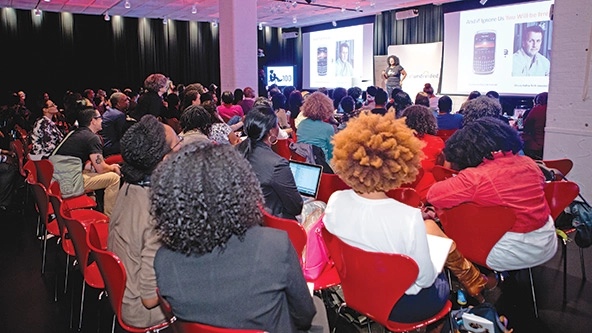
In 2012, she launched FOCUS100 in New York. Black women founders and co-founders from close to 50 companies attended the inaugural event. BlogHer and Andreessen Horowitz supported it; Ogilvy supplied space. Cory Booker, then mayor of Newark, was the keynote speaker. Finney had begun assembling a room in which founders could meet investors, mentors and one another.
First, count the people in the room
FOCUS100 grew into digitalundivided, the organization Finney led until 2020. A conference could make an introduction. Building a sustained program required more: staff, money, training and a convincing account of the problem. Potential partners wanted numbers showing how many Black women tech founders there were and what stood in their way.
Finney could not locate the research she needed. Her then-husband pointed out that she had a research degree from Yale. She could do the work herself. It was an unusually useful household intervention. The team began assembling the data, then spent weeks questioning and checking findings that looked almost implausibly sparse.
ProjectDiane, named for civil rights organizer Diane Nash, made those gaps visible. Released in 2016, the research documented how few Black women-led startups had received venture investment. Contemporary reporting described just 24 such companies receiving venture funding in a pool of roughly 10,000 deals during 2012-2014. Eleven could be confirmed as having raised more than $1 million.
The figures described a historical dataset, with definitions and boundaries. They were not a census of Black women’s ambition. Their force came from giving the funding conversation something specific to confront. The people who had been missing from investors’ mental picture could now be discussed in terms of companies and checks.
In Atlanta in 2016, digitalundivided launched the BIG Incubator. Its support combined business development with access to networks and capital. The research continued, expanding to include Latina founders. Counting and company building now reinforced each other: the numbers identified a gap, and the programs worked on the conditions that kept it open.
A small place in a large ledger
Money that could arrive before the paperwork
In April 2020, Finney started the Doonie Fund with $10,000 of her own money. She named it for her grandmother, Kathryn “Doonie” Hale, a fashion entrepreneur. The fund offered small amounts of capital directly to Black women business owners. The opening requirement was deliberately simple: a verifiable business website.
That design reflected her experience of running companies. A small business can need a small sum urgently. An elaborate application may consume the very hours an owner needs to keep earning. Finney wanted money to move quickly, with trust built into the process. She described early payments as the sort of encouragement a grandmother might put into your hand.
The fund has since supported more than 3,000 Black women-owned businesses, according to her current biography. Its backers have included Pivotal Ventures, the Surdna Foundation and UBS. The amounts were modest alongside venture rounds, but the decision about whose judgment to trust was familiar. The recipient got room to decide what her business needed.
Finney’s own money began the Doonie Fund, named for her grandmother.
Then she sat on the other side of the table
Genius Guild took the capital question to another scale. Finney founded the firm in 2020; its public launch in April 2021 announced more than $5 million secured from investors. Backers included Pivotal Ventures, Barbara Clarke’s Impact Seat, First Close Partners and Andrew Bosworth. The platform used a venture studio model to support Black entrepreneurs building scalable businesses.
The move put Finney in a position to make investment decisions herself. She had spent years building an audience, organizing founders and documenting exclusions. Now she was raising a fund and choosing where its money should go. Her argument was commercial as well as social: investors were overlooking opportunities in markets and communities they did not understand.
Her stated ambition includes returns for founders, investors and the communities around a company. A founder who hires locally or gives early employees equity can create opportunities beyond the founding team. That is the chain of ownership she wants to see repeated. It resembles her father’s story, with more places for someone else to enter.
In 2023, Finney received the Heinz Award for the Economy, recognizing her work on access to the startup ecosystem. Today she is based in Chicago and remains Genius Guild’s founder and managing general partner. Her career has brought her into venture capital through the practical work of finding people whom the industry had struggled to see.
“My life’s work has focused on creating a world where we all win”
Kathryn Finney · 2023 Heinz Award
A business has to fit inside a life
Her 2022 book, Build the Damn Thing: How to Start a Successful Business if You’re Not a Rich White Guy, became a Wall Street Journal bestseller. Its subtitle identifies the assumptions she wants readers to question. Advice about raising money from family, hiring a team or demanding terms in an investor meeting does not land equally for every founder.
She has also written about failure close to home. A dry-cleaning business she started with her mother and brother did badly. In a later essay, she examined the different goals, responsibilities and tolerances for risk each family member had brought to it. The lesson was specific enough to be uncomfortable: people who love one another may still be poorly matched as business partners.
That experience helps explain why her encouragement has conditions. She has urged prospective founders to test demand and calculate risk, and has welcomed people discovering early that entrepreneurship does not suit them. Someone liking a product is useful information. Someone paying for it is different information. Her enthusiasm leaves space for a spreadsheet.
Finney’s current work carries that approach into BUILD, her founder education offering, and her continuing newsletter. In 2026, her essays have addressed company values, first hires and the family members who often become a founder’s early team. A paperback edition of Build the Damn Thing was published in November 2025. The instruction in the title keeps acquiring practical footnotes.
Away from investor meetings, her tastes are reassuringly particular. She loves books, remembers furnishing her Yale apartment with finds from a Salvation Army store, and names Frank Pepe as her New Haven pizza choice. Asked what she would change about her university years, she wanted more pizza. The Budget Fashionista’s attention to value seems to have survived the job changes.
The bracelet seller, the fashion publisher and the investor belong to the same working life. Each requires noticing what somebody wants and deciding that it deserves to exist. Finney has made a career of questioning the price attached to being overlooked, then finding ways to put money into other hands. Somewhere, an older brother was introduced to that principle rather early.
Follow the work
More from Finney, and conversations worth your time.