The modern enterprise marketer lives in a small country whose official language is acronym. Its citizens speak of AI, RPA, SaaS, FHIR and APIs with the casual ease other people reserve for weather. Kartik Murugan has spent more than 27 years serving as translator there. His work is not to make complexity disappear. It is to make the complexity mean something to a buyer, an employee or a room of executives who have heard quite enough about transformation for one quarter.
Today, Murugan is the Chief Marketing Officer of CitiusTech, a healthcare technology company. He is based in Bengaluru, though his résumé reads like a tour of Indian enterprise computing: Wipro, IBM, HCLTech, Larsen & Toubro Infotech, Randstad India, SunTec Business Solutions, EdgeVerve and, since late 2022, CitiusTech. The sectors shift. The assignment holds. Find the useful human proposition inside a complicated machine.
First, learn the machinery
Murugan did not begin with a communications degree. He studied instrumentation and control engineering at the University of Madras, then earned an MBA from the Bharathidasan Institute of Management. That pairing feels less like a youthful detour than a blueprint. Instrumentation is about turning hidden conditions into readable signals. Marketing, on its better days, is not entirely different.
His working career began around 1999 at Wipro, where he was a territory manager. A business-manager role at IBM followed. Then came nearly eight years at HCLTech, moving through category and marketing posts and eventually into products and new-business incubation. These were not glamorous exercises in choosing a shade of blue. They were lessons in enterprise buying: long decisions, multiple stakeholders, high switching costs and the permanent suspicion that every vendor presentation has been polished one adjective too far.
Four eras, one translation problem
Enterprise foundations · strategic and employer brand · AI and automation products · healthcare technology
A short strategic-marketing chapter at LTI led to a longer, more public role at Randstad India. From 2012 to 2017 he led marketing, communications and digital for the staffing company. Here the thing being marketed was not merely software or services. It was work itself: a company’s reputation among clients had to coexist with its reputation among people who might spend their days there.
That period also brought one of the recognitions listed on his public profile: in 2013, the CMO Council and World Brand Congress included him among 50 talented CMOs in India. Seven years later, while at EdgeVerve, Enterprise IT World gave him a Global CMO Leadership Award. Awards are snapshots, not explanations, but the dates are instructive. They bookend a move from marketing people-centered services to marketing increasingly autonomous software. The audience changed; the demand for credibility remained.
In 2017, he published an essay called “The secret sauce of successful employer branding.” The title has the jaunty confidence of its era, but the subject is durable. An employer brand cannot live only in recruitment advertising. It is tested in ordinary encounters between what an organization says and what employees experience. Murugan’s later work would move back toward technology products, but the lesson travels well. A brand promise is a debt. Operations eventually collect it.
The automation years
After a 2018 stint leading marketing, digital and communications at SunTec, Murugan joined EdgeVerve, the Infosys subsidiary built around enterprise products. His portfolio covered AI, robotic process automation and software delivered as a service. This was the vocabulary before generative AI made artificial intelligence a dinner-table noun. The marketer’s task was harder then in one way and easier in another: fewer people arrived with an opinion, but more of them needed the whole idea explained.
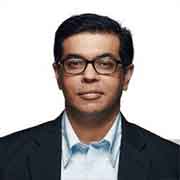
At EdgeVerve, Murugan also appeared on the editorial team of The Edge Quarterly. In January 2021 he wrote “The New Digital Normal,” an essay built around the disorientation that followed 2020. Its central observation was plain: digital capability had ceased to be an optional program. It had become operating infrastructure. The essay moved from changed consumer routines to AI, automation and enterprise resilience, then ended with preparation rather than prophecy.
One thought experiment does most of the work. Imagine the crisis in a world without the internet. The line succeeds because it swaps a technology catalogue for an absence anybody can feel. No diagram of cloud architecture is required. For a marketer surrounded by advanced products, that instinct is valuable: find the everyday counterfactual, and the system becomes visible.
The questions recur in his public language. “What’s next?” opened the 2021 essay. Its subtitle asked, “Are you ready?” Years later, introducing CitiusTech’s Knewron platform, he asked what might happen if AI understood healthcare’s particular workflows and challenges. This is a marketer’s habit worth noticing. A declarative claim closes a door. A precise question leaves just enough room for the customer to enter.
Healthcare raises the burden of proof
Murugan joined CitiusTech in November 2022 as its senior marketing leader and is now publicly listed as CMO. The transition from general enterprise automation to healthcare technology tightened the problem. Here, complexity is not theatrical decoration. Systems must exchange data, fit established workflows and operate inside demanding rules. New technology still needs ambition. It also needs guardrails, transparency and a credible account of what it will do.
Consider the language around Knewron, the healthcare-native AI product-development platform CitiusTech introduced in 2025. The message includes model routing, data ingestion and agentic workflows, but it also insists on healthcare-specific guardrails, trust and explainability. Those words are doing more than reassuring a cautious market. They acknowledge that in healthcare, intelligence without context is merely a fast way to misunderstand something important.
Murugan also publicly welcomed Health Data Movers after CitiusTech acquired the company, highlighting its experience with Epic, Workday and ServiceNow. Again, the material is a thicket of systems and integrations. The proposition underneath is continuity: make intelligence and automation useful inside the platforms organizations already depend upon. Transformation sounds stirring on a conference banner. Integration is what has to work on Monday morning.
His professional recommendations fill in the manner behind the messages. A former SunTec colleague describes him as accommodating, clear in expressing his views and willing to encourage unfamiliar ideas. Another colleague remembers his ability to grasp a new concept quickly and turn it into an executable business plan. These are modest compliments, which is why they carry weight. They describe the daily mechanics of leadership rather than the ornamental mythology of it.
The useful immunity of experience
Twenty-seven years in technology confers a useful immunity to the phrase “everything has changed.” Murugan has worked through hardware-era enterprise selling, the rise of digital channels, employer branding, cloud software, robotic automation and the current AI cycle. Every period arrives dressed as an ending. Each one soon becomes another layer in the operating stack.
That long view does not make novelty irrelevant. It makes novelty answerable. What problem does it solve? Who must trust it? How does it fit the work already being done? Murugan was scheduled in March 2026 for a Bengaluru panel whose title captured the distinction neatly: AI as a strategic partner, not a silver bullet. The wording is sober enough to survive the conference hall.
There is also a pleasing loop in the journey. The young instrumentation engineer learned to work with systems that translate conditions into signals. The CMO now works with another kind of signal: the language that tells a market what a system is for. Between those points sit nine organizations, executive programs at Maryland, Wharton and Stanford, two publicly listed marketing honors and a great many product decks mercifully lost to history.
The executive education belongs in that loop too. At Maryland’s Robert H. Smith School of Business, his 2014-15 program included a project on the push-versus-pull marketing conundrum. In 2021 he completed Infosys programs associated with Wharton and Stanford’s Graduate School of Business. The pattern is less about collecting prestigious names than periodically returning to the classroom while the working definition of marketing changes. A career this long requires revision. Yesterday’s reliable channel becomes today’s clutter; yesterday’s exotic technology becomes infrastructure; yesterday’s buyer becomes a committee armed with search, peers and very little patience.
The durable achievement is less decorative. Murugan has kept his career coherent while the technology underneath it repeatedly changed. He has moved from selling and managing enterprise accounts to shaping brands, from communicating employment to explaining automation, and from broad digital transformation to a highly specific healthcare context. The common work is patient translation.
Complexity will not go out of fashion. Neither will the temptation to hide it beneath grand language. Murugan’s public record suggests another approach: learn the machinery, ask the useful question, and make a promise specific enough that the operating business can keep it. In the little country of acronyms, that counts as fluent human speech.