The future of shopping, in Karine Terzibachi's telling, begins in an unglamorous place: the message inbox. It is where appointment reminders jostle with family plans, delivery notices and a hundred small claims on attention. Marketers have spent years trying to squeeze a shop window into that narrow strip of glass. Terzibachi, Attentive's Chief Business Officer, thinks the more interesting possibility is to make the window answer back.
Her favored tool is RCS, the messaging standard that can give a business a verified identity and let a customer swipe a carousel, watch a video or take action without leaving the thread. She often explains the difference with a wonderfully old medium: SMS is black-and-white television, while RCS brings color. There is a comic footnote. Terzibachi says she barely watches television.
That contrast suits her. She works in technology but resists living entirely through screens. She has run for almost 20 years, takes ballet classes regularly and recently added squash. During a company kickoff in Austin, she persuaded Attentive's Chief Product Officer, Nakul Narayan, to join her for a quick run. One imagines there are easier ways to schedule a one-to-one, though perhaps none so efficient.
01 / The useful detour
Before message flow, there was airflow
Terzibachi's career did not begin with advertising copy or loyalty programs. She studied mechanical engineering at McGill University. In 2011, her name appeared on a Journal of Biomechanics paper about how helium-oxygen mixtures move through heterogeneous airway obstructions. That same year, Canada's science and engineering research council listed her for graduate scholarship support connected with McGill's engineering faculty and MIT's biomedical engineering center.
The subject is far from mobile commerce, but the underlying habit is recognizable: observe a complicated system under pressure, study where resistance appears and work out how movement changes. It is a useful education for an operator. A company, like any network, behaves differently when the path narrows.
She moved into business analysis at McKinsey, then earned an MBA from Harvard Business School. At Harvard, the extracurricular list hinted at her range. She co-chaired the business program for the 2015 Harvard Arab Weekend and participated in groups spanning technology, the Middle East and North Africa, retail, the arts and dance. The engineer was learning to read institutions as readily as mechanisms.
Biomechanics research and graduate engineering study
Business analysis at McKinsey & Company
Commerce business leadership at Venmo
Joins Attentive in business strategy
Named Chief Business Officer
02 / Money learns to move
The payment button becomes a behavior
Braintree and Venmo brought the systems problem into daily life. Terzibachi led business operations at Braintree, then business operations and data at Venmo. By 2019, Branch's Mobile Growth Handbook introduced her as Venmo's Director, Commerce Business Lead. Her contribution posed a question: how could the mobile experience people loved travel into the offline world?
Payments are instructive because almost no customer wants to admire the payment system. The best outcome is confidence followed by disappearance. The technical rails may be elaborate; the human action should feel obvious. A tap works because identity, risk, data and merchant acceptance have already agreed backstage.
Terzibachi's later work follows the same pattern. A rich message may look like a colorful card with a button. Behind it sits a coalition: a carrier, a platform, a brand, a device, consent rules and enough customer context to make the interruption worthwhile. The message is the smallest visible part of the operating system.
The operator's recurring problem
payments, carriers, data
trust, timing, context
tap, reply, purchase
03 / From campaign to conversation
A richer message still has to earn the interruption
Terzibachi joined Attentive in 2021. She moved through business strategy and senior business operations roles as the company expanded beyond its original SMS business into email, AI products and additional channels. In March 2025, after nearly four years at the company, she became Chief Business Officer. Her remit now spans strategy, operations, analytics and messaging partnerships, with the RCS rollout as a prominent public focus.
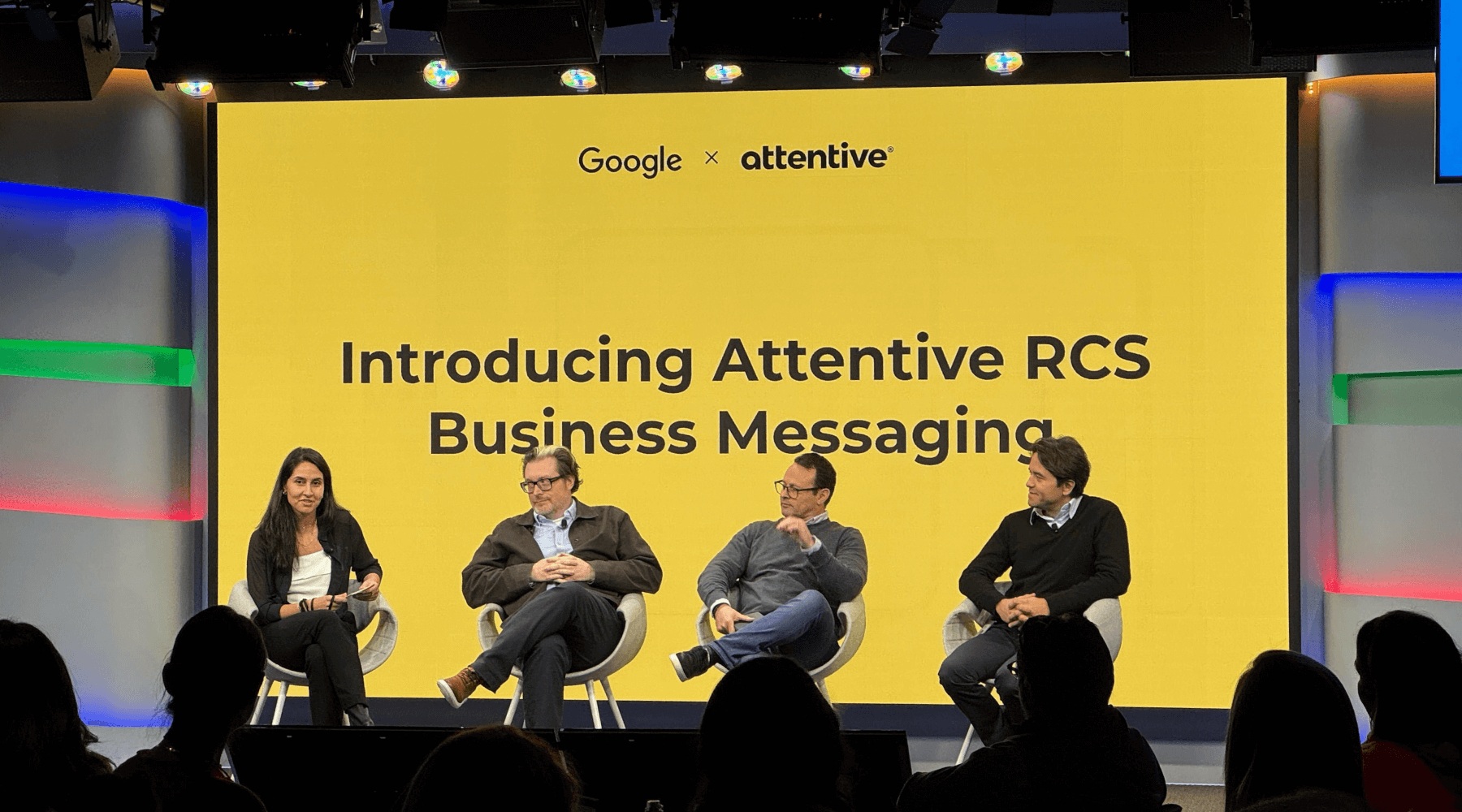
At an Attentive and Google event in January 2025, the promise of RCS was easy to see. Verified senders can help a customer know who is speaking. Carousels and video can make a product legible. Actions inside the thread can shorten the distance from browsing to checkout or loyalty enrollment. Attentive reported more than one billion monthly active RCS users worldwide at the time.
The danger is equally plain. New formats give marketers more ways to speak, not more reasons for anyone to listen. A carousel can be useful or merely several advertisements tied together. A personalized suggestion can feel thoughtful or unnervingly precise. Verification can create trust, but frequency can spend it.
Terzibachi's public language tends to return to context. She has argued that one-to-one conversations require it, and that AI is what allows context to operate at scale. This is a more demanding ambition than inserting a first name into a template. It asks a system to understand timing, intent and the history of a relationship, then choose whether and how to act.
That thinking also informs Attentive's proposed SXSW 2027 panel, which Terzibachi shared publicly in August 2026. Its title, “AI and the Death of Demographics Marketing,” sets real-time signals against static personas and segments. The premise is not that customers have become unknowable. It is that yesterday's bucket may be a poor guide to today's intention.
First, the message has to be seen
The work became unusually literal after Apple introduced filtering that can move messages from unknown senders into a separate inbox without notifications. In Attentive's 2026 account of the change, company research found that messages routed there converted 30 to 40 percent less often. The marketing problem suddenly resembled postal logistics: before debating the elegance of the offer, make certain it reaches the right box.
Terzibachi presented Attentive's response in customer guidance and company events. Its two-tap signup process is designed to help a brand become a recognized sender during opt-in, while contact-card prompts offer another route to visibility. The details are technical and procedural, which is precisely why they belong near business strategy. A campaign cannot perform if the operating conditions make it invisible.
This is also where trust stops being an abstract brand word. Recognition, consent and a clear sender identity are product features in a messaging channel. They tell the recipient who is present and why. RCS adds verification and richer content to that foundation, but its spectacle comes second. A vivid message from a stranger is still a vivid message from a stranger.
Terzibachi's portfolio joins these layers: the partnership that opens a new channel, the operational work that keeps it compliant, the analytics that reveal whether it performed and the strategy that decides where it belongs. Consumers encounter one bubble. The business must coordinate an orchestra behind it. If the orchestra does its job, no one thinks about the orchestra.
04 / The discipline behind ease
Operations is choreography with fewer sequins
There is something apt about Terzibachi's affection for ballet. The form prizes a clean line while hiding the strain required to produce it. Business operations has a similar bargain. Customers see a message arrive at the right moment. They do not see the partnership agreements, data plumbing, compliance work, campaign logic and measurement that had to land together.
Her advice to her younger self compresses the method: understand what drives the business, trust your judgment, work hard and keep the work enjoyable. It is not the language of a grand theory. It is the language of repetition, attention and the occasional correction at the barre.
Team continuity matters too. When Attentive asked what had been most rewarding about her time there, Terzibachi pointed to the talent around her and joked that some colleagues had tolerated her across several companies. Beneath the joke is an operator's truth. Systems run through relationships, and people who have solved one difficult problem together move faster on the next.
Her promotion also arrived after Attentive had undergone the sort of change operators remember in their bones. Terzibachi described watching the company move from a single-product business toward several products, a transition she acknowledged was difficult. SMS remained part of the foundation, while email and AI products widened the offer. Each addition created new possibilities for customers and new seams inside the company. Someone had to make the seams hold.
That helps explain why her role is broader than a tidy functional title. Strategy without operations can become a handsome document. Operations without analytics can become very efficient motion in the wrong direction. Partnerships without product coordination can produce announcements before utility. Put the disciplines together and a new channel has a chance to become a business rather than a demonstration.
The arc from laboratory airflow to payment flow to message flow looks unusual only if industries are the unit of measurement. Use behavior instead and it becomes orderly. Terzibachi studies how something complicated moves, where it encounters friction and what coordination makes the result feel natural.
RCS may become a standard layer of mobile commerce, or it may settle into a narrower place than its champions hope. The durable part of her bet is less technical. People prefer simple actions, recognizable senders and exchanges that respect their attention. They do not care which committee made the standard possible.
The next storefront, then, may indeed be a conversation. If Terzibachi's operating instincts hold, the machinery will remain backstage. Up front there will be a useful message, a clear choice and, with luck, enough restraint to leave the customer wanting to hear from the brand again.