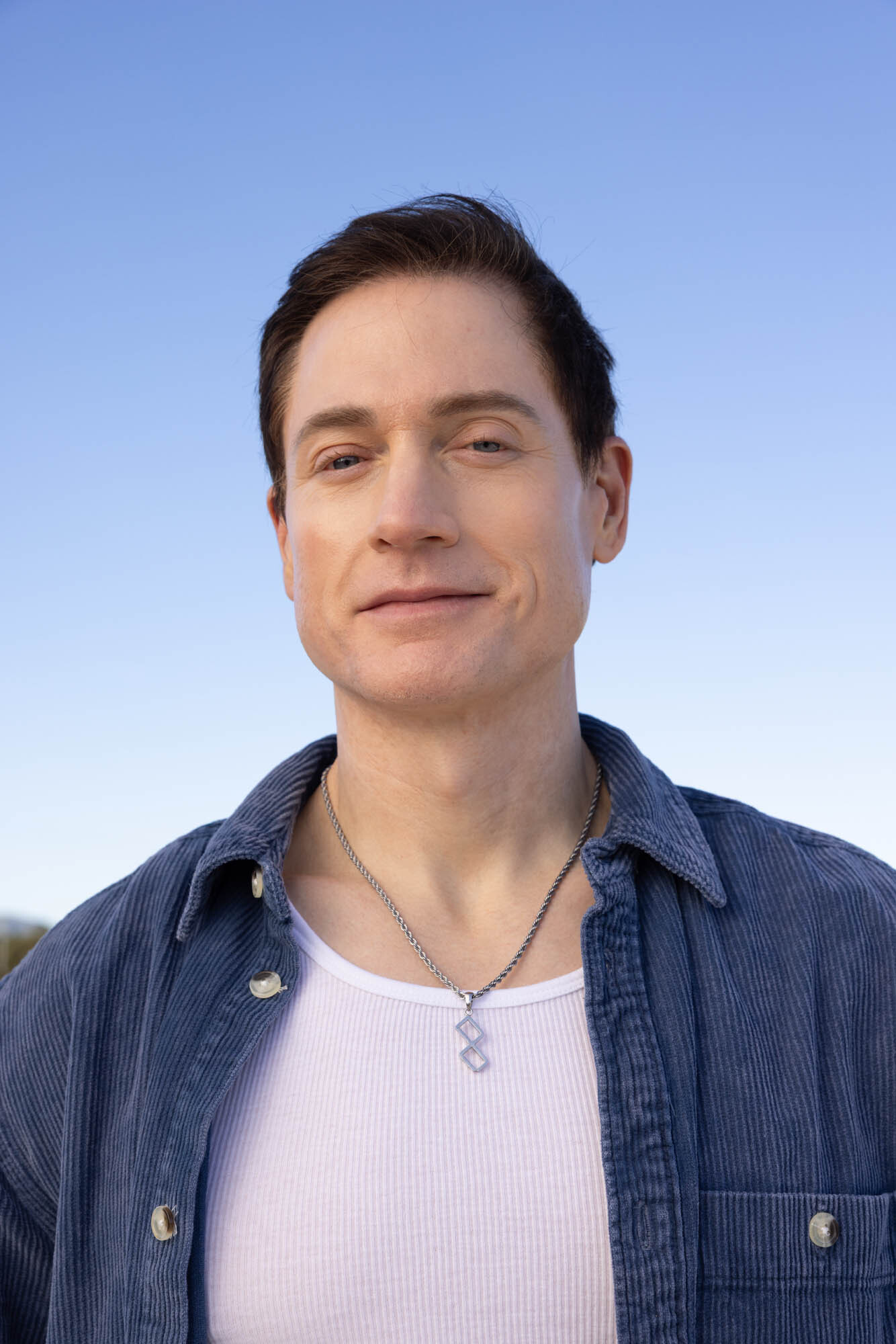
The man, the protocol, the pivot
Today Johnson runs Blueprint, a Venice-based company built around a personal regimen he started running on himself in 2021. The product line sells the food, supplements, and measurement tools he uses on his own body. The marketing strategy is to be the marketing. Walk into any conversation about longevity in 2026 and his name arrives within thirty seconds.
He calls the underlying idea "Don't Die." It is two words, and he says them constantly. To Johnson, Don't Die is not a brand line but a moral position: existence beats the alternative, and the alternative has been winning for far too long. He has spent the last year working to push Don't Die out of biology and into philosophy, with a "die score" he wants assigned to companies based on how much their products shorten or lengthen human lives.
Before the protocol, the payments
In 2007, fresh out of the University of Chicago Booth School of Business with an MBA, Johnson founded Braintree. Braintree built the rails underneath e-commerce checkouts you have used and never noticed. In 2012, Braintree paid $26.2 million for a tiny app called Venmo that let twentysomethings split bar tabs. A year later, in 2013, PayPal bought the whole stack for $800 million. Johnson, who had founded and run Braintree, walked away with a personal share widely reported at around $300 million.
Most people in that situation buy a yacht and a board seat. Johnson bought a thesis. He put $100 million into a venture firm called OS Fund, designed to back early-stage science companies working on what he liked to call "the operating systems of life." Synthetic biology. Genomics. Atomically precise manufacturing. The pitch was that software had eaten the world and the next course was biology.
Then he tried to read brains
In 2016 he founded Kernel, a neurotechnology startup pursuing wearable devices that could non-invasively record the human brain in everyday environments. Kernel's helmets - not exactly subtle - were shipped to researchers and pharmaceutical companies. The goal was to make neural recording cheap enough that brain data could be collected at the scale software companies collect clicks.
The brain turned out to be harder than payments. Kernel slowed, pivoted, and shrank. Johnson, by his own telling, kept funding it personally past the point a normal investor would. That stubbornness has become a tell. He does not exit theses. He doubles them.
Project Blueprint, born on a spreadsheet
In October 2021 he announced what he called Project Blueprint. He hired a team of clinicians. He picked a protocol. He started measuring everything that could be measured on a human, then publishing it. The reported annual cost ran to roughly two million dollars. The breakfast became famous - he named it Nutty Pudding, and yes, that's the actual name. The supplements were photographed and weighed. Sleep was tracked to the minute.
Blueprint the project became Blueprint the company. It now sells olive oil, longevity-leaning food products, and a "Blueprint Stack" of his own supplement protocol. Critics rolled their eyes. Customers ordered the olive oil anyway. As of 2026 the brand is one of the most recognizable in the consumer longevity category, a category that barely existed when he started.
The Netflix moment
On January 1, 2025, Netflix released Don't Die: The Man Who Wants to Live Forever, directed by Chris Smith. The documentary did what Netflix documentaries do. It turned a niche figure into a household one. Reviews were mixed. The Daily Beast said the film "complicated Johnson's self-presentation" but stayed sympathetic. TheWrap argued it gave him too much rope. Variety and the SF Chronicle were warmer.
The film leaned into the family. It included a now-retired multigenerational plasma exchange between Johnson, his father Richard, and his then-teenage son Talmage. The internet did what the internet does. Johnson did what Johnson does. He kept publishing.
A new kind of public figure
There is a category of founder who builds a company. There is a category of founder who builds a movement. Johnson, somewhere along the way, decided to build a category of person. He uses the phrase "a new kind of human" without flinching. He has said he wants Don't Die installed as a cultural philosophy by the end of 2026.
Treat that the way you'd treat any founder forecast. Discount it. But notice the patient capital. He sold Braintree thirteen years ago and has not, by any visible behavior, slowed down. His Twitter account, @bryan_johnson, posts daily. His YouTube channel publishes a stream of protocol updates. His Threads, Instagram, and personal site all push the same message in different formats. It is the most consistent personal media operation in the founder economy, and it is funded almost entirely by an exit that closed when Obama was in his first term.
The Mormon kid from Provo
Johnson was born August 22, 1977 in Provo, Utah, and raised in Springville. His mother and stepfather - a trucking company owner - raised him after his parents divorced. As a young Mormon he served a two-year mission in Ecuador. The mission shaped him; he has talked about it for years. He later left the LDS Church, a separation he has discussed publicly and at length.
He went to Brigham Young University and graduated in 2003 with a BA in international studies. He went to Booth and got his MBA in 2007. In 2016 Booth gave him its Distinguished Alumni Award. He has three children from a previous marriage. He has been linked to Kate Tolo, a Blueprint cofounder and now reportedly his partner. He confirmed the relationship himself in late 2025, on X, with the disarming opening: "Guys…I have a girlfriend."
What the numbers say about the bet
Public reporting puts his net worth around $400 million. He has said he has spent enormous amounts on his own protocol. He has also said he plans to keep spending. The economic model is unusual: a founder rich enough that his personal R&D budget is the brand, and the brand is the company, and the company's customers are buying access to the same protocol he is using on himself.
If Blueprint works as a business, he wins twice. If the protocol works on his body, he wins again. If neither works, he will still have been the most measured human in the world, and he will have made it cool to publish your own resting heart rate. Most founders would call that a loss. Johnson would probably call it Tuesday.
Why he is interesting
Strip away the regimens and the headlines and what is left is a very specific kind of operator. He picks unreasonable goals. He commits decades. He turns himself into the dataset. He publishes the dataset. He is not the first to try to live longer. He is the first to make doing so a documented public performance funded by a fintech exit.
Don't Die may end up as a footnote in the history of internet self-experiments. It may end up as a foundational text of a longevity industry that is now visibly forming. Either way, Bryan Johnson will have priced in both outcomes ahead of time. He has done that before.