A worksheet has an unusually durable career. It survives curriculum revisions, changes of principal, and the journey from a filing cabinet to Google Drive. Putting it on a screen, however, leaves a familiar problem: a page can travel instantly while remaining stubbornly difficult to use. Someone still has to explain the question, help a struggling reader, and find out who has stopped working.
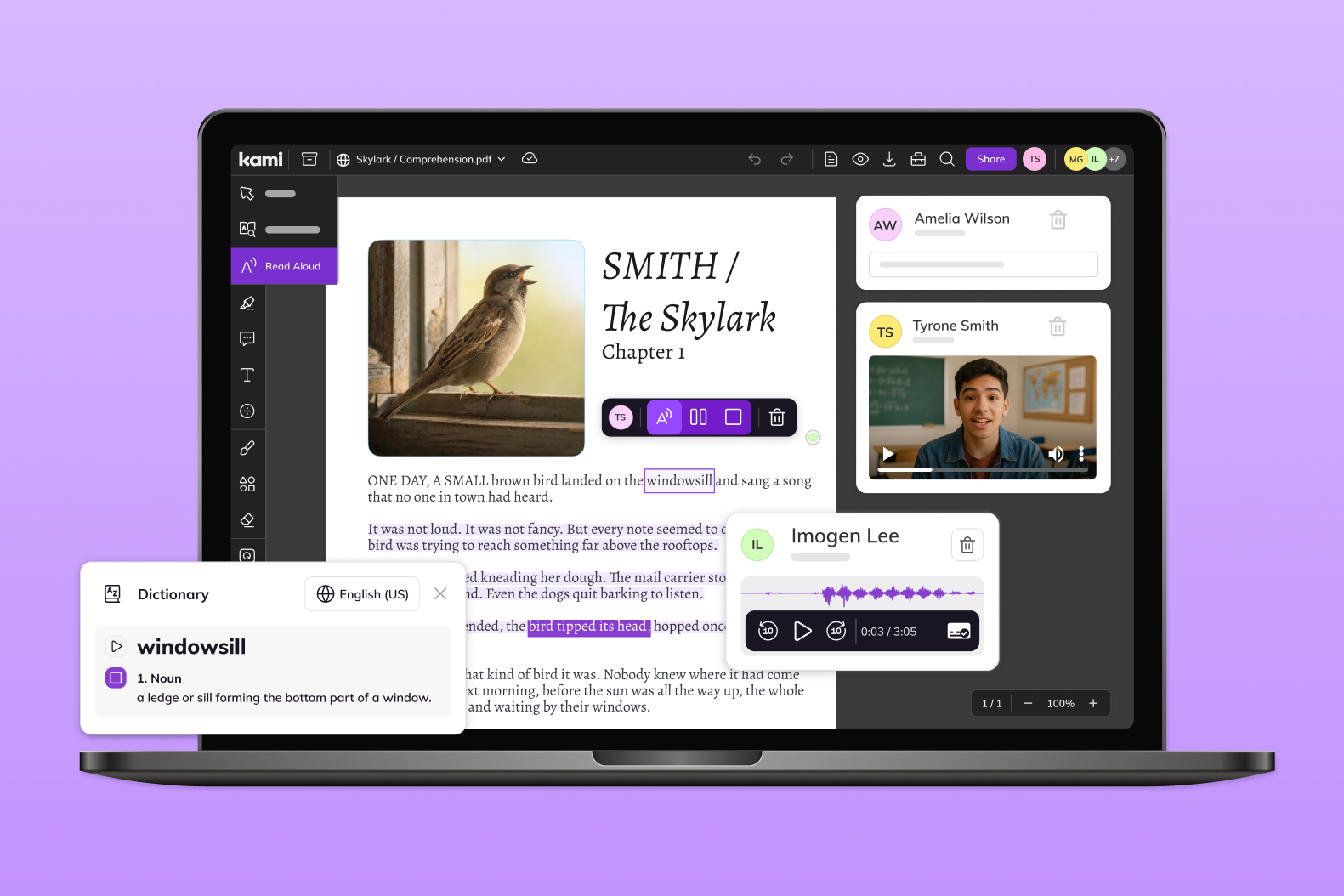
Kami built a business around that gap. Its software lets teachers take familiar PDFs, worksheets, and slides and add annotation, discussion, audio, video, and accessibility tools. Students can work on the page together. Teachers can see work as it develops. The interesting decision was to begin with the materials already on the teacher’s desk. Keeping those materials made room for a different way of using them.
- Keep the materials. Turn existing documents into interactive lessons.
- Offer more ways in. Let students type, speak, listen, and collaborate.
- Follow the workflow. Connect to the systems teachers already use.
01The students were the wrong starting point
The founders knew the irritation from university. Hengjie Wang, Alliv Samson, Jordan Thoms, and mentor Bob Drummond came together in Auckland; the company began in 2013. Early ambitions involved making lectures interactive. In a 2025 Funding Files interview, Samson described trouble gaining traction and monetizing the university product. Initial investors declined to put in more after the first year. The original customer assumption had run out of road.
The team broadened the product into PDF annotation. Teacher feedback then supplied direction. Samson recalls a US education conference, supported by an Education New Zealand grant, where they encountered teachers working with Chromebooks and digital textbooks. One user cried at how much work the product removed. By around 2016, education had become the focus.
Google Workspace integration arrived in 2014; Google Classroom integration followed in 2016. Those connections mattered because teachers already had a place to distribute assignments. Kami could join that routine. When remote schooling expanded in 2020, the company offered free subscriptions to schools worldwide. Its own timeline records 20 million users that year and 30 million in 2021.

02One page. Several ways in.
Consider a reading passage. One student can highlight a sentence and type a response. Another can hear text read aloud. A third can contribute a voice comment. A scanned page can undergo text recognition, making its words searchable and available to reading tools. The lesson remains recognizable while the routes into it multiply.
This is Kami’s particular expertise: combining document work, classroom feedback, and learning support. A conventional PDF editor offers another way to mark a page. Kami packages that activity for teaching, including assignment distribution through Google Classroom, Canvas, Schoology, and Microsoft Teams. Its market sits between document software, assistive technology, and classroom assessment.
The newer Companion product moves reading and writing support into web content. It offers read aloud, translation, voice typing, and tools for explaining or adjusting text. It runs in Chrome and Edge. That detail matters to a buyer: Companion does not run natively on iPads, whose operating system does not support Chrome extensions. A school’s device choices shape whether the product fits.
“Kami has opened accessibility doors in the classroom!”
Amber Moenning / ELAR Special Ed Teacher
03Free gets you onto the page
Kami’s commercial ladder starts with a free Basic plan: more than ten essential tools, cloud-drive integrations, and unlimited collaborators. The education pricing page lists a US$149 Teacher plan with more than forty tools and features, LMS integrations, training, and priority support. Schools and districts request a quote, with deployment and account management included in that tier. Companion also requires a school or district quote.
The practical buying question is which parts of the workflow need to be shared across a school. A teacher experimenting with annotation has a different problem from an administrator deploying software across thousands of devices. Starting free can demonstrate usefulness; coordinating access, support, and teaching practice is where the institutional purchase becomes meaningful.
*Education pricing checked October 26, 2026. Confirm billing terms with Kami.
04Then the worksheet company bought a book company
In August 2024, BV Investment Partners announced a strategic investment in Kami. A contemporaneous company release put the valuation above US$175 million. That figure described the value of the company, rather than a disclosed cheque for the same amount. The relationship brought a US growth partner to a business with a large American school audience.
In September 2025, Kami acquired Book Creator for an undisclosed sum. The fit is easy to understand. Annotation begins with an existing page; Book Creator gives students a place to make something themselves, combining text and multimedia into digital books. At the announcement, Book Creator said existing accounts, content, billing, and contracts would continue, and the products would remain separate.
Kami now also offers Coach in beta. The math product is designed to give hints during independent work and show teachers a record of students’ reasoning and coaching exchanges. It is currently standalone while the company tests the beta. The direction is clear: see more of the learning process while it is happening.
05A big footprint needs a careful reading
Kami says more than 50 million educators and students have used its platform, across 180 countries. It also reports active users in 92% of US K-12 public schools. That is a reach claim. It does not mean 92% of schools buy a district licence, or that every student in those schools uses Kami.
The learning evidence deserves the same precision. Kami describes an Empirical Education analysis involving more than 15,000 Moreno Valley students across 36 schools. Daily use was associated with a four-percentile-point reading advantage, and eight points for multilingual learners. Association is useful evidence for further investigation; it cannot establish that the software alone caused the difference.
The lesson others can copy is concrete. Find a task people repeat, preserve the useful material inside it, and make the next action easier. Schools can try that approach with one existing assignment and observe what changes. The conditions still matter: suitable devices, time to learn the workflow, and teachers who use the feedback. A more capable worksheet gives them more options. They decide what to do with them.
Open a few more tabs
Try Kami, explore plans, or browse the company blog and product updates.