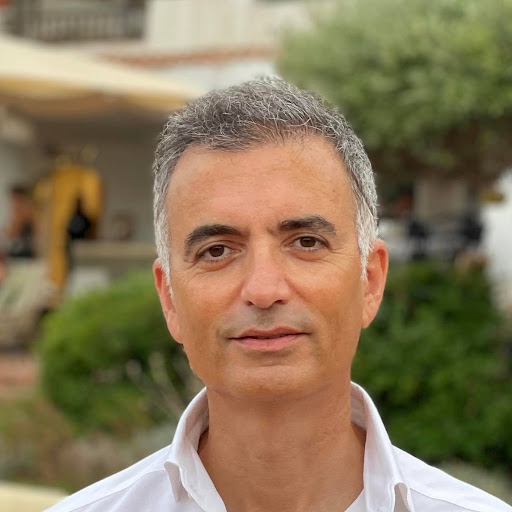
On any given Tuesday at 1810 Gateway Drive in San Mateo, Kam Eshghi is selling something most people cannot picture. Not a chatbot. Not a model. An inference operating system - the connective tissue between an AI agent and the silicon it runs on. He is OpenInfer's Chief Business Officer, which is a polite way of saying he is the adult in the room.
OpenInfer is sixteen people with a single, slightly heretical thesis: the cloud is not the right home for most inference. The right home is wherever the data already is. The phone. The laptop. The edge box behind the warehouse. The hospital server that legal will never let you wire up to anyone else's cloud. The plumbing for that future is the company. The plumber is Eshghi.
He is well cast. Before this chapter he co-founded Lightbits Labs, the startup that pioneered NVMe over TCP - a storage standard that quietly rewired the bottom of every modern AI cloud. Lightbits was acquired by NVIDIA. Before that he was VP of Strategic Alliances at DSSD, where his EMC partnership was so well constructed that EMC simply bought the company for roughly a billion dollars. Before that he built the NVMe controller business at IDT from a memo to a market leader. Before that he was at Intel, deciding what the next generation of server chipsets and Ethernet switches would look like.
"Enabling AI to run wherever the data lives."- Kam Eshghi, on OpenInfer's mission
There is a personality type in Silicon Valley that gets very excited about new layers - new APIs, new frameworks, new wrappers on top of whatever shipped yesterday. Eshghi is the opposite. He gets excited about old layers becoming new again. NVMe was a storage protocol. NVMe/TCP was the same protocol, but suddenly cloud-native. The trick was not invention. The trick was timing and packaging. The trick was making the boring thing feel inevitable.
OpenInfer is the same bet, scaled up. Inference has been with us forever. The boring thing is that you can now run a serious model on a serious laptop, and most companies are still routing every token through someone else's GPU farm. Eshghi thinks that arrangement does not survive contact with agentic AI. Agents do not chat. They burst. They reason in long loops. They want context the cloud is too far away to provide. They need a scheduler that knows the difference between a CPU heartbeat and a GPU sprint. They need, in his shorthand, an inference OS.
The cap table reads like a casting call: Jeff Dean, the Google Senior Fellow who effectively invented modern large-scale machine learning. Eric Schmidt, via Innovation Endeavors. Gokul Rajaram, the operator's operator. Cota Capital, Brave Capital, Essence VC, Operator Stack, StemAI. Brendan Iribe, the Oculus co-founder. Eight million dollars on this thesis, at seed, with names that do not write checks lightly into AI infrastructure unless they already think the bet is alive.
Eshghi's job is to convert those names into a customer pipeline. That is the unsexy part of building infrastructure - and the part he has done four times already.
Two coasts, one degree each
Eshghi did graduate school twice. An M.S. in Electrical Engineering and Computer Science from MIT, where he still serves as an Educational Counselor and mentors first-time founders at StartMIT every January. And an MBA from the Walter A. Haas School of Business at UC Berkeley. That combination is rarer than it sounds. Most operators pick a side - deep technical or deep commercial. He kept both fluently, which is why he can run a slide deck with VPs of Engineering on a Monday and Heads of Procurement on a Tuesday and not blink at the code switch.
It also explains the book. Eshghi co-authored Inside Solid State Drives (SSDs), published by Springer - a textbook that doubled as a market education program for the industry he was simultaneously building. While he was selling NVMe controllers at IDT, the same engineers who would one day buy them were reading his chapters in graduate seminars. He has, in other words, been working both ends of the supply chain for a long time.
The agentic detour
OpenInfer was started by Behnam Bastani and Reza Nourai, who spent the better part of a decade scaling AI systems at Meta Reality Labs and Roblox. They are the technical engine. Eshghi is the go-to-market shape. The split is intentional. You do not build an inference OS by being friendly. You build it by getting Fortune 500 procurement to say yes to a sixteen-person company. That is a craft. He has it.
His public posts on LinkedIn are a tell. He does not write about himself. He writes about numbers. A recent OpenInfer hackathon, he reported, processed 711 inference requests and 865,000 tokens in a sitting. He posts photos of CPU utilization graphs the way other founders post selfies. Reading him for a month is reading a man who finds GPU idle time genuinely amusing.
The pattern, named
The Eshghi pattern is roughly this. Spot a protocol layer that is about to become important. Build a real commercial business on top of it before the rest of the market notices it is a protocol layer at all. Sell to a giant. Repeat.
SSDs were a pattern. NVMe was a pattern. NVMe/TCP was a pattern. Inference is the current pattern - hidden under a different word, because everyone is talking about models when the actual constraint is the runtime that schedules them. It is the same trick. The boring layer wins.
He once described his Lightbits work, on a Forbes Council page, as "making high-performance storage simple, agile and cost-efficient for any cloud." Substitute three nouns and you have the OpenInfer brief: making high-performance inference simple, agile and cost-efficient for any device. The job is the same job. The era is different.
Why the edge
If you ask why inference at the edge matters now, the answer is partly latency and partly economics, but mostly governance. Private AI is not a slogan. It is a procurement requirement. A bank's compliance team cannot ship customer data to a third-party endpoint. A hospital cannot send PHI to an inference API. A defense buyer cannot run agents over a public network. The companies that solve those buyers' problems do not look like model companies. They look like infrastructure companies. They look like OpenInfer.
Eshghi is not the loudest voice in AI. He does not tweet take-downs. He does not run a podcast. He is, almost defiantly, a guy who has spent his career making the unglamorous layer indispensable, and is doing it again. The pattern is the point.