Joshua D. Tobkin gave people an unusually specific reason to disagree with him. In November 2025, the co-founder and CEO of Supra announced that he would commit up to $1 million worth of his own SUPRA tokens to a developer or research team that could produce a faster, verifiably correct parallel execution engine. A founder saying his technology is quick is familiar. A founder attaching a personal allocation and a testing procedure makes the conversation rather more interesting.
The object of the challenge was SupraBTM, the engine behind SupraEVM. The initials are less memorable than the proposition: if someone could improve on the team’s work under defined conditions, Tobkin would put something of his own behind the result. Anyone accepting the invitation would need more than a confident post. They would need working code.
A wager with footnotes
The announcement required an open-source submission, reproducible results, and tests on at least 100,000 consecutive Ethereum mainnet blocks using no more than 16 CPU cores. The requested improvement was at least 15 percent across specified thread configurations. That is a reasonably demanding way to say: show your workings.
The personal pledge also came with a calendar. It involved tokens from Tobkin’s allocation, unlocking in 2027 and vesting over two years. The challenge page described a further opportunity for Supra to respond with its own improved implementation. The size of the promised reward depended on that outcome. A large number made the invitation travel; the conditions made it a technical contest.
Real Ethereum history. Up to 16 CPU cores. Correct execution before a speed result counts.
Published entry conditions, not a claim of network throughput.There is a temptation to read the episode simply as bravado. Tobkin’s earlier career makes a more useful reading possible. Games, incentives, and the question of what can be demonstrated had been part of his professional vocabulary long before the bounty arrived.
Before the chain, the game
Tobkin came to blockchain after working in software businesses, digital payments, and online gaming. His public biographies describe roles including creative director and chief technology officer, along with a successful exit. Those are different jobs, but they share an obligation: somebody has to use the thing once the presentation is finished.
His May 2024 interview covered earning money through online poker. It also ventured into slot-machine psychology and crypto education. The combination has an odd charm. An industry fond of elaborate economic mechanisms can sound more comprehensible when a participant has experience with games people actually play.
That background does not make poker a complete explanation for Supra. It does give the personal bounty an earlier chapter. Tobkin had already spent time around systems where rules affect behavior, where payments matter, and where the experience presented to a user has to sit on functioning software. His later work would carry those concerns into a different setting.
A reading group takes the plane
In 2017, Tobkin organized the Bay Area Whitepaper Club in San Francisco. It is a pleasingly literal name. Before Supra had an infrastructure pitch, he had a group for examining proposed ideas. The reading came before the product.
He described beginning to work with Jon Jones at SF blockchain week in early 2018 and meeting another co-founder, Larron Armstead, at an event in Los Angeles. Jones then encouraged him to take the startup effort to Taipei. There, they established Unitychain, a blockchain research lab exploring scaling techniques.
The detail matters because this story contains other people at its turning points. A conversation changes the city. A research group becomes a lab. Colleagues join an argument that will eventually become a company. By December 2021, Tobkin described a team with members from more than eight countries.
He was particularly interested in randomizing node selection. Over time, that research suggested an opening in oracle infrastructure. SupraOracles emerged from the effort to decide how outside information could enter a blockchain reliably. The journey from reading club to data network was gradual enough to leave room for a change of subject.
“help make the world a more fair place”
Joshua D. Tobkin / 2021
The trouble with knowing the price
An oracle has a rather grand name for a practical job. It supplies a blockchain application with information from outside the blockchain. A financial contract may know exactly what action to take at a particular price. Finding a trustworthy price is a separate problem.
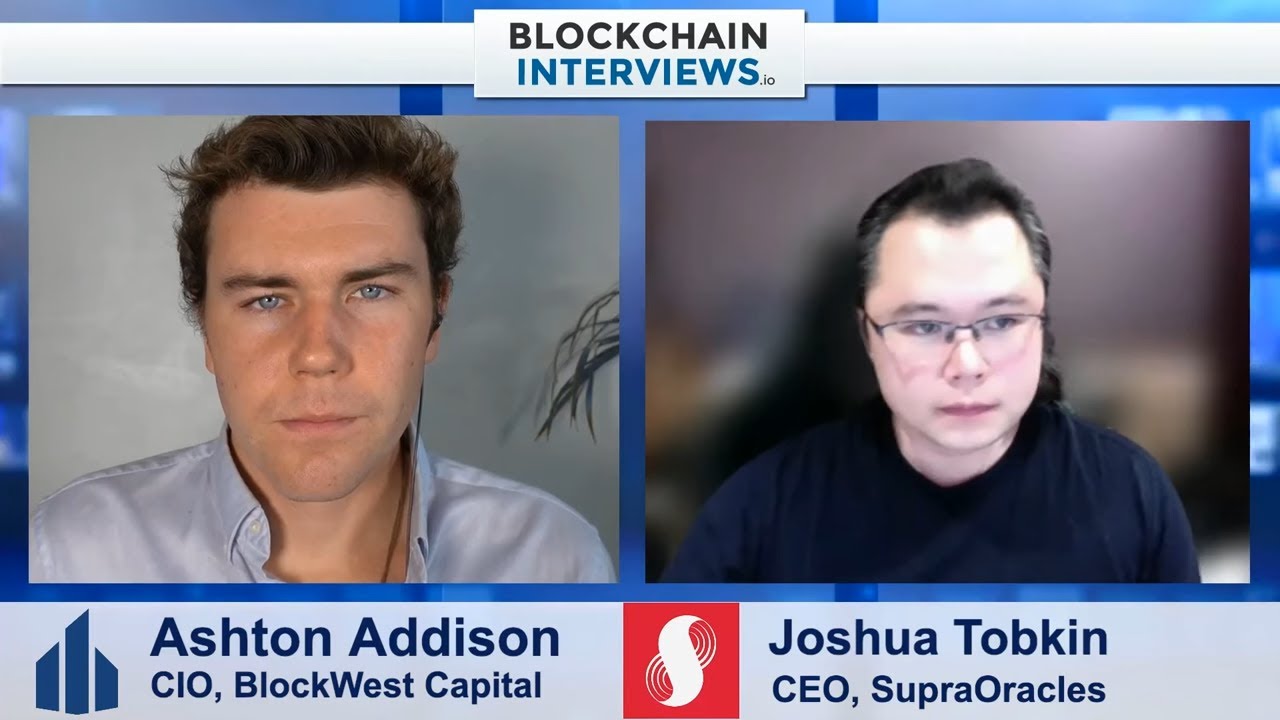
In his early interviews, Tobkin repeatedly returned to the importance of data integrity. He described the frustration of developers arriving from conventional software, proposing an application, and discovering that it required outside information their smart contract could not obtain by itself. The missing input could determine whether the proposed application worked at all.
The research record puts names and a formal problem behind that interest. Tobkin co-authored DORA with Prasanth Chakka, Saurabh Joshi, Aniket Kate, and David Yang. Accepted at ICDCS 2023, the paper examines agreement among oracle nodes receiving information from different places at different times.
Its approach uses the observation that many reported values lie close together, alongside an agreement-distance rule and a fallback when the expected cluster fails to form. The interesting question is how to reach agreement efficiently while accounting for faulty participants. It is the sort of work that turns an ordinary word, “price,” into several pages of necessary qualifications.
Waiting is an engineering problem
Data is only one part of Tobkin’s research trail. In January 2024, he appeared alongside Isaac Doidge, Raghavendra Ramesh, and Nibesh Shrestha on the Moonshot preprint. The related conference paper was published at the 2024 IEEE/IFIP Dependable Systems and Networks conference.
Moonshot concerns consensus: the process by which distributed participants agree on the ledger. Its subject is the delay between proposals and the time required to commit them. The paper presents protocols and evaluates their performance against an existing approach under a defined network model.
For a reader who has never contemplated a rotating leader, the human relevance is waiting. Applications inherit the delays of the infrastructure beneath them. Making those delays smaller requires attention to messages, timing, and failure assumptions. The mathematical vocabulary is dense because the circumstances in which agreement must hold are dense too.
Tobkin therefore occupies two visible positions in the Supra story. He is the executive explaining what the company intends to build. He is also a named collaborator in work specifying how parts of that machinery might function. The second role gives the first something concrete to discuss.
The machinery moves indoors
Supra’s Layer 1 mainnet went live on November 27, 2024. The company’s account of the launch describes a core chain running MoveVM, followed by native oracle and randomness integrations. The earlier oracle effort had become part of a broader infrastructure project.
By March 2025, Tobkin was discussing the design on Bell Curve: smart contracts, native oracles, cross-chain communication, on-chain randomness, and automation within a shared system. The conversation extended to developer incentives, governance, and the treatment of value extracted through transaction ordering.
His argument for vertical integration is that developers should be able to build using capabilities already inside the network. Each extra service an application depends on brings its own arrangements. Bringing several functions together is intended to reduce that assembly work. It also gives the network more responsibility for the result.
A conceptual sequence behind Tobkin’s AutoFi pitch. The rule and its inputs still matter.
In June 2025, Tobkin explained AutoFi as a way to execute strategies when predefined conditions are met. He also discussed Threshold AI Oracles, intended to bring AI-generated assessments into blockchain workflows. These were descriptions of the direction he wanted the platform to take. They did not remove the need to examine the information behind an automatic action.
Different stages, the same argument
Tobkin’s public conversations have involved people building quite different kinds of infrastructure. The December 2023 India Blockchain Week agenda placed him on an interoperability panel with Polygon co-founder Sandeep Nailwal, Manta Network co-founder Kenny Li, Caldera CEO Matt Katz, and Web3Auth co-founder Yong Zhen Yu.
At Permissionless in Salt Lake City in October 2024, the scheduled discussion compared modular expansion with vertical integration. The lineup included Mert Mumtaz, Kyle Samani, Nick White, and Rushi Manche. Tobkin’s proposal was being discussed alongside competing approaches, in front of the people expected to build with them.
By November 2025, another interview returned to the foundational problem of prices. Tobkin discussed data sourcing, reference pricing, anomalies, and the possible role of circuit breakers. The subject remained recognizable even as Supra’s scope expanded: what should a system do with the information it receives?
A new kind of memory
In July 2026, Tobkin and David Yang submitted a preprint called Supra Cognitive Modes: A Routed Architecture for Agent Memory. The subject had moved into AI, where a simple factual lookup and a question requiring synthesis across a long history call for different retrieval procedures.
The paper describes routing queries through different procedures over a shared memory substrate. It reports results for an implemented configuration and distinguishes those observations from claims about the causal benefit of routing. The distinction is valuable. A measured result invites examination; the explanation for that result requires its own evidence.
Read alongside the earlier papers, it supplies a continuing research thread rather than a neat final act. Tobkin keeps appearing near questions of agreement, useful information, and the machinery between an input and an action. The domains change. The need to specify the behavior remains.
The personal token challenge adds a more public expression of that habit. Its spectacle fits comfortably in a social feed; its conditions take longer to read. For understanding Joshua D. Tobkin, the time spent on those conditions is well spent. That is where the wager becomes work.
Follow the argument
Explore Supra’s website, Tobkin on LinkedIn, and his X profile.
- The 2021 conversation about the whitepaper club and Taipei
- Poker, payments, and blockchain: the 2024 interview
- DORA research · Moonshot research · Supra Cognitive Modes
- Bell Curve: vertical integration and automatic DeFi
- The June 2025 AutoFi interview · The November 2025 pricing discussion
- The personal token challenge and its conditions
- Watch Tobkin’s oracle interview on YouTube · Supra’s video channel