The bank was in trouble. The startups wanted their money somewhere else. Joshua Summers was helping them move it when an awkward detail intervened: some borrowers had promised to keep their cash precisely where they now wished it wasn't. A loan covenant, sensible in ordinary weather, had become an obstacle in a storm.
That experience during the 2023 banking turmoil helped set Summers on the path to EnFi. He had already built companies, worked through acquisitions and become an angel investor. Now the founders calling for help were giving him an unusually close view of lending's machinery. The phone calls would eventually lead to another company. First, they led to questions.
There is a pleasing inconvenience about his career: it resists the polished origin story. Entrepreneurship arrived through a layoff. Boston entered the picture through his future wife. His latest venture grew out of helping other people with an emergency. Summers keeps building businesses, but the interesting part is how often the next one begins outside the business plan.
An internet café changes the itinerary
In 2002, Summers was travelling in Thailand with Rachel, whom he would marry the following year. At an internet café, he learned by email that he no longer had a job. The dot-com bust had joined the holiday. Former colleagues invited him into a new technology consultancy, Business Innovation. He joined them, beginning the entrepreneurial career he now describes as four startups.
He is admirably unsentimental about that first company's name, calling it “terrible name” in a later recollection. Before consulting, he had studied at Carnegie Mellon, switching from mechanical engineering to industrial management and economics. After graduating in 1999, he moved to Boston with Rachel and went into financial-services projects at Sapient. The geography involved a negotiation: she was going to Boston; he was welcome to come along.
It is an origin with some useful rough edges. The degree changed. The job disappeared. A group of colleagues offered the next opening. Looking backwards, those turns form a career. Living through them would have required the less glamorous work of deciding what to do next.
First the phone, then the television
Summers's subsequent ventures put him close to changes in how people used screens. Zync, an early social-networking business using machine learning, was acquired by WHERE. WHERE developed location-based services and mobile advertising, and was itself acquired by PayPal. Summers held senior advertising responsibilities there. The businesses changed hands; the experience in making data useful accumulated.
In 2012, he co-founded clypd and became its CEO. Its territory was television advertising, where selling audiences could benefit from more automation and data. Television offered a familiar medium with a complicated commercial engine behind it. The viewer saw a programme and an advertisement. The seller had inventory, audience information, pricing decisions and a workflow to manage.
One revealing personnel decision came in 2015, when clypd appointed former Nielsen data-science executive Peter Doe as chief research officer. Summers stressed the importance of research to customers' results. It is a small detail that makes the company more concrete: this was a business requiring television knowledge as well as software, with people who understood measurement working alongside people building the tools.
AT&T's advertising business Xandr acquired clypd in October 2019. An exit is a tidy line on a biography. It also marks the end of a particular arrangement of colleagues, responsibilities and daily work. Summers would spend part of the interval before EnFi helping other founders assemble their own arrangements.
Moves to Boston
Television advertising
AT&T acquisition
Commercial credit
The investment was also an introduction
TBD Angels, which Summers co-founded in 2020, gave that interval a structure. Its members are founders, operators and executives who invest in early-stage businesses and offer practical assistance. Fundraising, hiring, strategy and introductions are all part of its stated purpose. For someone who had spent years building companies, it offered a way to remain useful between them.
The distinction matters because an investor's network can become a working relationship. Summers and Scott Weller got to know each other while co-investing through TBD Angels. Weller had co-founded SessionM, acquired by Mastercard in 2019. Both had experience taking data businesses through acquisition. They also had founders who would call them when something went wrong.
By September 2024, Summers described TBD Angels as having roughly 300 members and investments in around 80 companies. Those are dated figures, but they convey the scale of the community around the EnFi origin. The next startup emerged from people already doing things together. An introduction had time to become trust before it became a co-founder relationship.
Four dozen conversations before the pitch
When the banking crisis exposed those restrictive cash arrangements, Summers and Weller began asking lenders about their work. They held roughly four dozen conversations across private and institutional lending. The questions expanded from covenants to underwriting, origination and what happened after a loan was made. They were still investigating when a product thesis began to take shape.
“With every company I've started over the years, I wish I had done this.”
Joshua Summers, on discovery before selling
That sequence gives EnFi's formation its particular character. Experienced founders could have arrived with a product and a presentation. Instead, Summers valued being able to listen before having something to sell. Once there is a product, every conversation carries the temptation to defend it. At this stage, the awkward details could still change the idea.
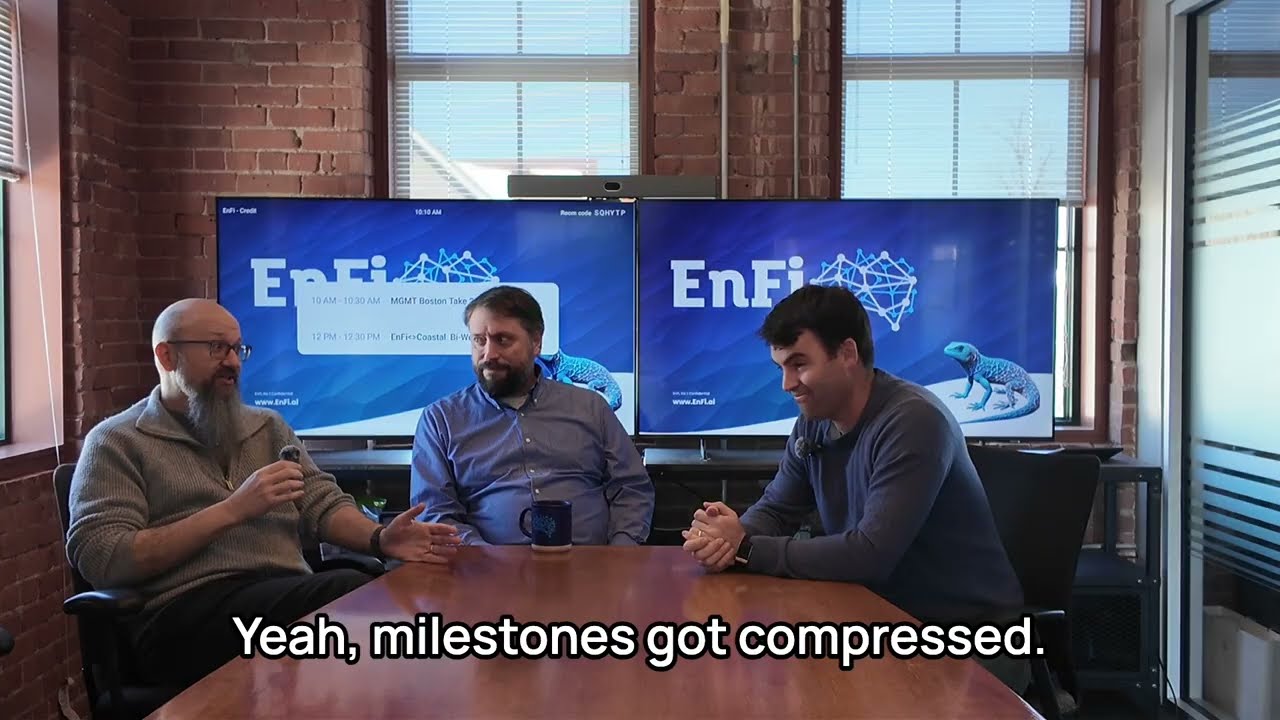
EnFi was founded in 2023 by Summers, Weller and Michelle Breitman Hipwood. Summers became CEO, Weller CTO and Hipwood CFO. Hipwood had led finance at clypd through its acquisition. Their shared history supplied continuity, while the new company asked them to apply it to a different kind of work.
A credit desk has only so many hours
EnFi's early backers made a case around the amount of work lenders needed to do. Unusual Ventures led its $7.5 million seed round in 2024, pointing to the burden of gathering information, assessing it and monitoring loans. The opportunity was tied to a shortage of experienced people able to carry out that analysis.
For Summers, the pitch now centres on capacity. A smaller bank can have demand for loans and still struggle to process the applications. Reviewing documents, checking financial information and preparing an analysis takes staff time. In a February 2026 interview, he argued that AI agents could help smaller institutions compete by expanding what their credit teams can handle.
That month, EnFi announced a $15 million Series A led by FINTOP, bringing total funding to $22.5 million. Patriot Financial Partners and Commerce Ventures joined existing investors Unusual Ventures and Boston Seed Capital. The investors' combined networks span more than 150 financial institutions. That is a distribution opportunity, rather than a count of EnFi customers.
$22.5M total company funding announced by February 4, 2026.
The current platform covers work from document intake to credit memos and ongoing monitoring. Summers is selling into institutions where the usefulness of a result depends on its details. A credit professional needs to understand what an analysis says and how it was reached. Producing more output creates value only if someone can put it to work.
The CEO has a backlog, too
Summers's public writing becomes particularly engaging when the grand discussion of AI meets office chores. In one post, he described spending hours on board slides and asked for a tool that could handle the final formatting properly. He valued the communication. He wanted to spend less time polishing the deck. Even a company building AI has slides that refuse to align themselves.
Elsewhere, he described EnFi engineers using Claude Code to tackle accumulated development work: refactoring, small features and interface improvements. The team was identifying tasks suitable for more independent execution. That is a recognisable operating question beneath the fashionable vocabulary: which neglected jobs can now get done, and how much supervision do they require?
His interest also extends to using AI to question the company's own analytics. He has written about connecting Honeycomb data to Claude Code so employees can investigate platform activity and usage. These are experiments inside the business, alongside the product sold to lenders. They give his arguments about changing work a practical place to be tested.
By May 2026, he was writing about how agents might alter enterprise software itself. His emphasis fell on context: agents need information with meaning, relationships and provenance. A task can fail when the necessary context is missing. It is a concern consistent with someone selling analysis into credit, where a neat answer is a beginning and an explanation still has to follow.
Experience, with the instruction manual open
Summers has also questioned the comfort of being experienced. In a post about building his fourth company, he acknowledged the advantages of relationships and pattern recognition, then challenged the assumption that familiar organisation charts and development sequences still applied. His earlier companies give him useful knowledge. EnFi requires him to keep examining which parts remain useful.
Outside work, his interests include environmentally friendly home construction. He talks about family and community as well as companies, and has made workplace culture part of his approach to building them. Former colleagues joining another venture are a tangible connection between those concerns. A new company asks people to commit their time again.
The thread through Summers's career is easiest to see in those repeated commitments: colleagues starting a consultancy, operators forming an angel group, investors becoming co-founders, lenders explaining a frustrating process. His work has moved from mobile advertising to television to credit. The next useful question has often come from someone he already knew well enough to help.