The Off-Market Reformer
Josh Stech's Stanford honors thesis didn't examine the 2008 subprime crisis from an economist's comfortable distance. It tracked how the collapse reverberated through remittances back to Latin America - the specific money flows that dried up when Latino families lost their homes. That's not the kind of research that leads to a consulting career. It leads to Las Vegas.
He moved there in 2009, when the housing market was still on the floor, and started buying homes at bank auctions. Not flipping one or two to test the waters - he bought and renovated hundreds of houses in his first two years. He was also lending money to other investors doing the same, effectively building a private credit operation before "private credit" became a buzzword. When he eventually totaled up the activity at Purpose Built Investments, his first formal real estate fund, the number came to 1,200 transactions.
"I wanted something that got everybody the best outcome while creating transparency in what has been historically a pretty opaque market."
- Josh Stech, Co-Founder & CEO, SundaeThe pattern Stech kept confronting was the same one that made his thesis so unsettling to write. Homeowners who needed to sell fast - because of divorce, or a job loss, or because the house had gone past the point where they could afford to fix it - had exactly one option: the off-market. And in the off-market, they were alone with whoever showed up first, usually a wholesaler offering something well below what a competitive process would have yielded. There was no auction. No transparency. No way to know if the first offer was the best offer. It was just a transaction that happened, and the homeowner walked away with less.
Stech spent five years at LendingHome - now known as Kiavi - as Founding Partner and SVP of Sales, watching the same dynamic at scale. LendingHome became the largest institutional bridge lender in its category, reaching 350 employees and $150M in venture capital. The company had built something real. But the problem of the homeowner sitting on the other side of these deals, with no visibility and no competition working in their favor, remained unsolved.
Before founding Sundae, Stech ran a company called Just Be The Bank - a private-lending education business where he conducted more than 20 workshops teaching over 500 people how to become real estate lenders. That's not a side hustle; that's a man who understands the full capital stack of residential real estate well enough to teach it from scratch. It's also where he built the investor network that would later power Sundae's marketplace.
In 2018, he co-founded Sundae with Andrew Swain, who had been CFO at Airbnb. The combination was deliberate: deep real estate operator instincts paired with Silicon Valley finance architecture. The pitch was simple enough to fit on a napkin. Homeowners with properties that need repairs list on Sundae. Thousands of qualified local investors see those properties and make competitive offers in an auction format. The homeowner picks the best one. No showings, no repairs, no commissions, and - critically - a real competitive process for the first time.
Stech's framing for the category is characteristically precise: "a marketplace for houses that need love." That's not marketing softness. It's a boundary condition. Sundae operates specifically in the segment - roughly 13% of all U.S. home sales - that trades off-market to investors. Stech has been explicit about what Sundae is not: "Sundae is never going to get in the business of fixing up homes." The platform connects and competes. It doesn't renovate.
"Every homeowner deserves a competitive and transparent process when selling their home."
- Josh StechThe investors backed the thesis hard. By July 2021, Sundae closed an $80M Series C co-led by Fifth Wall and General Global Capital, with participation from QED Investors, Wellington Management, Susa Ventures, Founders Fund, and First American Financial. Total funding exceeded $135 million. Forbes named Sundae one of America's Best Startup Employers in 2024.
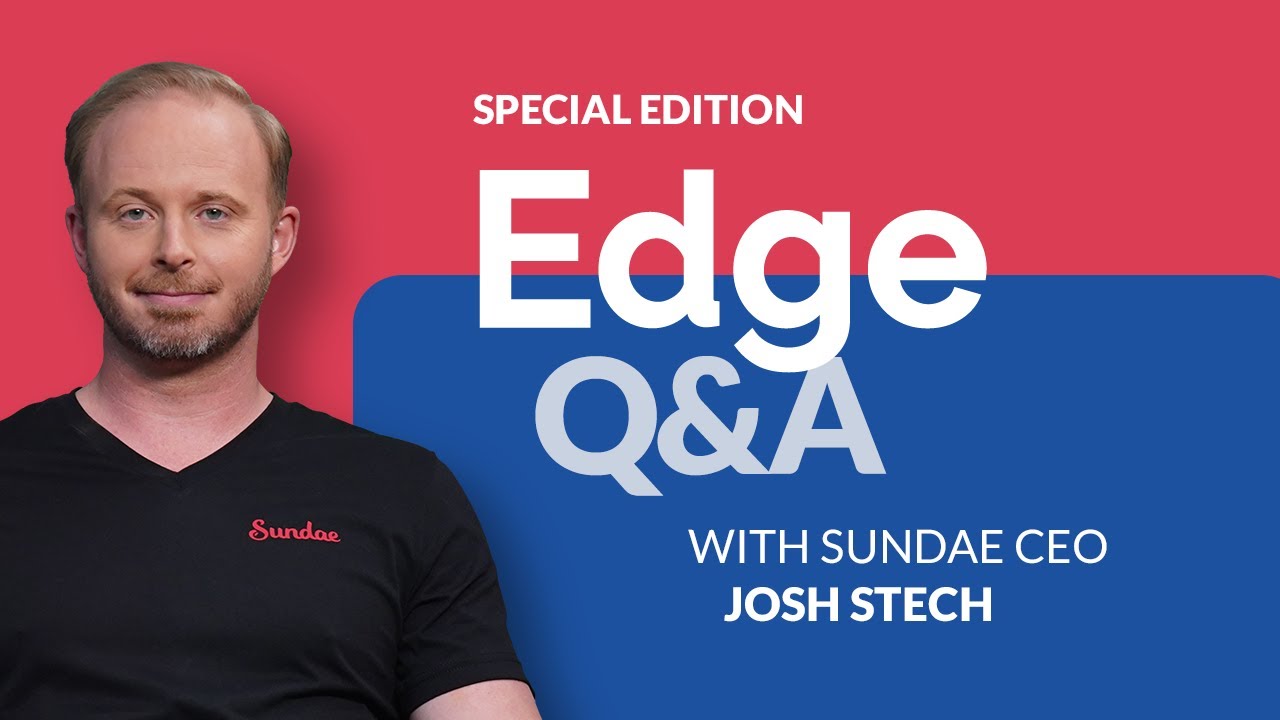
Stech's instinct for product expansion tracks the lifecycle of a distressed property deal. Sundae Funding launched in 2022 to provide direct lending to investors. Edge, a premium investor membership, added AutoOffer bidding and education tools. The roadmap beyond that - construction curriculum, purpose-built insurance, a construction materials marketplace, even a labor marketplace with RFP functionality - maps directly to every friction point that comes after a distressed home is purchased. Sundae isn't building a listing platform. It's building the infrastructure for an entire market segment.
There's a fundraising principle Stech has shared publicly that says as much about his communication style as anything else: "If you're explaining, you're losing." He doesn't belabor the problem or the solution. He lets the numbers do it. 1,200 transactions. $150M in venture funding at LendingHome. $138M raised at Sundae. Those facts require no explanation.
The company Stech has built sits at an uncomfortable intersection that most founders avoid: it serves people in distress without being extractive. It serves investors without being purely mercenary. It has managed to build a business model where the homeowner's best outcome and the investor's best opportunity are the same transaction. That's the structural bet at the center of Sundae - and so far, the market has agreed it's worth making.