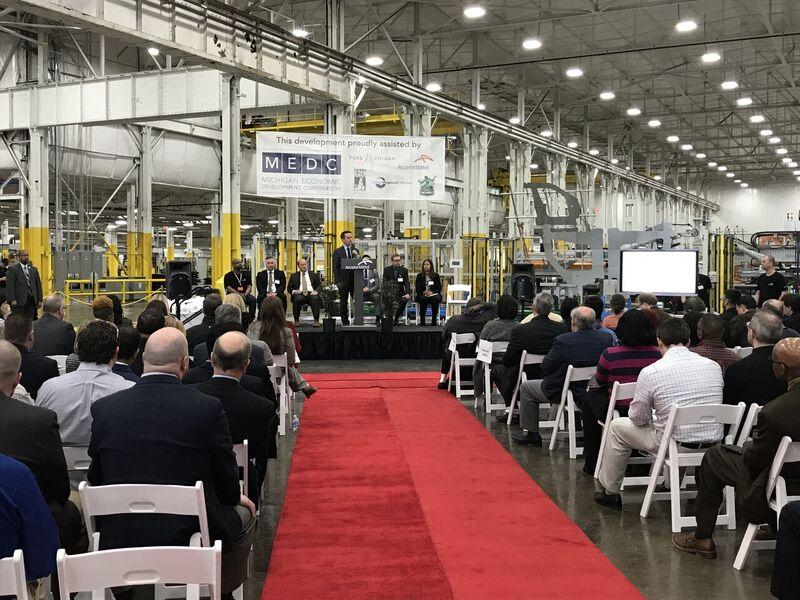
A factory opening has excellent manners. The chairs face the same way. The speeches have endings. Someone has remembered the scissors. In the photograph from ArcelorMittal’s Detroit opening, a red carpet runs between rows of white folding chairs, with industrial equipment rising behind the stage. For an afternoon, manufacturing has made room for ceremony.
Josh Hundt was among the officials who joined that celebration in 2018. The company’s $83 million Tailored Blanks operation made high-strength, laser-welded steel blanks for automakers. It employed more than 80 people at the time of the announcement. Detroit’s proximity to customers, its workers and government support had helped bring the investment there.
The photograph catches the easy-to-see part of economic development. Hundt’s career offers a view of the less photogenic part: the conditions that make a factory possible, the competition that can send it elsewhere, and the questions that follow when taxpayers help pay. A ribbon is wonderfully cooperative. A development project has considerably more opinions.
Before Lansing’s meeting rooms, a catcher’s mitt
There is an earlier, smaller scene in Hundt’s public record. On May 6, 2005, Hope College was playing Olivet. Hope entered the ninth inning tied at seven, then scored three runs. In the bottom of the inning, Josh Hundt went in at catcher. Olivet put two runners on base; a foul out to the catcher supplied one of the outs. Hope won 10-7.
The box score provides a pleasingly ordinary detail about someone usually encountered through a title. He was a college baseball player, participating in the unglamorous business of finishing an inning. Hope’s 2005 spring guide listed him as a junior catcher; the following academic year, Joshua Hundt appeared on the conference academic honor roll.
It would be tempting to make catching explain everything that came after. That would ask rather a lot of one foul ball. What the record does establish is a Michigan education followed by a Michigan career. Hundt graduated from Hope in 2006 and earned a master’s in public administration at Western Michigan University. His LinkedIn education listing dates the Western Michigan period to 2009-2011.
A map becomes a working day
By April 2012, Hundt had been promoted to senior regional project manager at MEDC, handling business and community development projects in West Michigan. That description matters. His early work covered both businesses and the places around them. A company’s expansion and a community’s redevelopment might appear on separate forms, but they occupy the same map.
In the years that followed, his responsibilities expanded. A 2017 Michigan Strategic Fund meeting packet identified him as vice president for business development projects. He joined MEDC’s executive team that year and later served as chief business development officer. In 2022, the organization’s functional chart placed him over strategic accounts and projects.
Those titles chart a move from regional delivery toward statewide decisions. They also describe an occupation with an unusual constituency. Company executives need an answer. Local partners need a workable project. A board needs enough detail to vote. Legislators need to understand the public commitment. Each audience can reasonably want something different from the same conversation.
Hundt’s present title is Senior Vice President, Account Strategy & Growth. His work includes strategic initiatives, business growth opportunities, project management and counsel to MEDC’s marketing and growth team. He also represents the organization in board, legislative, business and media settings. The career has brought execution and explanation increasingly close together.
The land has to be ready first
Industrial property can look available long before it is useful. A parcel may need a boundary survey, suitable zoning, a clearer title, soil information or environmental investigation. A photograph of an empty site answers almost none of those questions. The attractive expanse of land comes with a substantial reading assignment.
The Build Ready Sites program addressed that problem. In November 2020, ten Michigan industrial sites received $728,500 in grants, with $1.3 million in local matching funds expected. The money could support studies, land assembly and other preparation. Hundt publicly framed the work around improving the state’s inventory of sites able to compete for business.
The examples were concrete. At Eastern Market’s Superior Street area in Detroit, a $75,000 grant supported assessments and title work. Ecorse’s former steel-mill site needed contamination evaluated and addressed. In Dorr Township, utilities and roads were part of making a proposed sustainable business park investable.
These are useful windows into Hundt’s profession because they put ambition beside a task list. A state can advertise its manufacturing history all day; a company still needs to know what lies under the soil and whether the site can support its operation. Hundt has helped develop programs intended to get such questions answered earlier.
and boundaries
and conditions
and permitted uses
The factory needs people who can use it
Land is only one part of readiness. In discussions of manufacturing investment, Hundt has repeatedly returned to workers. He has described talent as an issue that appears throughout the projects MEDC considers, pointing to recruitment, training and retraining as practical parts of competing for business.
That emphasis became explicit in the 2021 Talent Expansion Initiative. Hundt spoke about a shrinking talent pool and a mismatch between available workers and employers’ needs. The initiative included regional grants for organizations providing training and employment support, with priority for people from low- to moderate-income backgrounds.
There is an important distinction inside that approach. Having jobs announced does not automatically make workers ready for them. People need access to training; employers need skills suited to their operations. Bringing those two sides together takes more than putting a vacancy on a website and hoping the right person happens past.
The same issue appears in his work on Industry 4.0, the introduction of connected and digital manufacturing tools. In early 2021, he reported that only 12 percent of Michigan’s small and midsize manufacturers had adopted those technologies. His concern was about resilience as well as adoption. A new machine changes very little if a business cannot put it to productive use.
“Talent is something that comes up in every aspect”Josh Hundt, discussing manufacturing projects
Ninety-nine sites, and no guaranteed ending
In March 2024, Hundt described the search that brought Fortescue’s proposed advanced manufacturing center to Detroit: 99 sites across twelve states. The company chose a former Fisher Body plant on Piquette Avenue. He discussed labor availability, operating costs and speed to market as parts of the decision, alongside the existing industrial community.
The appeal, in his telling, was to take accumulated automotive experience and “build a bridge to the future.” The proposed reuse gave that idea an address. His explanation extended beyond the plant to suppliers, tax revenue and nearby restaurants and venues. He was describing the wider effects he expected from investment, rather than simply counting the building itself.
Competition also produces losses. In 2023, Michigan offered roughly $280 million in incentives while pursuing a Joby Aviation manufacturing plant for Detroit’s city airport. The company chose Dayton, Ohio. Hundt said he was unsure what had determined the choice. He pointed to Michigan reaching the finalist stage, while acknowledging the competitive process.
That episode gives the career some necessary texture. An incentive package can be large, a location can have industrial strengths, and another state can still win. It also makes diversification more tangible: Hundt was pursuing an aircraft manufacturer as part of a broader future-mobility strategy. The work involves trying to extend Michigan’s capabilities into markets whose decisions the state cannot control.
The other room where projects are tested
A factory stage and a legislative committee room offer different sorts of hospitality. On June 11, 2025, Hundt and MEDC executive Christin Armstrong faced questions from Michigan House oversight subcommittees about Ford’s Marshall battery project. Lawmakers challenged the state’s support and the licensing arrangement with Chinese battery company CATL.
Hundt argued that access to battery technology could help Ford compete and create work in the United States. Committee members questioned why the automaker had not partnered with companies from other countries. The exchange exposed a basic pressure in his job: industrial competitiveness, public spending and foreign-policy concerns can arrive at the same table.
There was separate scrutiny around Global Link International’s $20 million legislative grant. A September 2025 court filing said the attorney general had identified MEDC chief executive Quentin Messer as a potential target and possibly Hundt as well. That wording was a statement about an investigation, not a finding of wrongdoing.
In May 2026, the attorney general announced sixteen felony charges against grant recipient Fay Beydoun, alleging theft and fraudulent administration of the funds. The announcement said the investigation remained ongoing. The charges described there were against Beydoun, who is presumed innocent unless proven guilty. For Hundt’s career, the episode places public grant administration alongside the investment-attraction work that usually supplies its photographs.
What remains after the chairs are stacked
Hundt’s working relationships extend beyond MEDC. Automation Alley lists Joshua Hundt on its board’s executive committee. In an energy webcast, he appeared alongside ITC Michigan’s Simon Whitelocke, Detroit Regional Partnership’s Maureen Krauss and Consumers Energy’s Brian Rich. The company deciding where to build needs a community of institutions capable of working together.
Across his public work, the recurring ambition is to carry Michigan’s manufacturing knowledge into new uses. The scope includes sites, training, technology and investment. Those subjects are connected in practice: prepared land is more valuable with workers nearby; a skilled workforce has more opportunities when businesses invest; existing suppliers give new manufacturers reasons to consider the region.
His career is therefore best read through the projects and programs that have occupied it. The early regional assignments, the site-preparation grants, the talent initiatives and the contested industrial deals show the range of decisions behind a seemingly simple announcement. They also give the public concrete things to judge: preparation completed, commitments kept and money accounted for.
Return to those folding chairs in Detroit. The ceremony celebrates a decision that has become visible. Its usefulness will be measured later, through the operation and the work it sustains. Hundt’s profession continues after the guests leave, in follow-up meetings, board decisions and questions about results. The scissors, having performed their sole contractual obligation, can go back in the drawer.
Continue the conversation
- MEDC leadership biography
- Josh Hundt on LinkedIn
- Fortescue interview, March 2024
- Build Ready Sites announcement
- Talent Expansion Initiative
- ArcelorMittal Detroit opening
- Hope College game record
- Joby competition, October 2023 (PDF)
- Marshall hearing, June 2025
- Global Link court filing, September 2025 (PDF)
- Attorney general announcement, May 2026
- Energy discussion webcast listing
- Automation Alley board
- MEDC website
- MEDC on X
- MEDC on Facebook