The cosmetic counter is a theatre of adjectives. Creams promise to brighten, smooth, firm, renew and rescue. Bottles gleam under obliging light. Labels speak fluent confidence. Then, somewhere away from the mirrors, José Luis Mullor asks the impolite question: does the thing do what the sentence says?
That question became a company. Mullor founded Bionos Biotech in Valencia in 2013 after years in academic research and after establishing his own laboratory in 2005. Bionos works in the unglamorous but decisive space between a promising ingredient and a marketable claim. Its scientists design efficacy studies, test active ingredients and finished products, quantify changes, and turn the results into reports that product teams can act on.
The business is built around translation. A marketing team may want to say that a product improves a visible quality. A scientist must decide what can actually be measured, under which conditions, against which comparison, and with what level of confidence. Between those two conversations lies an entire industry of wishful thinking. Mullor chose to put a laboratory there.
01 · The useful frictionA scientist learns to stop polishing
Mullor’s move into entrepreneurship exposed a quarrel between two respectable instincts. Scientists are trained to remove uncertainty. Founders are trained to move while uncertainty is still making itself comfortable. In an early interview about building Bionos, he observed that scientists struggle to start companies because they are educated to make the product perfect.
Perfection is excellent company in a controlled experiment. It can be an expensive houseguest in a young business. Customers arrive before every process feels finished. A proposal needs writing. A trade fair needs staffing. Someone must explain a complex method without emptying the room. There are invoices, deadlines, hires, and the peculiar founder duty of knowing which small fire deserves the only extinguisher.
His answer was not to weaken the science. It was to broaden the scientist. “To start a business, you have to be willing to do a little of everything,” he said. The line is almost comically modest for a career change. Yet it captures the shift exactly: from depth as a complete job to depth as the anchor for a much wider one.
The claim-to-evidence loop
02 · Evidence as a productThe laboratory report earns a business model
Bionos took a service that could easily feel bespoke and slow, then gave it commercial edges. Studies are tailored to a client’s question, but the company presents a normal turnaround of four to six weeks. Continuous feedback is part of the offer. The report is not meant to disappear into an archive; it is supposed to help a team choose a claim, improve a formulation, or decide whether an ingredient deserves another round.
The scale accumulated quietly. Bionos now lists more than 1,750 products and ingredients tested, more than 800 scientific reports completed, and more than 135 international clients. Those numbers do not describe one grand discovery. They describe repetition - the underrated craft of asking a slightly better question on project 801 because project 80 taught the laboratory where confusion tends to hide.
This is the practical beauty of a research service: evidence compounds as operating knowledge. One client pays for one answer. The laboratory keeps the scar tissue of having learned how to find it. Over time, the company becomes valuable not merely because it owns instruments, but because its team recognizes the difference between a technically impressive study and a useful one.
When an industry becomes crowded with claims, build the evidence layer. Make it rigorous enough to trust, quick enough to change a decision, and collaborative enough to test the right question.
03 · Fifty live questionsTrade fairs as field research
In 2017, Mullor and colleague David González took Bionos to in-cosmetics Global in London. A scientific director at a trade show can behave like a lecturer with a lanyard. Mullor treated the floor as a listening device. The pair spoke with more than 50 potential clients about what they needed and where existing studies fell short.
His comment afterward joined sales and research in the same breath. Direct contact offered a first-hand view of each company’s needs, he said, which would help Bionos stay at the front of study development and keep the service tailored. The booth was not simply a place to explain a portfolio. It was a temporary observatory for unanswered commercial questions.
That habit explains much of Mullor’s public thinking. A market does not contaminate research merely by having needs. It can sharpen research by revealing which unknowns block a real decision. The danger arrives when the desired claim dictates the result. The opportunity arrives when the desired claim is converted into an honest experiment.
04 · Two clocksWhat universities have that companies lose
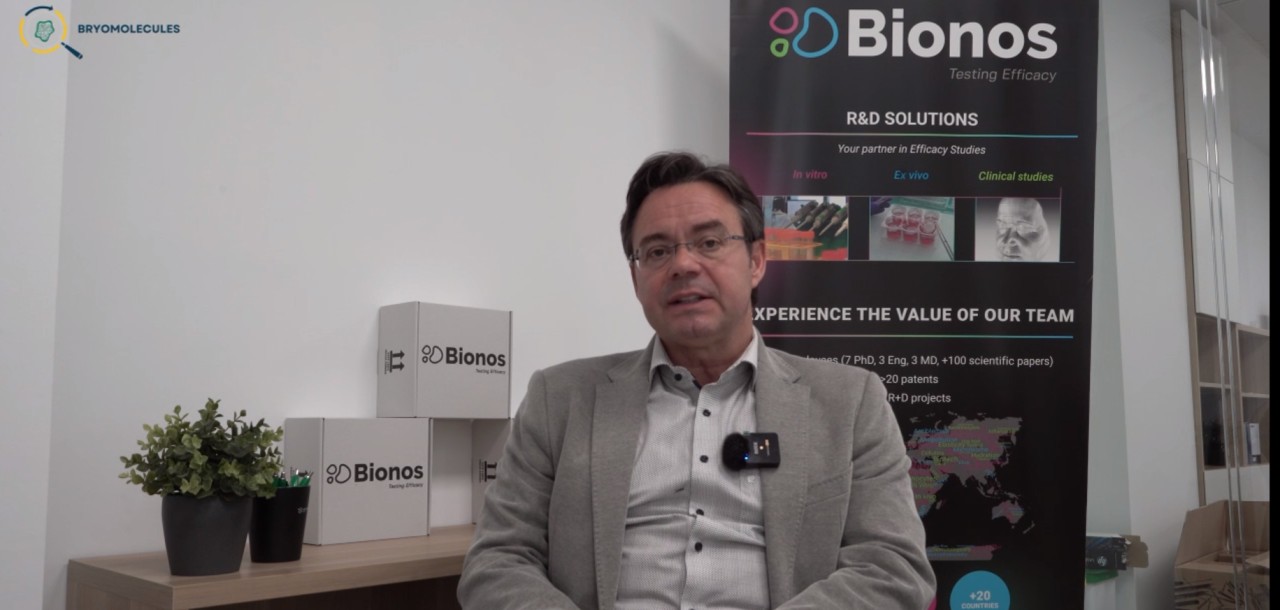
In the Bryomolecules interview, Mullor described another tension with the precision of someone who has occupied both sides. Academic laboratories have people focused on research. They can read, think, and develop ideas without every hour being interrupted by the operating demands of a company. Businesses have customers, production costs, safety requirements, scale constraints, and very little empty calendar.
Each side is missing something the other takes for granted. Researchers may not know whether an elegant compound can be made at a viable cost. A company may know exactly what the market wants but lack the time, equipment, or scientific depth to discover a credible route there. Mullor’s preferred answer is not a ceremonial partnership. It is repeated contact across many laboratories and many projects.
Bionos has made this bridge part of its routine. Mullor has participated in European collaborations involving microalgae, natural compounds and industrial testing. He has remained connected to doctoral education as a thesis director. The company receives ideas and extracts from research partners, then examines functionality, practical fit and whether the result belongs in a conversation with the cosmetic or food industry.
The metaphor is a bridge, but the daily reality is closer to a customs desk. Ideas cross from one territory to another only after someone checks the paperwork: Can it scale? Is it safe? What does it cost? Which property matters? How will it be measured? Mullor’s career has been spent making that border less theatrical and more useful.
05 · ContinuityThe company grows beyond its origin story
Bionos began as a spin-off linked to Valencia’s Hospital La Fe research environment. In 2023 it entered a larger chapter through its acquisition by LabAnalysis. Public corporate records show Mullor continuing on the board and serving as secretary, while his current title remains founder and chief scientific officer. The ownership changed. The scientific question stayed put.
That continuity matters because founder stories often become trapped in the romance of the first year. Mullor’s more interesting work happened after the origin story: hiring teams, widening the test portfolio, producing hundreds of reports, sustaining international collaborations, and remaining in the room when the organization gained a larger corporate frame.
There is also a measured stubbornness in his path. A public professional recommendation describes him as reflective, persistent, results-oriented and resilient. Such adjectives are usually fog. Here they match the architecture of the work: a founder who made measurement his product, stayed close to academic research, and continued adjusting the commercial machine around it.
The academic thread never vanished beneath the company paperwork. A 2025 congress biography credits Mullor with more than 40 scholarly articles. He is a named inventor on an international patent assigned to Bionos, and the Universitat de València lists him among external doctoral directors in biomedicine and biotechnology. One industrial thesis completed under his direction carries a neat symbol of his hybrid career: a university document certified by the chief executive of a biotechnology company.
This is more than résumé symmetry. Directing a thesis demands patience with a question that may take years. Running a testing business demands answers within weeks. Mullor has kept a foot in both tempos. The combination helps explain why he talks about research and profitability as neighboring disciplines rather than opposing camps. He knows the luxury of following a difficult question, and he knows the invoice will not wait for philosophical closure.
06 · The plain questionProof has better manners than hype
The most transferable lesson from Mullor is not that every scientist should become a founder. Many sensible people have avoided that conclusion. It is that a commercial claim becomes more useful when someone is willing to reduce it to a testable sentence. This requires humility from the marketer, imagination from the scientist, and enough trust between them to accept an inconvenient result.
Mullor has argued that researchers need more awareness of profitability, production and customer needs. He has also argued that companies need academia’s depth and protected thinking time. Both ideas resist a familiar vanity: the belief that one profession owns the entire route from insight to shelf.
Bionos occupies the middle with instruments, assays, volunteers, reports and deadlines. Its work is exacting without needing to be grand. The client arrives with a promise. The laboratory turns it into a question. The result returns with fewer adjectives and more value.
On a crowded cosmetic counter, that may be the rarest formulation of all.