A new company needs a name. Edward Lanphier had one in the family already. When he founded Sangamo BioSciences in 1995, he reached back to Sangamo Electric, the Illinois company his great-grandfather had helped establish. He liked its logo and asked his father about using the old identity again. His father’s answer was uncomplicated: “That would be great!” Nearly a century separated the two businesses. A few words connected them.
It is an appealing beginning for a career usually described through job titles. Lanphier spent 21 years as Sangamo’s president and chief executive. Yet his story also passes through a Connecticut classroom, a college tennis program, a succession of corporate development jobs, and a family cottage in northern Michigan. The company occupies a long stretch of that life. The places on either side help explain its shape.
A name already in the family
Sangamo Electric was organized in Springfield in 1899. Robert Carr Lanphier, Edward’s great-grandfather, was among its founders. Its work included electrical meters and other components. The name belonged to the industrial history of the city where Edward grew up, long before it appeared on a California biotechnology company.
The revived identity brought an old-fashioned family connection into a business built around unfamiliar research. It also makes Sangamo an unusual entry in the startup naming contest. While other founders search for a word nobody has used, Lanphier chose one that people in his family had used for generations. The brand consultant, on this occasion, was Dad.
There is no need to make the two companies identical to appreciate the link. Their work differed enormously. What survived was a name and, for a time, a logo. A new enterprise could carry a recognizable piece of the family’s past without inheriting the earlier company’s machinery.
The teacher before the title
Lanphier attended Choate Rosemary Hall, graduating in 1974, and then Knox College in Galesburg, Illinois. At Knox he earned a B.A. in biochemistry in 1978. The college’s athletics history also includes him among former men’s tennis players. Before executive biographies filled his working life with acronyms, there were science courses and tennis courts.
After college, he returned to Choate to teach science from 1978 to 1980. Cameron was teaching mathematics there. They met as members of the faculty. The later partnership between Edward and Cameron has an educational beginning, quite separate from the company he would found.
One former student, writer Lee Smith, remembered a less polished detail: Lanphier nearly failed him in biology. Smith recalled being given a break and hearing, on graduation day in 1980, that biology was hardly his reason for being there. It is Smith’s account of a teacher willing to make an individual judgment. Every distinguished school building has a backstory; this one includes a narrow escape from a biology grade.
- 1978Knox degree; returns to Choate to teach.
- 1995Founds Sangamo in Richmond.
- 2000Company completes its IPO.
- 2015Choate dedicates the Lanphier Center.
- 2016Hands over the CEO role.
- 2017Leaves Sangamo’s board.
An idea needs permission to become a business
His next professional chapters were in industry. At Eli Lilly, he worked in the strategic business planning-biotechnology group. He served as vice president of corporate development at Synergen from 1984 to 1986 and at Biotherapeutics from 1986 to 1987. He later ran BioGrowth, which merged with Celtrix Laboratories in 1991.
From June 1992 to May 1997, he held senior roles at Somatix, including executive vice president of commercial development and chief financial officer. These were jobs concerned with making a business work: its finances, agreements, and commercial direction. They place the future founder close to the decisions that connect research with an organization.
In 1994 and 1995, Lanphier became interested in the work of Jeremy Berg and Srinivasan Chandrasegaran on engineered zinc finger proteins. He founded Sangamo in 1995 and joined it full-time in 1997. The overlap with Somatix matters. Starting the company and moving into it full-time were separate steps, two years apart.
Sangamo’s early strategy involved obtaining licenses from academic institutions, including Johns Hopkins, MIT, and Scripps. Over time, other university agreements added to the collection. Research was spread across institutions; a company needed workable rights to pursue it. That made licensing part of the founding work, alongside financing and recruitment.
In July 2001, Sangamo acquired Gendaq, a British company associated with Nobel laureate Aaron Klug. The acquisition added expertise and intellectual property. The business was gathering people who knew how to do the work as well as rights that allowed the work to proceed. A patent portfolio could occupy a filing cabinet. An organization had to occupy considerably more.
The arithmetic behind the ambition
Lanphier began with $750,000 raised from family and friends. Sangamo’s financing subsequently widened beyond that circle. An early $2 million Advanced Technology Program grant provided funding without issuing more shares. Partnerships became another way to support the company while putting its technology to use.
On April 6, 2000, Sangamo began its initial public offering. It sold 3.5 million shares at $15 each, raising $52.5 million gross. The figure after underwriting discounts was $48.8 million, with other offering expenses reported separately. Corporate arithmetic has a way of making even a round number arrive with footnotes.
The offering came in smaller than the ambitions described in earlier registration plans. Contemporary coverage recorded a reduction in the number of shares offered and pricing at the low end of the proposed range. Going public gave Sangamo access to a different pool of capital. It also put the company’s ambitions into numbers other people could inspect.
Lanphier continued to use partnerships in areas such as research tools and agriculture. Sigma-Aldrich and Dow AgroSciences were among the partners. The practical logic was to let a broader set of businesses use the underlying platform while Sangamo concentrated its own resources. The agreements gave a small organization a way to participate in work beyond its walls.
Two teachers, one building
On March 27, 2015, Choate dedicated the Cameron and Edward Lanphier Center for Mathematics and Computer Science. Edward and Cameron were the lead donors. They had first known the school as a workplace; now their names were on a new place of work for teachers and students.
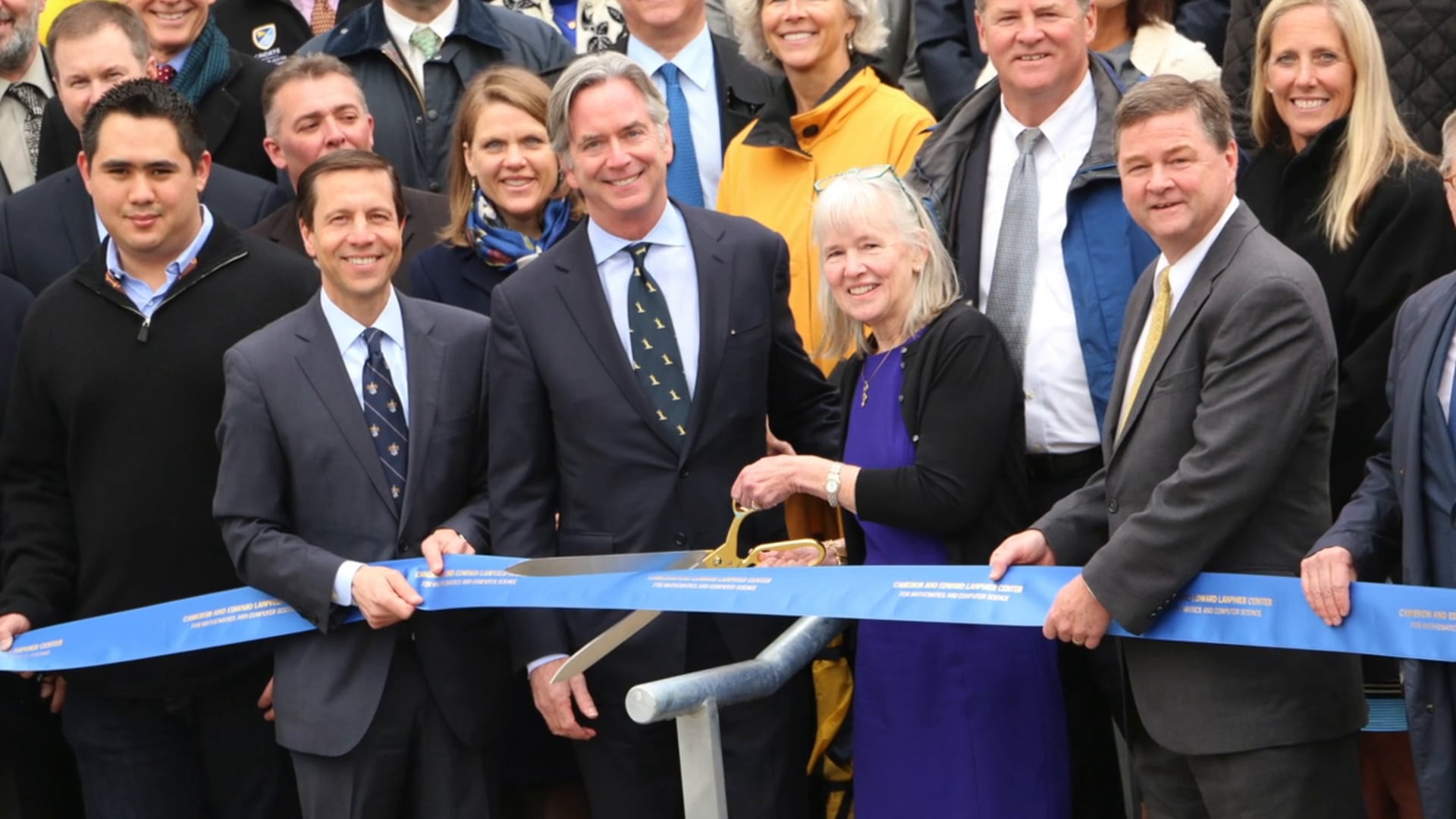
The center included an i.d.Lab, with movable furniture, bench space, and room for exploration across subjects. Its purpose extended beyond conventional classrooms. Students could work on robotics, design, architecture, and reverse engineering. It made room for the kind of activity that produces questions as readily as answers.
“This will be a wonderful gathering place where ideas can be kicked around.”
EDWARD LANPHIER / CHOATE CENTER DEDICATION, 2015
The architects, Pelli Clarke Pelli, arranged the building around the existing campus and its landscape. A mature beech tree helped shape the courtyard; a bridge connected the new center with the nearby science building. The design gave meeting and making a physical setting. Lanphier’s hope for students had acquired classrooms, a courtyard, and a front door.
How a founder hands over the keys
In June 2016, Sandy Macrae succeeded Lanphier as Sangamo’s president and CEO. Lanphier moved to the chairmanship of the board after the annual meeting that month. The announcement described a company entering another stage and a succession process discussed by its board.
Lanphier’s endorsement was direct: “Sandy is the right person to take Sangamo forward”. He stayed through a transition year, then left the board in 2017. The sequence makes room for a handover in the biography: first the daily management, then the board role, then departure.
1995–2016 · SANGAMO
Other institutions also called on his management experience. He had joined the Buck Institute’s trustees in 2012 and became its interim president and CEO in autumn 2016. Eric Verdin was named the permanent successor in November. Lanphier continued as a trustee, finance committee chair, and adviser during that transition. For a time, his working life contained two handovers moving in different directions.
The cottage becomes home
In 2014, Edward and Cameron purchased a Leelanau County cottage that had been in the family since the 1940s. They once spent the off season in Ross, California. By February 2023, a community profile described northern Michigan as their full-time home. An address associated with part of the year had become the address for all of it.
His present public profile lists Glen Arbor. The Grand Traverse Regional Community Foundation includes him among its directors representing Leelanau County. The foundation’s board provides oversight and strategic direction across a region encompassing several counties. Local work has become a visible part of his biography.
The Glen Lake Association has also acknowledged his involvement, including a term as president documented in its Spring 2022 newsletter and service on its Development Committee. Its 2024 annual report lists the Edward and Cameron Lanphier Family Trust among donors with at least $100,000 in lifetime giving. The family connection to a cottage now sits alongside a recorded commitment to the surrounding lake community.
The company’s later chapter
Sangamo’s subsequent business history has been difficult. It filed for Chapter 11 on June 23, 2026. On September 4, it completed a $50 million sale to Lilly that included its technology platforms and other assets. These developments came years after Lanphier’s departure from management and the board.
That later chapter belongs in the company’s story, alongside the earlier financing and expansion. Lanphier’s own story continues across other institutions and places. A borrowed company name remains part of it. So does a school building named for two teachers, and a cottage that became home. Follow those names and addresses, and the biography becomes a little less confined to the executive chair.
Follow the names and places
- Edward Lanphier on LinkedIn
- Sangamo’s website
- Community Foundation board
- Choate’s 2015 dedication film
- The 2019 career interview
- The family history behind Sangamo
- The 2016 leadership handover
- September 2026 asset sale
- Sangamo’s IPO figures
- Inside Choate’s Lanphier Center
- Lanphier’s Glen Lake presidency
- The Lanphier Center’s design
- Lee Smith’s classroom recollection
- The early financing history
- April 2000 IPO reporting
- Lanphier on company financing, 2010
- The move to northern Michigan
- Glen Lake’s 2024 annual report