Neil Aaronson earned a law degree and then chose a career in finance. It is an economical opening to a career that would eventually involve both: acquisitions, contracts, real estate, restructuring, and the negotiations required to get people with different interests to agree. A legal education remained on his résumé. Investment banking became his first job. The distinction matters because the story starts with a choice, before the titles and transaction values began to accumulate.
The choice after law school
Today, Aaronson is President (Americas) and Executive Director of Real Estate at Hilco Global. His remit includes the firm’s long-term growth strategy and the integration of its businesses. That is a considerable distance from analyzing an individual acquisition. It also raises a different sort of question. Once a business has collected expertise across many fields, how does it make that expertise useful together?
The career behind that question is unusually continuous. Investment banking led to Cendant, a client that became an employer. A move back to Chicago led to Hilco. Responsibility for real estate widened into responsibility across the Americas. There are promotions within those chapters, but the chapters themselves have lasted. In an industry fond of announcing the next transaction, Aaronson’s own working life has involved a good deal of remaining in place.
His education took place at the University of Pennsylvania: economics at Wharton, followed by a Juris Doctor from Penn’s law school. The combination puts numbers and agreements beside each other. A transaction needs both. A purchase price can look tidy on a spreadsheet while the obligations attached to the purchase prove considerably less accommodating. Paperwork has a gift for outliving enthusiasm.
Before the boardroom, a doubles partner
Aaronson’s story has an earlier chapter on Penn’s tennis courts. In 1995, he earned first-team All-Ivy recognition in singles tennis and in doubles with David Graziani. He also appears among Penn’s Academic All-Ivy honorees that year. Those are specific accomplishments, earned before the corporate biographies and leadership announcements.
As a senior co-captain that February, he headed to the Princeton Invitational with teammates J.J. Cramer and Brad Goldberg. The competition was a regional tournament, with singles and doubles players traveling to Princeton’s Jadwin Gym. This is a pleasingly concrete detail in a résumé otherwise dominated by institutional names: three players, a weekend tournament, and a captain still finishing college.
College competition gave Aaronson an early leadership responsibility alongside his studies. A co-captain had teammates as well as opponents, and a doubles player had a partner across the net from the same pair of rivals. In his senior year, the sporting honors and the academic recognition arrived together. The young captain already had more than one commitment demanding his attention.
The doubles honor gives the early chapter another name: David Graziani. The pair earned first-team recognition in the same year as Aaronson’s singles honor. It is a small but useful reminder that a personal résumé can hold a shared achievement. At Penn, his achievements included individual competition and a partnership with its own place in the team’s history.
A client becomes an employer
Aaronson’s early banking work at Furman Selz/ING Barings involved acquisitions, divestitures, and financing for public and private companies. He subsequently joined Cendant, where his responsibilities grew from corporate strategic development into business development for the hotel and timeshare businesses. The work concerned buying, financing, and reshaping businesses, rather than simply observing them from outside.
From 2000 to 2003, he was a vice president in Cendant’s Strategic Development Group. From 2003 to 2006, he served as senior vice president of business development. Those dates describe a progression within one organization. They also explain why a later move into a holding company could draw on more than a narrow property background: he had already worked with acquisitions across a diversified corporate group.
There is a practical change when an adviser joins a client. The acquisition that once arrived as an assignment becomes part of the employer’s continuing business. The negotiations end; responsibility carries on. That distinction provides useful context for Aaronson’s move from banking into corporate development, without requiring a claim about what he privately thought at the time.
- 2000Cendant strategic development
- 2006Joins Hilco as executive vice president
- 2008Leads Hilco Real Estate
- 2023Named Hilco co-president
- 2025Americas leadership through the ORIX transition
Chicago changes the itinerary
The turn toward Hilco began with a family reason for returning to Chicago and an introduction to Jeffrey Hecktman, the firm’s founder. Aaronson recalled the meeting with a short sentence: “We hit it off immediately.” He has spoken appreciatively of Hecktman’s mentorship and trust. The move had a personal cause and a professional consequence, which is often how careers actually change.
Aaronson joined Hilco as an executive vice president in 2006 and became CEO of Hilco Real Estate in 2008. His real estate work grew to encompass lease advisory, international brokerage, asset management, and receivership. These activities approach a property from different directions: the terms on which it is occupied, the market in which it can be sold, and the responsibilities involved in managing it.
A building is a physical object with a surprisingly crowded administrative life. An owner, a tenant, a lender, and a potential purchaser may all be interested in the same address for different reasons. A lease can be central to one party’s business and a constraint on another party’s plans. That is why a real estate practice can include several kinds of expertise without changing the street on which the asset stands.
Aaronson’s work has covered retail, restaurants, industrial property, hospitality, and offices. The variety matters more than an extravagant adjective attached to the portfolio. Each category poses different operational questions. The ability to negotiate a property transaction and the ability to understand the business using the property sit close together, but neither automatically supplies the other.
Seven stores make the work tangible
Copper Property CTL Pass Through Trust offers a concrete example of the real estate responsibilities. Aaronson serves as its principal executive officer. The trust was established to acquire 160 retail properties and six warehouse distribution centers from J.C. Penney’s reorganization and sell its assets. Here, the work can be described in addresses, leases, proceeds, and continuing obligations.
In September 2022, the trust announced sales of seven JCPenney retail locations for $65.2 million through three all-cash transactions. Five properties in Delaware, Maryland, and Virginia accounted for $53 million. Two further sales accounted for $12.2 million. Hilco JCP, an affiliate of Hilco Real Estate, and Newmark represented the trust.
Those numbers describe the trust’s transactions, rather than Aaronson’s personal wealth or a solo accomplishment. They also reveal something that the word “dealmaker” can conceal. Seven properties were sold through three transactions, with different lease categories and different prices. A portfolio supplies a convenient collective noun; the work underneath it retains all the particulars.
The example is useful because it makes a broad career legible. Real estate leadership can sound abstract when expressed entirely through titles. A named portfolio and a dated set of sales provide scale without turning an executive into the solitary author of everything his organization does. There are other professionals in the transaction, and the result belongs to the process they completed together.
Bars show each group’s share of the $65.2 million total. Historical trust sales, not personal earnings.
“We’re a team with a deep bench.”Neil Aaronson
Twenty-plus businesses, two divisions
In December 2023, Hilco appointed Aaronson and Henry Foster co-presidents. Aaronson retained the real estate CEO responsibilities while adding a wider assignment at the holding company. The appointment included company-wide initiatives, cooperation among operating businesses, and membership of the investment committee. A career built around transactions had acquired an organizational brief.
The geographic responsibilities were subsequently expressed as Aaronson’s presidency for the Americas and Foster’s presidency for the UK, EU, and APAC. The distinction helps keep the scale of Aaronson’s job clear. Hilco is a global business; leadership is distributed. The responsibilities of a president sit alongside those of divisional chief executives and the founding chairman.
In September 2025, after ORIX USA’s majority acquisition, Hilco announced a structure that brought more than twenty operating companies into two divisions: Professional Services and Capital Solutions. Advice and asset expertise would sit beside investing and lending capabilities. Aaronson continued as president for the Americas, with integration forming a central part of the assignment.
A chart can make this change look wonderfully clean. Two boxes occupy less space than twenty. The everyday task is harder: getting the right knowledge to the right decision, deciding where capital is useful, and making cooperation possible across businesses with their own histories. The organizational drawing describes the arrangement. It does not perform the work.
The distinction between the divisions is useful to a reader as well as a client. Advice helps establish what a situation requires. Capital helps fund a course of action. They can be relevant to the same business problem, and the new structure is designed to make their coordination easier. Aaronson’s career now places him near the junction between those functions.
Valuation, restructuring and specialist advisory work
Asset-based private credit and principal investing
Two divisions announced September 2025. Aaronson continued as President for the Americas.
The next question is how to grow
Aaronson’s public conversations since the ORIX transaction have concerned the next phase of the business. In December 2025, he appeared in a video interview with ABL Advisor publisher Michael Toglia about Hilco’s new operating model and its relationship with ORIX USA. In April 2026, he discussed commercial real estate lending with Institutional Real Estate, Inc., including underwriting and the lending environment.
Those subjects return the story to its original pairing of financial analysis and obligations. Lending against real estate requires attention to the asset, the structure of the transaction, and the conditions under which repayment must happen. The interview topics place Aaronson’s present responsibilities in that practical setting. Growth requires decisions about individual opportunities as well as decisions about the organization pursuing them.
He has described ambitions to add services and broaden Hilco’s geographic presence. These remain plans, rather than completed achievements. The important question for his next chapter is how the expanded firm turns its collection of expertise into work that clients can use. More capability creates more possible connections; management has to make the useful ones happen.
For all the institutional scale, one small sentence from his account of Hecktman’s mentorship remains unusually personal: “Hopefully, I’m continuing to make him proud.” It brings the story back to an introduction in Chicago and a relationship that continued as the responsibilities expanded. Aaronson’s career contains substantial transactions. It also contains a client that became an employer, a founder who became a mentor, and a long stay that kept producing a different job.
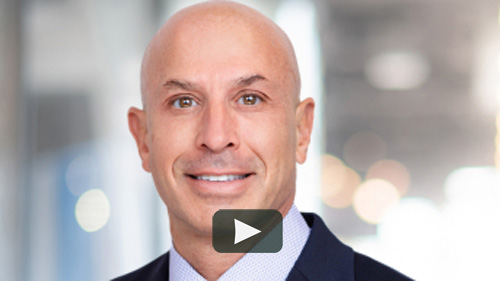 Watch the conversation ↗