An invention can have an awkward relationship with its inventor. The person who helped create it may know its history, its peculiarities and the questions it leaves unanswered. The rights to develop it, however, can belong somewhere else. For Jose M. Galarza, that distinction became a central part of the move from scientist to company founder. His work at Wyeth would acquire another institutional home: TechnoVax.
The hinge in this story is a licensing agreement announced in December 2006. TechnoVax obtained rights to a patent application rooted in research Galarza had conducted as a principal scientist at Wyeth. There was a scientific idea, a company prepared to pursue it and a legal arrangement connecting the two. The paperwork deserves a speaking part. Without it, an inventor’s familiarity with an idea is only familiarity.
Galarza is TechnoVax’s president, CEO and founder. Those titles sit beside another identity that continues through his publication record: working scientist. His career moves through universities, a large corporate research organization and an independent company. What makes the sequence interesting is the overlap. Research, management and commercial agreements keep appearing together. A discovery acquires obligations as it travels. Someone must take responsibility for those, too.
La Plata, then a much larger map
His academic training took place at the University of La Plata in Argentina, where he earned degrees in veterinary medicine and microbiology. The combination gave him two professional qualifications before the American research appointments that followed. Later came postdoctoral work at the University of Utah Medical Center in Salt Lake City, in virology and molecular biology. His subsequent research positions included the University of California, Irvine.
Those place names sketch a substantial professional journey: La Plata, Salt Lake City, Irvine and, eventually, the New York metropolitan area. They also mark changes in institutional setting. A university education, a postdoctoral appointment and a research position each give a scientist a different relationship to a project. Training leads to participation, then greater responsibility. Galarza’s later corporate leadership sits at the far end of that progression.
The distinction matters because a founder’s biography is often compressed until everything before the company resembles a preface. Here, the earlier work supplies the plot. Galarza arrived at entrepreneurship with years of research behind him. The company followed an established scientific career. Its founding makes more sense when read as another way to organize that work, with new responsibilities attached to familiar questions.
- La PlataDegrees & research training
- Salt Lake CityPostdoctoral research
- IrvineUniversity research
- Pearl RiverWyeth research leadership
- TechnoVaxInvention meets company building
The invention already had an employer
At Wyeth Pharmaceuticals in Pearl River, New York, Galarza became a principal scientist and led a development program. He also served on a technology advisory board. In other words, he worked both on a particular research effort and on the evaluation of emerging approaches. The roles placed him inside the machinery by which a large company decides what deserves further attention.
Galarza led the Wyeth team credited with inventing the technology that later underpinned TechnoVax. The team is an essential part of that sentence. Scientific work leaves a record of shared authorship and shared inventorship, and his career contains both. The company founder at the center of the business story was already operating in a collaborative setting before he put his own organization around the work.
The 2006 agreement made that institutional inheritance concrete. Its reported terms included an upfront payment, minimum annual royalties, development milestones, royalties on sales and an equity grant tied to an initial equity financing. Each term assigned a different kind of future obligation. The agreement connected the research’s corporate origin with the smaller company’s plans, while preserving an economic relationship between them.
An origin story usually prefers a moment of inspiration. This one has room for a royalty schedule. That is part of its appeal. The practical life of an invention involves decisions about ownership, resources and incentives. Galarza’s transition brought those decisions into the foreground. The scientific background explained why he knew the work; the license helped establish how his company could pursue it.
A company with several kinds of expertise
TechnoVax’s leadership brought together different professional histories. George R. Martin, its chief technical officer and co-founder, had held senior scientific leadership at FibroGen and was a scientist emeritus at the National Institutes of Health. Hector Munoz, its chief financial and corporate development officer, brought experience in business development, mergers and acquisitions, and international commercial work. Galarza supplied scientific leadership alongside the responsibilities of president and founder.
That arrangement gives the company story a useful cast. Technical decisions, financing decisions and business relationships do not become interchangeable because an organization is small. They remain different kinds of work. TechnoVax’s leadership structure placed people with distinct backgrounds around those responsibilities. The organization’s public face therefore tells a broader story than one researcher carrying an invention out of a laboratory.
Its stated partnership approach makes the division of labor explicit: TechnoVax brings expertise and early research funding, while partners contribute resources for further development. Licensing arrangements, research collaborations and strategic alliances all feature in that approach. For Galarza, building the company has meant working within this network of complementary contributions. The business gives the research a home, and agreements connect that home to capabilities elsewhere.
A patent granted in December 2018 adds another example of shared ownership. Its listed original assignees were TechnoVax and MannKind, with Galarza among the inventors. The record places the researcher and the companies in different legal roles: an inventor contributes to the claimed invention, while an assignee holds rights. Seen alongside the earlier Wyeth license, it makes intellectual property a recurring thread in his professional story. The relationships vary, but the need to connect scientific contributions with an institutional structure keeps returning.
“In 2003, I co-founded TechnoVax, Inc. and became its CEO.”
Jose M. Galarza
Recognition that comes with practical help
In May 2019, TechnoVax was named one of three North American recipients of MilliporeSigma’s Advance Biotech Grant. The announcement came through a program associated with its Biotech Start-up Summit at the Cambridge Innovation Center. Galarza appeared in the winners’ photograph alongside Richard Richieri of Rubicon Biotechnology and Tony Yaksh of RAFT Pharmaceuticals. The occasion put three separate company journeys into a single frame.
The support was practical as well as ceremonial. The program offered products and process development assistance, with awards described as ranging from $40,000 to $100,000. That published range applied to the program’s recipients; it was not a disclosed individual cash payment to Galarza. The distinction helps explain the award’s purpose. Access to expertise and equipment can be part of the prize itself.
A separate 2019 federal small-business award listed Galarza as principal investigator and TechnoVax as the recipient of $1,074,853 in Phase II project funding. Here, too, the labels matter. The award belonged to a company project and carried a named research responsibility. It adds another dimension to his role: the CEO also appeared as the person accountable for leading a funded scientific effort.
Principal investigator: Jose M. Galarza
The photograph opens onto Nigeria
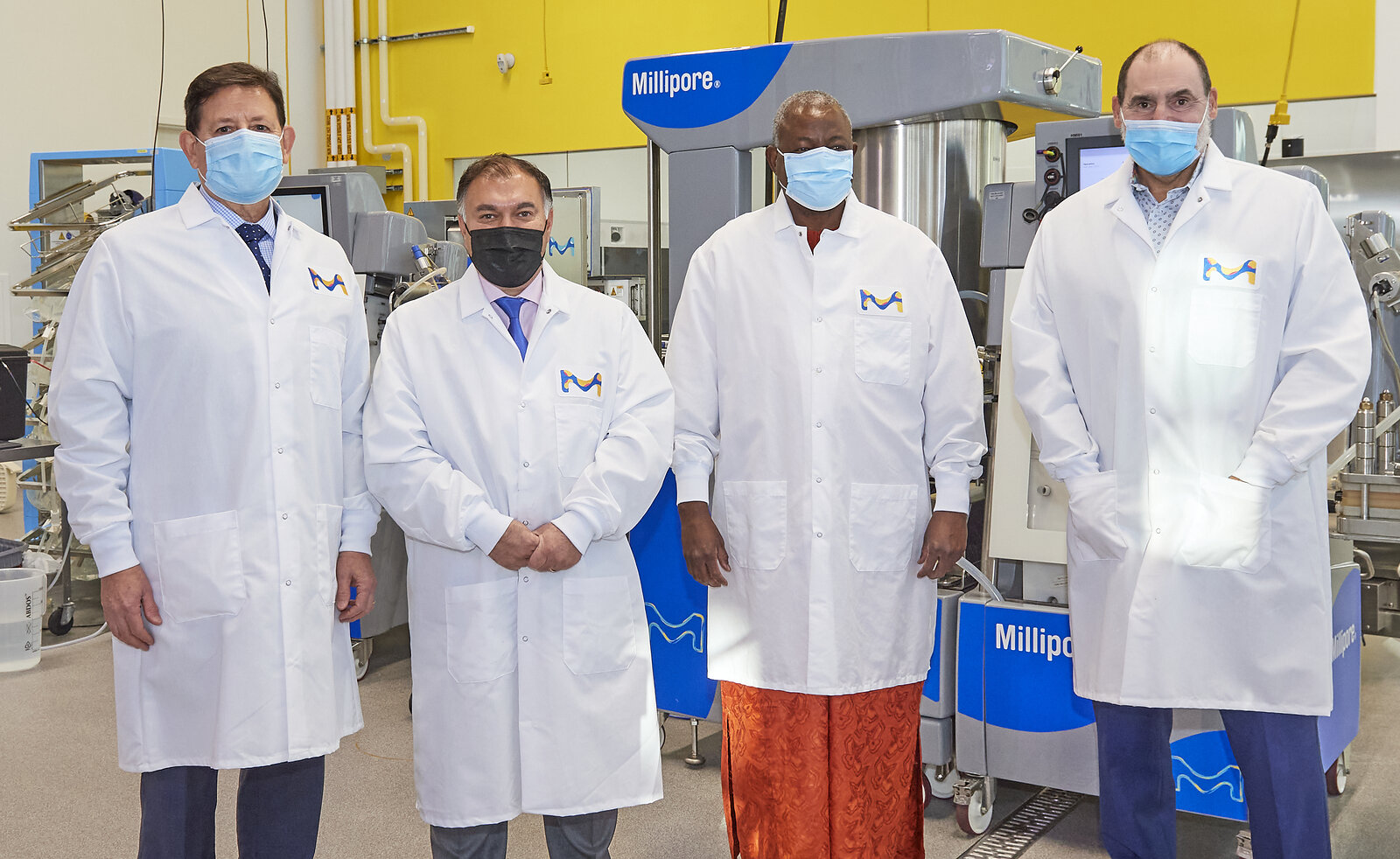
By December 2021, another photograph placed Galarza beside TechnoVax adviser Sohal Shah, Innovative Biotech CEO Simon Agwale and Merck executive Andrew Bulpin. The accompanying announcement concerned an agreement between Merck and Innovative Biotech to design a manufacturing process for a proposed facility in Nigeria. TechnoVax was identified as Innovative Biotech’s licensor. The company’s technology had become one component in a larger international undertaking.
The proposed work was described in phases, beginning with facility design for filling and finishing, followed by a focus on continuous manufacturing. Those were plans announced at the time. The significance for Galarza’s career is the relationship among the participants: a licensor, a local biotechnology company, an adviser and an organization contributing manufacturing expertise. The photograph captures a business network with a specific job to do.
This is a different view of scale from an office headcount or a headquarters address. A smaller organization can participate internationally through an agreement that connects its work with someone else’s infrastructure. In Galarza’s case, the licensing relationship placed TechnoVax within a project focused on local production capabilities in Nigeria. The institutional boundaries remained visible even as the project crossed national ones.
The byline keeps returning
Galarza’s research authorship continued alongside these commercial relationships. A January 2023 paper credited him with Ke Wen, Matthew Resch, Ryan Mazboudi and Hannah Mulhall Maasz. Its contribution statement assigned Galarza conceptualization, methodology, resources, supervision and funding acquisition, as well as writing responsibilities. Those categories show the range of work that can sit behind a name at the end of an author list.
In June 2026, he was again a co-author, this time on a paper in Proceedings of the National Academy of Sciences. The author group included researchers affiliated with City College of New York and Queens College, among other institutions. His own affiliation was TechnoVax. The credit is a recent marker of a career that continues to connect a company with academic collaborators.
The names in those papers also make the story less solitary. Scientific authorship records contributions that an executive title can obscure. Supervision, resources and funding sit beside experimental and analytical work. Reading the business record next to the publication record gives Galarza’s career its particular shape: leadership expressed through the organization of research as well as through the organization of a company.
Follow the sequence back to the 2006 license and the connecting thread becomes clear. An invention developed inside one institution found a route into another. Around it came colleagues, agreements, project funding and international partners. Galarza’s career runs through those connections. The interesting question was always what would happen after the invention. He made that question part of his job.