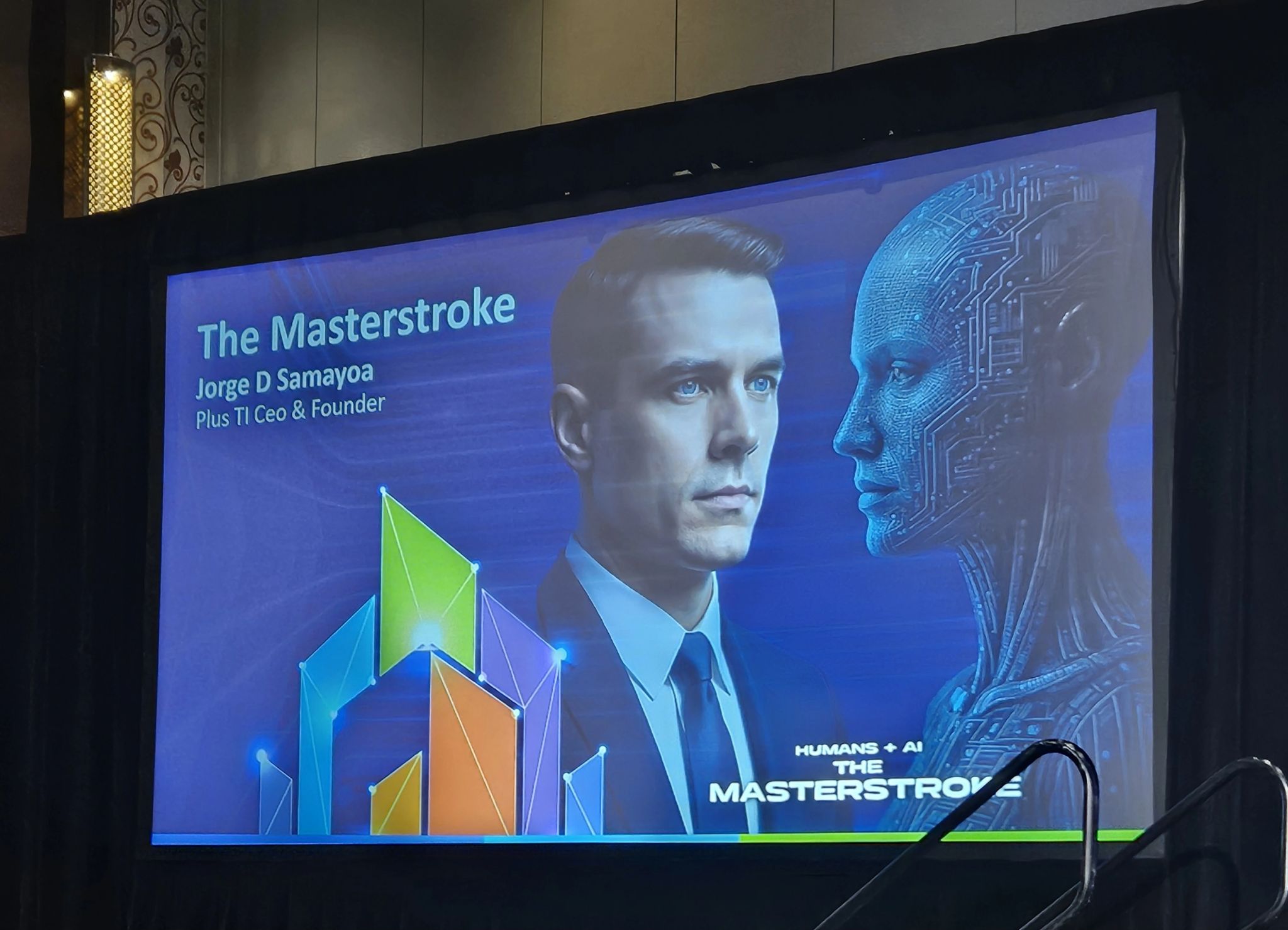
At a banking technology conference, the promise of artificial intelligence can occupy an entire screen. At the 2025 Monitor Plus User Conference, a slide bearing Jorge D Samayoa’s name put a human face opposite a machine face beneath the idea of humans working with AI. The faces were presentation artwork. The working arrangement was the interesting part. Somewhere beyond the screen, a bank employee would still need to decide what to do with the next alert.
Jorge Domingo Samayoa, founder and CEO of Plus Technologies & Innovations, works in the territory between a signal and a decision. His company, usually called Plus TI, develops Monitor Plus, software used to monitor financial activity and support the prevention of financial crime. The job involves transactions, models and people who must make sense of both. A useful alarm needs a useful response. Otherwise, the institution has acquired an unusually expensive doorbell.
A civil engineer in the fraud business
Samayoa’s professional background contains a detail that resists the usual software-founder shorthand: he trained as a civil engineer. He also holds an MBA. By April 2017, he had accumulated more than 30 years of experience in information technology. The combination places his work at an intersection of technical systems and business decisions, even if the structures he became known for were financial monitoring systems rather than buildings.
That year, at Securmática, he appeared alongside Fátima Cereijo Conde, who managed ABANCA’s loss and fraud prevention office. Their subject was holistic fraud prevention. The pairing matters. One speaker represented the technology provider; the other worked inside the bank where prevention had to function. It put the software and its operating environment on the same stage, with the person responsible for each available for the discussion.
They also shared a byline on an article about ABANCA’s integrated approach to fraud prevention. Its premise was practical: an old crime keeps evolving inside a banking world shaped by automation, multiple channels and international activity. Samayoa’s contribution belonged to a concrete institutional problem. A bank had to organize its defenses, and technology had to fit into the way that bank actually worked.
The crime can start before the payment
Later in 2017, his CELAES presentation in Ecuador addressed fraud in credit origination. The title moves attention upstream. Before a loan becomes an account to monitor, there is an application to assess. In that part of the process, the bank is deciding whether the person and the proposition in front of it deserve trust. The money may still be sitting politely in the bank.
In November 2018, an Asobancaria program in Bogotá listed Samayoa for a session on understanding digital identity and the new challenges of fraud prevention. The subject extended the same concern into a different setting. Digital banking asks institutions to recognize people through information and interactions. The familiar assurance of someone standing across a desk has been replaced by a collection of signals, each requiring interpretation.
Those two appearances give his career a more specific shape than the title of technology entrepreneur can provide. He was discussing both the beginning of a credit relationship and the problem of recognizing someone online. The recurring difficulty is how an institution establishes confidence soon enough to act. Once a decision has consequences, an elegant description of the technology offers limited consolation for a poor one.
Leave the controls within reach
Samayoa has described a design preference that goes beyond detecting suspicious activity. He wants technology to remain resilient over time while giving the institution autonomy. Discussing the company’s approach, he recalls reducing dependency as an intention present from the foundation. That is a revealing priority for a software executive: the customer should retain room to operate and evolve.
“our technology was designed from its foundation with the idea of being resilient over time, minimising dependency”
Jorge Domingo Samayoa · on the design of Plus TI’s technology
Plus TI describes its financial crime models as open to expert users. In practical terms, the proposition gives a bank’s specialists a role in understanding and adapting the machinery. The attraction is easy to see. A team knows its institution’s products, its patterns and its exceptions. That knowledge needs somewhere to go when a model meets a transaction requiring more context than a score can comfortably carry.
The company’s technology materials put expert judgment alongside machine learning. They also describe support for models through ONNX and an environment for testing before production. These are product design choices, with a human implication: expertise remains part of the operating process. Read together with Samayoa’s statement, they suggest a preference for a working relationship in which the institution can ask questions of its own system.
Who watches the watcher?
In June 2023, Samayoa brought another part of the problem to CLAIN, the Latin American congress for internal auditing and risk evaluation, in Antigua, Guatemala. His presentation considered intelligent monitoring systems and continuous auditing. The audience’s responsibility changed the emphasis. A fraud team asks what a system can detect. An auditor must also examine how the system is governed.
His material addressed access records, changes to permissions and modifications to models. It considered performance indicators and the handling of alerts. These are details with consequences: someone can alter a threshold, a case can remain unresolved, or a control can quietly lose effectiveness. The monitoring system is itself an operation, and operations require scrutiny. The watcher has keys, settings and a history of changes.
He also explored using monitoring for continuous auditing and for more parts of the institution. That creates a useful extension of his earlier work. The information collected to recognize suspicious activity can help people examine controls as work happens. In this view, monitoring supports an ongoing practice of checking, learning and responding. The machinery earns its place through what people can do with it.
- 2017Assess the applicationCredit origination fraud
- 2018Understand the identityDigital identity and prevention
- 2023Examine the systemMonitoring and continuous auditing
A conference is also a working room
Samayoa’s public career repeatedly returns to rooms full of banking practitioners. A 2016 announcement for the Latin American Congress of Technological Innovation in Lima included him among its international speakers. Years later, the Monitor Plus User Conference continued to provide a setting for his work. The repeated appearances place him in a professional conversation extending across countries and across different responsibilities inside banks.
At the 2024 conference in Mexico City, his scheduled morning session carried the title Our Commitment. Around it, the agenda divided into subjects including anti-money-laundering work, fraud, innovation and solutions. His colleagues had sessions on customer-facing threats, data, reporting and internal controls. The range gives a sense of the organization a founder must bring together: the same bank problem can arrive wearing several departmental badges.
The conference setting also puts specialists near one another. A discussion about a model can lead to a question about investigation, implementation or the customer experience. The agenda provides that context without requiring the founder to be the expert on every subject. Samayoa’s leadership sits within a company whose public speakers include people responsible for data science, innovation, consulting and product work.
There are individual acknowledgments, too. In 2025, Norma Morales, technology director at BAC Guatemala, included Samayoa in a public expression of thanks to people who had supported her career as mentors, coaches and guides. The acknowledgment does not describe a particular project between them. It does place him within the professional network she chose to recognize, alongside a wider group of people who had helped her.
AS·NET offered a different kind of recognition after the 2025 user conference. Its event account thanked Samayoa and the Plus TI team for their partnership. The subjects it highlighted included process management and SAMI, a solution based on generative AI. For Samayoa’s story, the significant detail is the combination: a familiar emphasis on operations alongside a newer category of technology.
The person still in the picture
The 2025 presentation screen brings those threads together. Human expertise and AI appeared side by side, with Samayoa’s name attached to the talk. It is tempting to treat such an image as a complete argument. His longer record gives it substance: credit applications, identity, adaptable controls and the auditing of the system itself are all places where someone has to exercise judgment.
The published 2026 Monitor Plus conference lineup again named him as founder and CEO. Event promotion put augmented intelligence at the center of the gathering, scheduled for July 15 and 16 in Guatemala. That continued emphasis fits the work associated with him over several years. The terminology evolves; the question of how people and monitoring technology should work together persists.
There is a sensible test for that relationship. An institution needs enough understanding to question a result and enough control to improve its response. Samayoa’s stated preference for less dependency is useful precisely because it makes the customer’s capacity part of the design problem. The bank has obligations that remain its own, however sophisticated the software running beside its employees becomes.
For a founder in financial technology, that is a substantial subject to keep returning to. The next generation of models may arrive with new names and brighter conference slides. The institution will still need people able to understand their work. Samayoa’s contribution is rooted in that durable arrangement: build the monitoring machinery, then leave the expert with a place to stand and something meaningful to do.