Joo-Wan Lee had found a way to explain a cross-border cloud deal without making anyone sit through a diagram. It was, he said, an “international marriage.” The comparison came with a laugh. A partnership with Japan’s Itochu Techno-Solutions, or CTC, had required the companies to work through online conversations and misunderstandings. Affection, in this particular romance, meant taking the other side seriously.
Lee remembered that CTC’s people had listened to his company’s ideas and treated it with respect. He had sensed the possibility of working together before he knew what form the relationship would take. A capital alliance had surprised him. The negotiations ended with a business arrangement, but the detail he chose to emphasise was how the people had behaved.
That is an appealing place to meet the founder of MegazoneCloud. Cloud computing tends to arrive in public wearing an expensive vocabulary. Lee’s recollection offered a smaller unit of explanation: two organisations discovering that they could get along. It also supplies a useful question for the rest of his career. What does a founder build when much of the technology already belongs to somebody else?
Before the cloud, there was an assignment
Lee founded Megazone in 1998. Its early work included websites, online shopping and hosting. These were jobs with an identifiable customer and a deliverable. Someone wanted a site built; someone needed it to run. The company’s eventual cloud business grew out of that practical relationship with other businesses, rather than a consumer application with the founder’s name attached.
The turning point came through a Samsung Electronics development assignment in 2009-2010. Megazone used Amazon’s cloud to build a customer-care report collection system. Lee saw an opportunity to turn that experience into a business. He later recalled a year of study before securing an AWS partnership in 2012, followed by four or five years without commercial success in the cloud operation.
Growth accelerated after AWS opened its Seoul region in 2016. Lee’s account leaves the waiting in the story. A useful technology, an agreement to work with its supplier and a market ready to buy the service had arrived at different times. The calendar refused to compress itself into a launch announcement. Anyone who has tried to sell an unfamiliar idea will recognise the inconvenience.
The useful work between the boxes
In 2018, the cloud business became a separate company, MegazoneCloud. The distinction matters: Lee’s entrepreneurial history began twenty years before that incorporation. A new corporate name marked a stage in a longer working life. Websites and hosting had given way to a business concerned with how organisations adopt and operate infrastructure supplied by cloud providers.
In January 2020, Lee described infrastructure as a starting layer. He wanted to add capabilities such as AI and data services above it. Acquisitions and equity investments could help secure those capabilities. “We cannot provide all the technologies alone,” he explained. The admission was quite compatible with ambition. It gave him a reason to find collaborators, and a way to decide what each should contribute.
A layered business has a practical attraction. A customer can need several things at once: somewhere to run its systems, help organising its data and an application that does a useful job. The founder’s task becomes partly one of assembly. Choosing the pieces is consequential; making them work together is where the promise meets the customer’s day. The diagram may look tidy. The work seldom fits inside a rectangle.
An editorial illustration of the layered approach Lee described in 2020.
A classroom belongs on the balance sheet
The partnerships required people who could do the work. By late 2019, Lee was talking about a shortage of trained cloud staff. Existing workers were moving around the industry, while demand for expertise kept growing. Megazone had become an AWS training partner that February and opened an education centre in June. Within four months, more than 300 people had passed through its courses.
Lee wanted teaching that prepared people for assignments in the field. Established curricula were combined with practical exercises, and technical executives helped deliver the hands-on work. Students could carry their skills into Megazone or elsewhere in the industry. The classroom had a purpose beyond producing a certificate: it increased the number of people able to make the service work.
There is a pleasantly concrete quality to this part of his career. Infrastructure can be remote; instruction needs a room, a teacher and a person willing to ask the next question. Teaching also changes the timescale of a business. A contract can allocate responsibility immediately. Competence takes longer to acquire. Lee’s training effort acknowledged that the next assignment would depend on somebody learning enough to handle it.
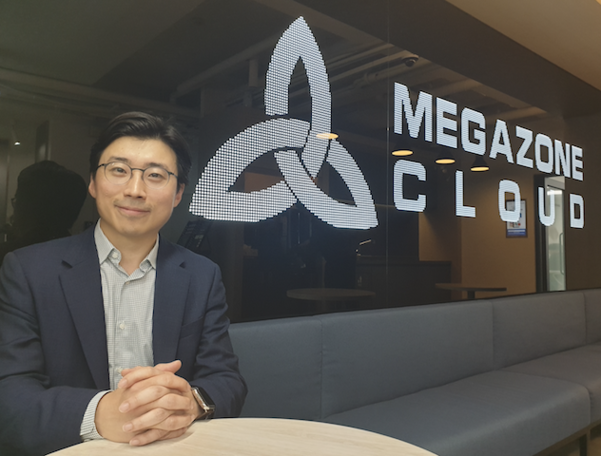
People trained in the centre’s first four months, as Lee described in November 2019.
The founder changes seats
On January 2, 2025, MegazoneCloud announced Doug Yeum as its new CEO. Yeum had led AWS’s global partner organisation. Lee moved to board chairman, with responsibilities covering IPO preparation, new business, future strategy and investment opportunities. Hwang In-chul became chief revenue officer. Operations, sales and the founder’s longer-range work now had a more explicit division.
The announcement described a business with approximately 2,800 cloud specialists across MegazoneCloud and its affiliated companies. This was a different organisational problem from the early agency’s customer assignments. The chairman’s remit made room for choosing the next areas of work while another executive took responsibility for overall management. A founder could remain closely involved without personally occupying every chair.
Titles are useful here because they explain the arrangement. They are less useful as a substitute for it. Lee’s new job put investment choices and future direction at the centre of his responsibilities. The important question became where the company should place its accumulated experience next, and which relationships would make that move possible. The early habit of looking beyond the company’s own walls had a continuing purpose.
Another table, a different map
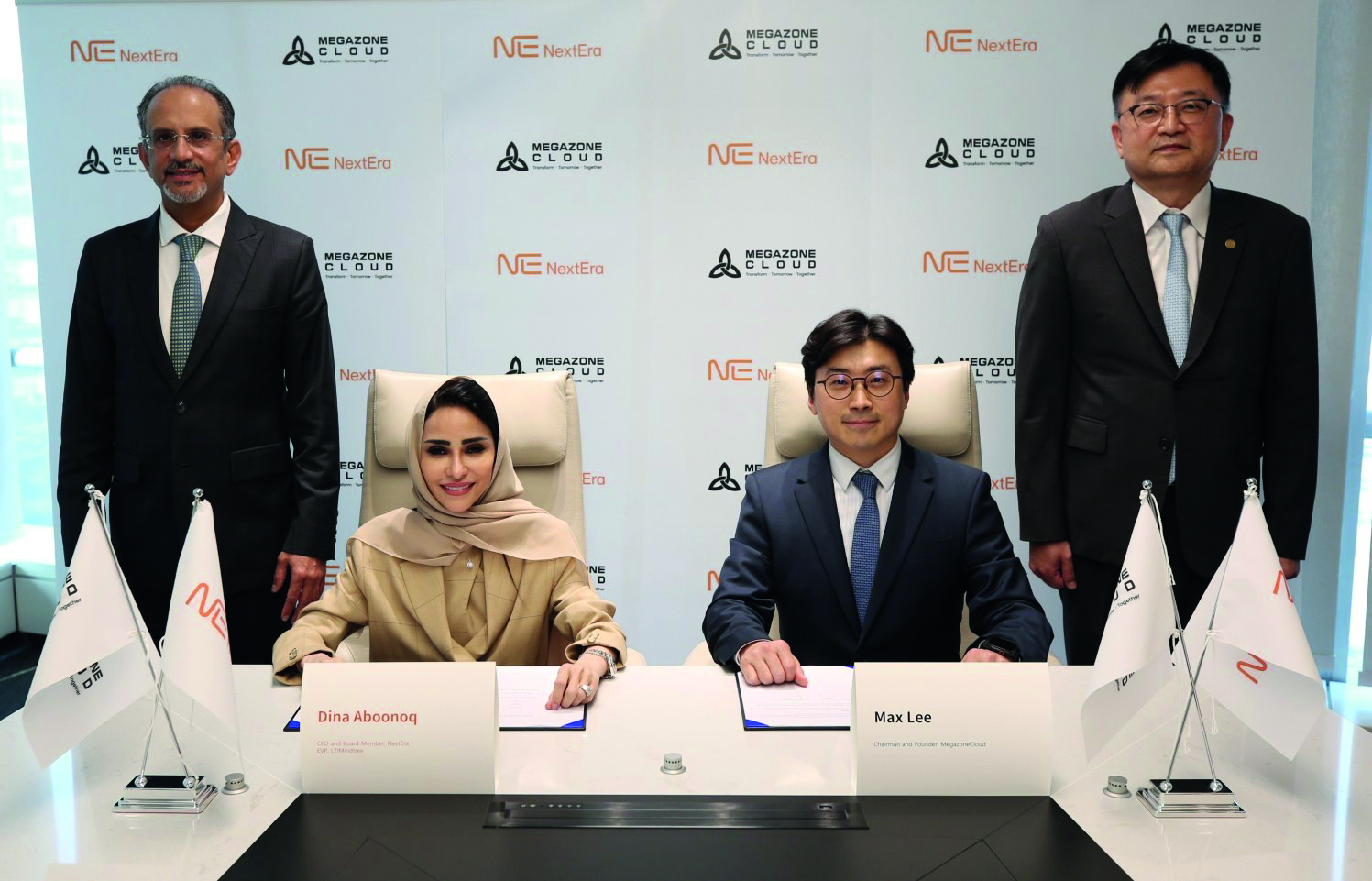
In June 2025, MegazoneCloud signed an exclusive partnership with NextEra, the Saudi digital-solutions business established by Aramco Digital and LTIMindtree. Lee appeared at the signing table beside NextEra CEO Dina Aboonoq. The agreement named MegazoneCloud as NextEra’s exclusive cloud partner in Saudi Arabia and concerned the supply of its SPACE CloudOps platform.
The platform’s remit included organising multi-cloud environments, with functions such as governance, automation and monitoring. The relationship also carried plans to help Korean SaaS and AI businesses enter the region, alongside training and talent development. A supplier relationship could therefore become a route for other businesses to travel. Local knowledge and technical capabilities would have to meet in the same arrangement.
The photograph gives the abstraction some furniture. Nameplates, folders, flags and four people make the agreement look reassuringly terrestrial. Lee’s earlier marriage comparison comes to mind, although this is a separate partnership with its own terms. Expansion requires somebody on the other side of the table. A map can show where a company wants to go; it cannot introduce the people who will receive it.
The future still needs an introduction
Lee’s public interests widened to AI, quantum computing and robotics. At a January 2025 young-leaders camp, he discussed those fields and urged patience in pursuing a vision. His advice was plain: “Keep doing what you want to do.” He also described Megazone’s emphasis on applying AI within enterprises. The question of usefulness remained close to his discussion of newer technologies.
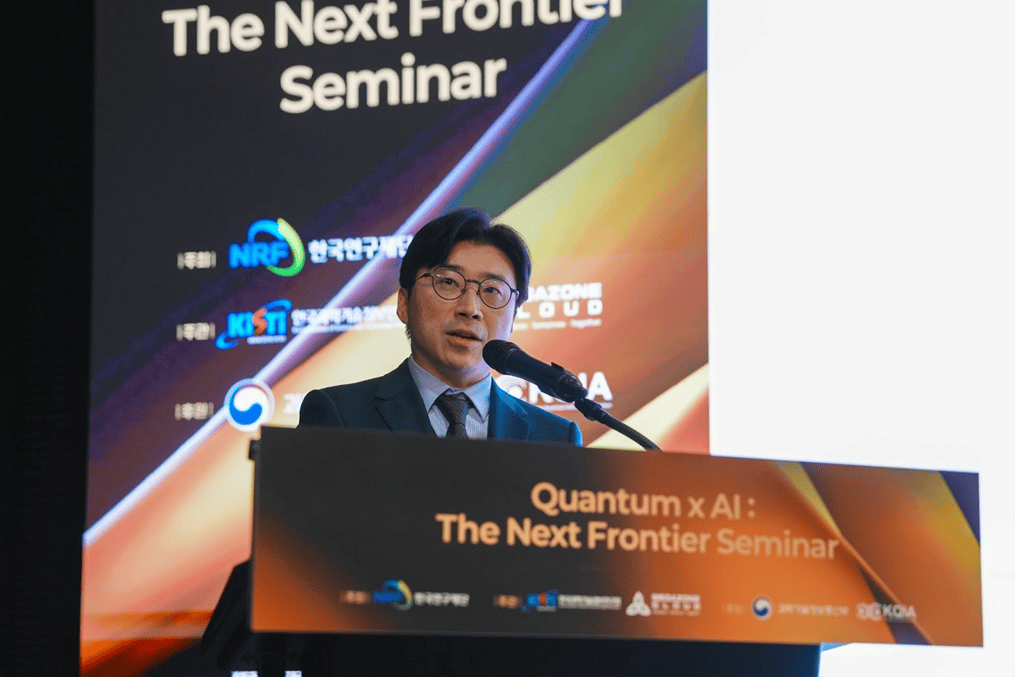
In November 2025, MegazoneCloud and the Korea Institute of Science and Technology Information held a seminar on quantum computing and AI. Lee delivered welcoming remarks. Around 200 participants from industry, universities and research institutions attended. He set out an ambition for the company to connect quantum AI with practical industrial use. The gathering brought potential users and technical specialists into one conversation.
A July 2026 memorandum with Pasqal supplied another specific avenue. The companies agreed to explore neutral-atom quantum technology within managed cloud services, develop use cases and consider on-premises quantum processing units. Those were areas for collaboration, with exploration built into the terms. The difference between signing a memorandum and delivering a working deployment deserves to remain visible in any account of the future.
That distinction suits the earlier cloud story. Lee had already experienced the gap between finding a promising tool and building a market around it. Quantum computing adds a new set of technologies and questions. It also gives his company a familiar kind of assignment: work with the people building the underlying technology, then establish how another organisation might use it.
“Keep doing what you want to do.”
Joo-Wan Lee · January 2025 · translated from Korean
Who gets to come along?
Lee’s partnerships also extended into the regional startup community. In June 2025, he attended a Gwacheon roundtable as chairman of G Startup Bridge, a private-led Gyeonggi startup council launched that February. Participants discussed connecting startups with investors and established companies, and helping them expand internationally. Lee emphasised private networks and experience as resources for supporting local businesses.
In May 2026, he joined Sungkonghoe University president Kim Kyung-moon for an agreement covering AI, cloud and big-data research, educational programmes and practical placements. Lee spoke about the importance of people who could apply AI in workplaces. The intended connection between study and assignments echoed his earlier interest in training cloud workers, now expressed through a university partnership.
By September 2026, MegazoneCloud and the Korea AI·Software Industry Association were jointly operating a pavilion for ten Korean AI and software companies at Tech Week Singapore. The programme supported access to Singapore and the wider ASEAN market, including business matching. The company’s overseas connections had become something smaller businesses could use, rather than simply a collection of offices on a corporate map.
Lee’s career is full of institutions with lengthy names. The human action underneath is easier to follow: learn a tool, find a collaborator, teach somebody, open a door. His account of the CTC deal offers the least pompous explanation. People listened to one another and decided to work together. For a business built around computing at a distance, getting along up close has proved an enduring part of the job.
Follow the conversations
Explore Lee’s public interviews, partnerships and educational work.
- MegazoneCloud website
- Joo Wan Lee on LinkedIn
- The CTC partnership interview (Japanese)
- The cloud-business origin interview (Korean)
- The education-centre interview (Korean)
- The 2025 leadership announcement
- The NextEra partnership
- The Sungkonghoe University agreement (Korean)
- The Pasqal quantum-computing agreement
- The September 2026 Singapore programme