A cloud company needs people on the ground. In 2019, Joowan Lee was showing a visitor around a training centre inside Megazone’s Gangnam headquarters. The business had plenty to discuss: customers, overseas offices, a proposed joint venture. Yet the classroom offered a particularly useful view of its founder. Lee had identified a shortage of people who could work with cloud systems. He had opened a place to teach them.
The photograph is pleasantly ordinary. Lee stands beside the room’s equipment, wearing glasses and a dark jacket. There is no theatrical demonstration of the future. There is a room where somebody will have to learn something difficult. For a business associated with infrastructure that customers cannot see, this was a surprisingly concrete answer.
That room belongs in a story usually told through funding rounds. Lee founded Megazone in 1998, established MegazoneCloud through a spin-off in 2018, and became its board chairman in January 2025. Between those dates, he built a career around the distance between having access to technology and knowing how to use it. His company occupied that distance. So did its classrooms.
A website was the first assignment
Megazone began with web agency work, shopping malls and hosting. These were practical jobs in the early internet economy: make a business presentable online, give it somewhere to run, help it reach customers. Lee’s starting point was the work businesses needed done, rather than a single consumer product carrying his name.
An account of the early company describes a busy operation that had grown beyond 200 employees by 2005. Activity was abundant; its central business was less sharply defined. Digital marketing became more prominent as the company developed. This is an untidy origin, and therefore a useful one. The eventual cloud business emerged from an organisation already learning what customers would pay someone else to handle.
Megazone’s own chronology records a restructuring into digital marketing, digital agency and platform services in 2006. In 2009 it entered the software-as-a-service business as a Google Apps partner. The progression has a certain everyday logic. Build the site, support the systems, then help the organisation adopt services that arrive over the internet. Each assignment brought another part of the customer’s technology into view.
The project that became a business
Lee later recalled a development assignment in 2009-2010: using Amazon’s cloud to build a customer-care reporting system for Samsung Electronics. The agency was encountering cloud computing as a working tool. It offered a way to deliver the project, and Lee began considering whether helping others use it could become a business in its own right.
He described spending a year studying before securing an AWS partnership in 2012. Commercial success took longer. For four or five years, the cloud operation did not succeed commercially, by his own account. Initially, the services supported overseas uses. Growth accelerated after AWS launched its Seoul region in 2016. The dates matter: a partnership agreement and a functioning market are separate events.
There is something bracing about that admission. Technology histories tend to compress the awkward interval into a tasteful arrow. Here the arrow lasted years. Lee had seen a useful capability before the surrounding business was ready to make full use of it. Studying, selling and waiting were all part of the job.
The AWS relationship became an important part of Megazone’s development. A presentation Lee gave at AWS Summit Seoul in 2015 addressed cloud operating optimisation, customer cases, Megazone’s Hyper-Series solutions and third-party tools. Its agenda was concerned with what happens after adoption: the customer has bought access, and the system still needs to work.
The space between purchase and usefulness
Managed services is an undramatic phrase for a demanding responsibility. MegazoneCloud offers consulting, design, implementation and operation around cloud infrastructure. The underlying platform may belong to another company. The customer still needs a workable arrangement of services and people who understand its requirements. An invoice does not perform those tasks, however confidently it arrives.
That explains the position Lee built. A business can purchase cloud capacity without automatically acquiring the skills to organise its applications, data and operating processes around it. MegazoneCloud’s work sits alongside the platform, helping customers make the transition and manage what follows. The relationship continues after the initial sale.
By January 2020, Lee was describing cloud infrastructure as the first layer of a larger structure. Above it he wanted to provide capabilities including artificial intelligence, data and security. He also explained that the company would obtain technology through acquisitions and equity investments where appropriate. Building every component internally was never the stated requirement.
“We cannot provide all the technologies alone.”
Joowan Lee, January 2020 · translated from Korean
That short admission helps explain his appetite for partnerships. It gives the founder a different task from personally possessing every answer. He must decide which capabilities the company needs, where they should come from, and how to make them useful together. The resulting organisation has several relationships to maintain at once.
A classroom in a growth story
Return to Gangnam. Megazone had opened its education centre in June 2019 after becoming an AWS training partner that February. More than 300 people had passed through its courses within four months. Lee described a combination of established curricula and hands-on teaching, with technical executives helping deliver the practical work.
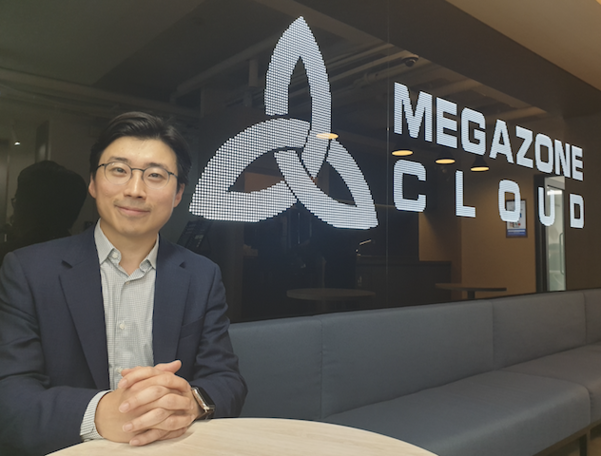
His concern was that existing cloud workers were circulating through the industry while the supply of trained people remained insufficient. The centre was intended to prepare people for actual work, beyond teaching a book or awarding a certificate. Some would work at Megazone; others would carry their skills elsewhere in the sector.
A classroom seems a modest response beside international expansion. It is also an unusually direct response. If the company’s service depends on expertise, teaching becomes part of its capacity to serve. The desks belong in the growth story as much as the overseas offices do.
Money for a wider map
The cloud operation became a separate company in 2018. In 2022, MegazoneCloud became South Korea’s first cloud-industry unicorn. That September it announced a 450 billion won investment from MBK Partners and IMM Private Equity. MBK invested 250 billion won; IMM invested 200 billion. KT had announced a separate 130 billion won investment earlier that year.
Lee’s accompanying ambition concerned other Korean companies as well as his own. He wanted MegazoneCloud to help competitive domestic software businesses expand globally. Overseas offices were part of that plan. A services company could bring a customer into a new market alongside the infrastructure it helped manage.
The financing also marks how far the business had travelled from its agency origins. It had attracted investors willing to fund further expansion and acquisitions. Those sums describe capital raised by the company. They belong to the story of its resources and obligations; they cannot be read as a balance sheet for its founder.
A different chair at the table
On January 2, 2025, MegazoneCloud announced Doug Yeum as its new CEO. Yeum had previously led AWS’s global partner organisation. Lee became board chairman, with a remit covering IPO preparation, new business areas, future strategy and investment opportunities. Hwang In-chul took the chief revenue officer role.
The arrangement divided responsibilities that had previously sat around the founder’s leadership. Yeum would oversee operations and global growth. Lee would concentrate on the company’s future direction and investment decisions. For a founder whose work had repeatedly involved choosing what to add next, it was a recognisable continuation in a different seat.
Later that year, Lee was seated at a signing table with NextEra CEO Dina Aboonoq. NextEra, established by Aramco Digital and LTIMindtree, signed a master services agreement with MegazoneCloud. The ceremony took place during a visit to the company’s industry-academia-research centre in Gwacheon.
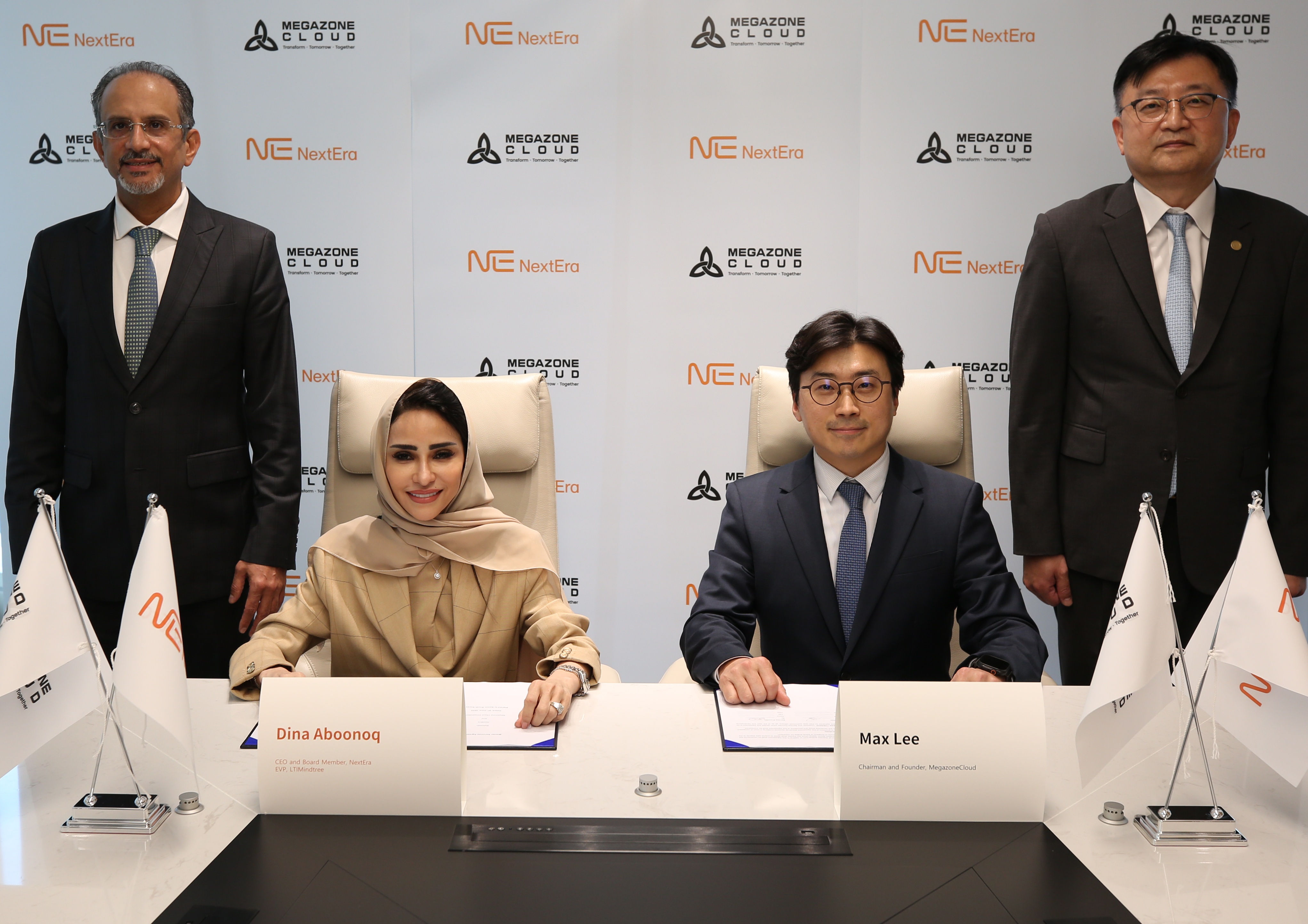
The agreement concerned cloud management and data orchestration for Saudi Arabia. MegazoneCloud’s announcement identified SpaceONE, its cloud management platform, as part of the arrangement. The business Lee had built around helping customers organise technology was now being put to work through a partner in another market.
The next assignment still needs people
In May 2026, Lee attended an agreement signing with Sungkonghoe University president Kim Kyung-moon. The planned cooperation covered AI, cloud and big-data research, industry-oriented curricula, internships and practical placements. MegazoneCloud would contribute technical expertise and project experience to the educational work.
It is a familiar concern expressed through newer technology. Lee spoke about the growing importance of people able to apply AI in workplaces. The 2019 training centre and the 2026 university agreement are separated by seven years, a change of title and a considerable expansion of the company. Both address the same practical question: who will be ready to do the work?
In September 2026, MegazoneCloud and the Korea AI and Software Industry Association ran a Tokyo market-entry programme for ten Korean AI and software companies. Its activities included local-market guidance and individual business meetings. Lee’s earlier ambition to help Korean software businesses travel had acquired another concrete setting.
His career has proceeded through assignments: a website, a reporting system, a cloud operation, a classroom, a partnership. The technology has changed. The recurring job is to help another organisation use it. Somewhere beyond the signing photograph, somebody still has to understand the system well enough to make it run.