An energy drink is an unlikely place to begin an advertising career. In a battle royale game, it is more useful as something to pick up while trying to survive. Jonathon Troughton saw another possibility. Playing PUBG in 2018, Frameplay’s founders noticed a drink that looked at home in the world around it. Then a patch made the can anonymous. A small piece of realism had become a missed commercial opportunity.
The observation helped inspire Frameplay, which Troughton co-founded with Eric Rossi that year. The question was pleasingly ordinary: if a game already contains objects that resemble the commercial world, could actual advertisers pay to occupy some of that space? A developer might earn revenue. A brand might become visible. The player could carry on with the rather more pressing business of playing.
Troughton’s interest was personal before it became a pitch. Frameplay still lists PUBG as his favorite game. That detail gives his business story a useful starting point. He understood the attraction of being inside a constructed world, and his proposed advertising model depended on preserving it. Selling an interruption would have been a peculiar way to express affection.
The business hidden in the scenery
Frameplay’s chosen word was “intrinsic”: advertising placed within the game environment. Think of a roadside billboard or a board beside a sports court. The commercial message occupies a surface the setting can plausibly accommodate. The distinction matters because a game has its own geography, pace and visual grammar. A message that belongs beside a road might look absurd in a different world.
For Troughton, the developer had to retain a central place in that arrangement. In his introduction to Frameplay’s 2022 advertising report, he described game worlds as places he had grown up in and loved. His concern was how their creators could keep paying for development and ongoing support without damaging the experience they had built. Advertising was one proposed answer to that practical problem.
“Our approach is to empower the developer first.”
Jonathon Troughton, 2022
There is a business discipline inside that sentence. A studio supplies the setting, controls the integration and lives with the player’s response. An advertiser supplies money and expects something useful in return. Troughton was arguing for an arrangement in which the creative work could survive the transaction. The advertisement would have to behave like a guest with a reasonable understanding of the house rules.
The classroom test
In spring 2020, that idea reached a classroom at Louisiana Tech’s School of Design. Students in the Art: 477 Game Design course were making games in teams, bringing together game design, graphic design and computer science. Their projects incorporated Frameplay’s software development kit. They set up accounts, placed advertising spaces in their environments and sought technical help as they worked.
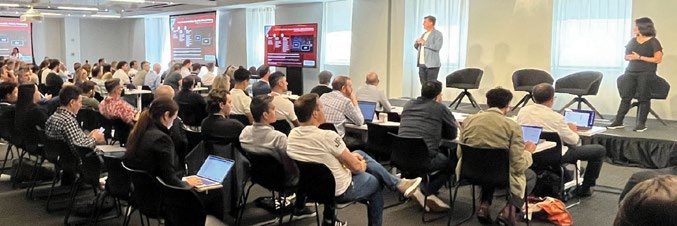
Troughton personally demonstrated the technology. His presentation addressed the less photogenic parts of a product promise: network traffic, ad quality and runtime performance. A game with an elegant advertising plan still has to run. For students trying to finish a working project, that is a fairly effective method of keeping a visiting executive honest.
The episode makes his developer emphasis tangible. The people using the tool were still learning their craft, but their constraints were recognizable. They needed to decide where a placement belonged, integrate it and check its effect on the result. Here, Troughton’s pitch met a useful test: whether another person could turn it into something playable.
A moving world needs a different ruler
By October 2020, Troughton was also explaining the proposition to the advertising industry at Advertising Week. His session separated advertising directly inside games from advertising around esports. It addressed creative work, measurement and buying methods. The distinction was essential to his argument: reaching someone watching a competition and reaching someone playing a game involve different activities and different opportunities.
He was willing to be blunt about importing old assumptions. In 2021, discussing Frameplay’s technology, he said: “Existing web technology has no place in games.” The claim was sweeping, but the underlying difficulty was specific. A camera can turn away from a virtual billboard. Lighting changes. An object can block the view. Presence in a scene leaves a great deal to be established.
Frameplay’s SDK communicated with game engines so developers could turn suitable surfaces into advertising inventory. Troughton discussed the engineering required to support studios with their own engines, as well as the need for people to build that support. The product’s apparently modest promise concealed considerable work. A sign beside the road sounds simple until the road is software.
- 01 / PlaceA studio chooses a surface that suits its game.
- 02 / ServeA brand’s creative appears inside the scene.
- 03 / MeasureVisibility is evaluated as gameplay continues.
In April 2022, Frameplay announced Intrinsic Time-in-View, measuring how long an impression met its viewability requirements during play. Studies with Lumen and eye square compared the company’s calculations with eye tracking. Dentsu’s Attention Economy team participated in the work. A Frank’s RedHot campaign in Basketball Battle supplied the test environment, putting an abstract measurement argument beside a basketball court.
The studies reported a close relationship between the approaches. That gave Troughton’s broader case something more useful than enthusiasm: evidence that a measurement designed for the game could be checked against another method. It also left an important distinction intact. Time when an advertisement is viewable, attention paid to it and a purchase afterward are different things. A credible business needs room for those differences.
The money arrives. The selling continues.
In December 2021, while Troughton was CEO, Frameplay announced an $8 million Series A led by Hiro Capital. Razer’s zVentures and Kona Venture Partners also participated. The investor group brought gaming experience as well as capital. Brands including Microsoft, Disney and Pizza Hut had already used the company’s technology. His idea had acquired recognizable commercial company.
Led by Hiro Capital, with participation from Razer zVentures and Kona Venture Partners.
Money did not remove the work of persuading buyers. By late 2023, Troughton was still describing the time and resources Frameplay devoted to showing marketers how intrinsic advertising worked. The company had cut its margins to improve sellers’ commissions. That is a rather concrete expression of patience: make the economics more attractive while explaining why the channel deserves a place in the plan.
His comparison was connected television, another channel that had needed time to become a routine consideration for media planners. The ambition was to make gaming similarly familiar. There is a long distance between a marketer agreeing that people play games and allocating a dependable budget to reach them there. Troughton’s public work kept returning to that distance.
He was building connections across both sides of it. In 2021, he appeared with Miniclip’s Zach Stadlin-Robbie at IAB UK’s Gaming Upfronts to discuss gaming’s appeal to advertisers. In March 2023, he welcomed Jurgen Post as Frameplay’s chairman. Post brought experience at Miniclip and Tencent. These were relationships rooted in the commercial realities of games, where a proposed revenue stream must coexist with the game itself.
A different seat at the table
In October 2024, the leadership arrangement changed. Sandy Shanman, who had joined as chief operating officer in 2023, became CEO, and Troughton became president, effective October 2. Shanman brought advertising and monetization experience. Troughton described the transition using the gaming instruction “git gud.” A boardroom had briefly acquired the vocabulary of a difficult level.
That same month, Frameplay launched an exchange that included inventory from Adverty and AdInMo alongside its own. Troughton, speaking as president, discussed the combined supply and welcomed other companies joining. The arrangement gave buyers a route into placements across multiple providers. Competitors could participate in the same storefront while continuing to operate their own businesses.
The move addressed a different sort of friction from the one that had interested him in PUBG. Early on, the question concerned the fit between an advertisement and a game. Now it also concerned the fit between a scattered collection of games and an agency’s buying process. The founder’s job had expanded from explaining a plausible object to explaining a usable market.
A later milestone gives Troughton a place in the technical record, too. In June 2025, the European patent office published the grant of a patent titled User Specific Advertising in a Virtual Environment. It names Troughton and Rossi as inventors. Named inventorship is a precise achievement; it also reminds us that a commercial founder’s biography can include work beyond the public pitch.
Across these episodes, the demands on Troughton kept changing. A student needed a usable demonstration. An investor needed a business case. A media buyer needed a buying route and credible measurement. He appeared in each of those conversations. Following them gives a more revealing account of his Frameplay years than treating the company’s launch as a single, completed act.
The current Frameplay team page identifies Troughton as co-founder and Shanman as CEO. Alongside the titles, it retains the favorite-game question. Troughton’s answer remains PUBG. It is a small, unusually apt piece of biography: the game that helped supply the business idea still sits beside his name.
His Frameplay story is most interesting at that scale. A can becomes anonymous. A student tries an SDK. A media buyer asks what a number means. An executive makes room for another executive. Each episode tests the distance between a promising observation and a business other people can use. Through them runs the same demanding condition: however the advertisement gets there, the player should still have a game worth playing.
Keep reading. Keep playing.
Explore the work, conversations and public record.