Johnny Le's route to the C-suite begins with a small-town soccer problem: there was no league. Growing up in Nebraska, he played pickup in the street with children from Vietnamese and Mexican immigrant families. He was usually the tallest player and, by his own cheerful assessment, possessed the worst touch. So he went in goal. It was an early lesson in team formation. You use the field you have, invite whoever turns up and discover a role by playing.
Decades later, Le arrived at Nelnet Business Services as Chief Marketing Officer with a more formal brief and a much larger field. Nelnet operates in the complicated country where education, payments, technology and service meet. Marketing there must translate systems for institutions while remembering the people who actually have to use them. Le brought more than two decades in design, digital marketing and leadership, plus an extracurricular résumé that reads like an unusually energetic Saturday: soccer coach, referee, nonprofit organizer, bowling coach and national supporters' group brand manager.
The combination makes sense once you stop treating a career as a ladder and start treating it as a team sheet. Design taught him to notice how parts fit. Digital work taught him to coordinate specialists. Sport taught him that identity is not decoration. A shirt can attract you, as it did when Le first noticed The American Outlaws, but a community keeps you after the shirt has gone through the wash.
First half / Learn the shape of the field
A designer learns to conduct
At the University of Nebraska-Lincoln, Le studied fine arts, concentrating in graphic design and drawing from 1995 to 2000. He also joined the university bowling team and its graphic design student group. The pairing feels almost too tidy in retrospect: composition on one side, repeatable motion on the other. Both reward attention to small adjustments. Neither forgives confusing intention with result.
His professional roots remained close to the work itself. Le describes a background in design and code before his responsibilities widened into digital products, clients and teams. At Swanson Russell he became Senior Vice President and Director of Digital Services. He also taught art direction as adjunct faculty at his alma mater. His portfolio names work for PERC, Verity Health Systems, OREGON Cordless Power Tools, Barrett-Jackson Auto Care, Textron and Minn Kota Motors, with recognition from AIGA, the ADDYs and W3 Awards.
The more revealing number is 38. That was the size of a digital marketing group he led, bringing together UX designers, motion designers, strategists and developers. These professions do not always share a dialect. A strategist may call something a proposition. A designer sees hierarchy. A developer sees a dependency with a deadline. The leader's job is not to flatten those differences. It is to make them legible enough to cooperate.
“His greatest strength is his ability to empower his employees.”Former colleague Andy Clabaugh
Former colleagues describe Le as supportive, empathetic and willing to give people room to test unconventional ideas. They also remember the office folklore: a Game of Thrones-themed beach party, a day on trampolines, karaoke and theme-party enthusiasm. None belongs on an org chart. All of it explains an operating preference. Teams do serious work more readily when people are allowed to be recognizable human beings.
A career drawn as one continuous touchline
Second half / The whistle changes things
Grace, with boundaries
Soccer returned to Le's life by parental ambush. His son was five, the YMCA team required a coach, and he was pushed into the role. He discovered that he loved it. The assignment expanded into supporting his children's teams, local clubs and Nebraska's Olympic Development Program. In time, he founded ONYX for Change, a soccer-focused nonprofit whose mission linked goals with the greater good. Its events, including a downtown Lincoln tournament, raised money for local charities while asking young players to become stewards of their community.
Eventually the children stopped needing him as coach, team manager or, as Le put it, juice-box supplier. He still wanted to share a field with his oldest son. There was a referee shortage. Father and son signed up, accepted payment to run while strangers shouted at them, and found a fresh challenge hiding inside the abuse. Le studied the laws, worked YMCA, club and high-school matches, then joined Nebraska's referee delegation at the US Youth Soccer Presidents Cup in Cincinnati.
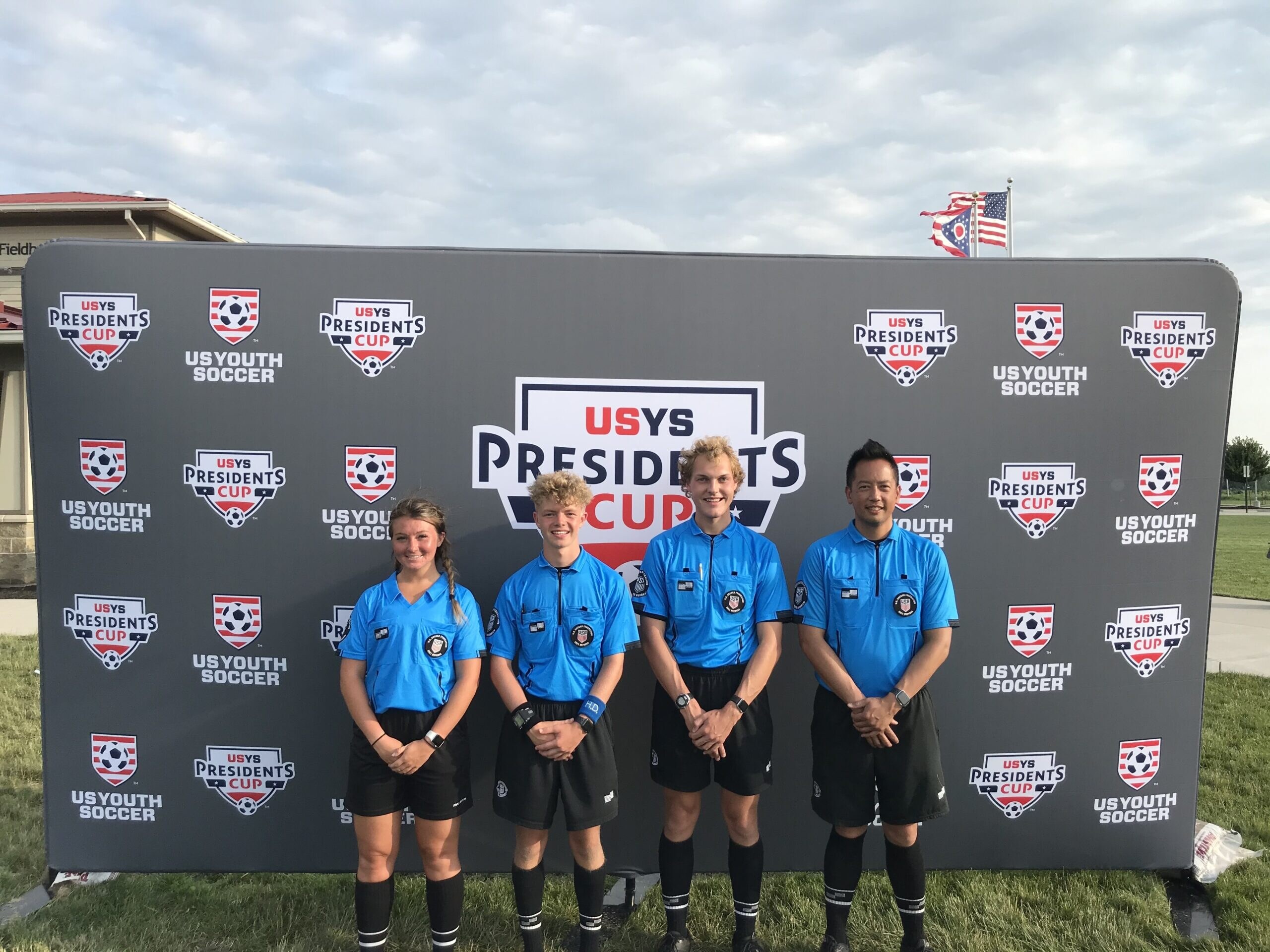
Refereeing supplied a portable management principle. Le said he learned to give people grace when they are upset by calls he makes or fails to make. It is not a slogan about avoiding judgment. A referee still has to decide. The useful distinction is between holding a boundary and treating somebody's frustration as a personal attack. Creative reviews, client presentations and organizational changes contain plenty of disputed calls. The leader can become defensive, or the leader can keep the match playable.
“As a ref, I learned to give people some grace if they're upset by the calls I make or don't make.”Johnny Le
The Le field guide
Make roles visible. A designer, developer and strategist can disagree productively when each understands the shared objective.
Let people play. Empowerment means more than assigning tasks. It means giving capable people room to explore the work they care about.
Separate reaction from intent. A disputed decision can stay a problem to solve instead of becoming a verdict on the people involved.
Extra time / Belonging is the product
The shirt is only the invitation
Le joined The American Outlaws because the Lincoln soccer crowd seemed to be in it and, importantly, the shirts looked cool. A few watch parties at Captain Jack's completed the conversion. In 2020 he became the national staff's first brand manager, connecting his professional toolkit with a community that had already claimed him. He worked on the central brand and AO Impact, its charitable arm, during the run-up to the 2022 World Cup.
For Le, the supporters' group carried an additional meaning. As an Asian-American athlete, coach, referee and father, he had encountered assumptions about who looks athletic or belongs on the field. He wanted his children to understand that being Asian did not restrict what they could pursue. He also spoke of wanting more Asian-American representation at the top levels of the sport, hoping for a player whose example might open the imagination of a new generation.
This is where Le's design work and community work finally look like the same practice. A brand is a promise about belonging, but the promise is cheap without operations behind it. ONYX needed events. The Outlaws needed watch parties, travel, charitable work and a coherent identity. A digital team needed workflows in which different crafts could contribute without surrendering their differences. Community is what remains when the visual system has done its job and people begin acting for one another.
In April 2025, Le announced his next chapter at Nelnet Business Services. He thanked predecessor Jodi Spethman for the transition, Storybent leader Percy Wang, colleagues Jaylyn Armstrong and Daniel Dunbar, and the clients from his time in Chicago. It was a departure note framed as a chain of relationships. Even the career move arrived as a team photograph rendered in words.
A larger field in Lincoln
Nelnet brought Le back into a Lincoln institution operating across education services and financial technology. The scale is different from a youth tournament, but the underlying marketing questions are familiar. Complex products need a common language. Institutions need reliability. Users need to know what happens next. Employees need to understand which promise they are helping keep.
The work also puts an old designer's instinct to practical use. Financial and education systems accumulate terminology because each term carries a technical purpose. Customers, however, experience the whole arrangement as a sequence of ordinary moments: sign in, understand the balance, make a payment, get help. Marketing sits between the vocabulary of the institution and the day of the person using it. The craft is partly subtraction, partly translation and partly choreography. Le has spent his career around people who see different pieces of that sequence. His advantage is not pretending those differences disappear. It is knowing how to put them on the same field.
Le's career offers no mystical formula for that work. It offers something more useful: a set of rehearsed habits. Start close enough to the craft to respect it. Translate without flattening. Give specialists room. Build identity through participation. Make the necessary call, then leave enough grace for the game to continue.
There is a pleasing symmetry in the goalkeeper becoming a referee and the designer becoming an executive. Each move changes the vantage point. The person once responsible for a patch of the field must learn to see the whole system. Yet Le's story keeps returning to the same small gesture: turn up, notice what the team needs and accept the role. Sometimes that means a campaign. Sometimes a whistle. Occasionally, one suspects, it still means remembering the juice boxes.
Keep following the thread