John Sergides likes the sort of recreation that requires a serious conversation with gravity. He kitesurfs, freedives and heads into the mountains for helicopter-accessed skiing or snowboarding. For someone whose working life involves fund administration, this is a fairly extravagant way to get away from the paperwork. Yet his account of taking risks begins with preparation: think through the decision before making it, and accept responsibility for what follows.
That combination makes a useful entry into his career. Sergides leads MUFG Investor Services, a business that handles much of the machinery surrounding investment funds. Its work sits behind the more visible business of choosing investments. It is a world of records, transactions, financing and relationships, where a promise eventually has to become an operation that works. His story turns on how much more of that work one organisation can take on.
There is little theatrical glamour in a properly administered fund. No one buys a cinema ticket to watch a reconciliation. But the apparently dull question of who keeps everything running becomes rather interesting when the sums involved reach a trillion dollars. Sergides has spent his career close to that question, then broadened the answer to include more services, more countries and a longer view of what clients need.
An engineer enters the banking machinery
His education began somewhere other than a business school. Sergides earned a master’s degree in mechanical engineering at Imperial College London. The university’s foundation records his mechanical engineering connection against 1997. His later career took him through banks and financial technology, with early roles at Barclays Capital, CLR Financial Group, HSBC and Point Nine Financial Technologies.
At JP Morgan he became an executive director heading hedge fund services solutions and sales. Deutsche Bank followed, with responsibilities spanning alternative fund services strategy and transaction banking cross sales. By the time he worked at UBS Global Asset Management, his remit included sales and business development. The recurring subject across those roles was the practical relationship between financial institutions and the investment businesses they serve.
He joined MUFG in 2015 following its acquisition of UBS Alternative Fund Services. Before becoming CEO in 2019, he was deputy chief executive and global head of sales and marketing. That route placed him close to clients before giving him responsibility for the whole business. It also supplied a particular vantage point: the questions customers ask when a service has to work across an organisation, rather than look attractive in a presentation.
The client already in the room
In 2023, Sergides recalled that MUFG Investor Services had been little known in Western asset servicing when he arrived. Its international platform had been assembled through acquisitions, including Butterfield Fulcrum and Meridian in 2013, followed by UBS Alternative Fund Services. Those purchases provided an entrance into the market. The next question was what kind of relationship the business would build after arriving.
He argued for a provider that could support an investment manager across a broader range of tasks. Administration was an established business with established expectations about service and price. Competing for the same assignment could leave a firm pursuing work that another administrator already held. A broader relationship offered room to develop alongside a client, rather than continually searching for the next handover.
His language about negotiating is revealing. He objects to treating a transaction as a contest in which one side must surrender something to the other. In this account, a useful partner makes the customer’s ambitions easier to pursue, and earns further business by doing so. It is an ordinary proposition, perhaps, until it has to survive the demands of an actual customer.
“The best deal is one where you both win.”John Sergides
More of the work, fewer handoffs
The strategy became concrete in the services available around the fund itself. In 2022, MUFG Investor Services launched a business consulting group. Sergides and Joseph Latini, then global head of business development, described a client offering that reached into the operating structure of an investment business. The ambition extended beyond processing the work already assigned to an administrator.
Latini explained that the team would help clients compare their operations with peers, consider investments in efficiency and think about talent management. Sergides described bringing together services that a client might otherwise obtain from several institutions: lending, financing, hedging, banking and escrow among them. The practical attraction was less fragmentation. For a client, each additional provider means another relationship to manage and another boundary across which work must travel.
He also acknowledged the commercial pressure behind the proposal. Customers wanted more while paying the same or less. That is a familiar request in almost any trade, although it becomes particularly demanding when the work involves complex funds. His answer was to widen what the institution could provide. The consulting initiative gave that idea a human form: people helping clients examine how their businesses function, alongside the services that carry out the work.
Selected services within the firm’s offering. A map of capabilities, not a ranking.
A ribbon, and a return to Limassol
Some of this expansion brought Sergides back to familiar ground. “My family grew up in Limassol.” Speaking in Cyprus in 2023, he connected the city with the value placed on long relationships. He saw a resemblance between those expectations and the Japanese parent company’s approach to employment and commitment. The connection was personal, but it also fitted the argument he was making about the business.
The Limassol office gave that argument an address. On 13 September 2023, President Nikos Christodoulides attended its inauguration. Sergides described the operation as a model for expansion into other locations. A ribbon cutting can make a business look finished for an afternoon. His description pointed instead to a starting point, with the new office expected to contribute to the firm’s development elsewhere.
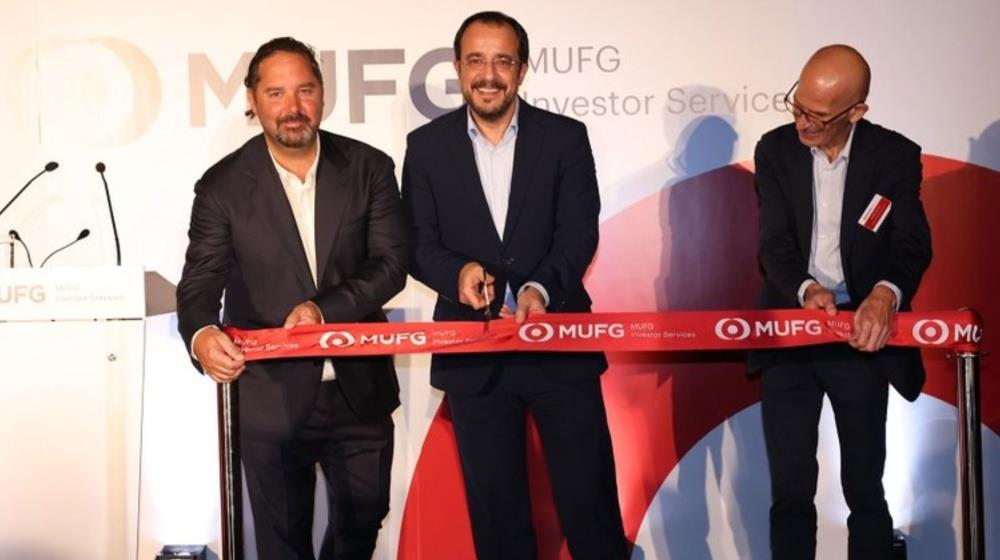
His earlier discussion of Cyprus with PwC had made a specific case for an operations centre serving international clients. He pointed to the combination of talent, infrastructure, costs and time zone. He wanted sustainable jobs with career prospects, backed by connections between businesses, universities and financial technology firms. That proposal asked Cyprus to compete through the work people could do there, as well as through the funds that might choose it as a domicile.
The numbers need their proper names
By early 2024, MUFG Investor Services had passed $1 trillion in assets under administration. A 2025 account of the business also placed assets under custody at $565 billion. The distinction matters. Administration and custody describe services provided to clients; the amounts involved belong to those clients. They are measures of the scale of an institution’s work, and should be read with their particular labels attached.
Acquisitions form part of the earlier history. The more recent growth story, as Sergides tells it, emphasises technology investment, expanding capabilities and lasting client partnerships. That chronology makes the business more understandable than a single rising number. Buying a platform and developing the relationships on it are different kinds of work. His career at MUFG has encompassed both.
Looking ahead to 2026, he reported $1.28 trillion in assets under administration and annual client retention close to 100 percent. He paired those figures with an acknowledgement of the pressure on teams: complicated client demands, tight implementation schedules and continuing volumes of work. The numbers describe scale. His accompanying remarks bring attention back to the people expected to make that scale manageable, one delivery at a time.
Questions that travel beyond the ledger
Sergides’s public conversations also show him looking outside the immediate business. At the New York Alts & Private Markets Forum in June 2024, he spoke with economist Paul Romer about inflation, debt, China, artificial intelligence and the idea of charter cities. His explanation for that breadth was practical: conditions in the wider economy influence the products the firm develops and the risks it considers.
In Singapore that October, he held another forum conversation, this time with Jeffrey Jaensubhakij, GIC’s group chief investment officer. The discussion examined global economic questions and issues specific to the region. These exchanges put the administrator’s work within the same changing world as the investors it serves. A client’s operating requirements do not stand still simply because an existing process runs smoothly.
In his own writing for the alternatives industry, Sergides has examined the operational consequences of new investors entering private markets. Greater participation brings demands for technology, data handling and revised processes. His agenda for 2026 includes automation and AI, alongside further investment in service capabilities. Read together, these interests suggest a continuing question: what will clients need their infrastructure to do as their businesses change?
The next person through the door
His connection with Imperial has continued through service on the Imperial College Foundation’s board. It also reaches students. MUFG Investor Services partnered with Imperial Business School on the Empowering Futures Scholarship, which supports academically strong applicants facing financial disadvantage or entering university as first-generation students. Sergides champions the initiative as an alumnus.
The first recipient, MSc Finance student Bruna Travassos, described support covering tuition and living expenses, together with mentoring and coaching from MUFG leaders. That combination gives the partnership a practical purpose. Admission to a demanding course is one threshold; being able to afford the course, and having people to consult about what comes next, are further ones. The programme addresses more than the congratulatory letter.
Asked in 2025 about his eventual legacy, Sergides returned to family, adventure and colleagues. He wanted a workplace shaped by fairness and respect, where talented people could do their best work. The ambitions of the business remain substantial. The personal test he describes is more intimate: whether people can build something worthwhile together, and whether they have reason to keep showing up. For an executive drawn to adventurous departures, staying has become a recurring subject.