The first cheque came from his sister: $50,000. Long before John Poulos became a familiar face outside a Delaware courthouse, his election technology company depended on people who knew him personally. That is a particular kind of investment committee. It can ask about the business and still see you at dinner.
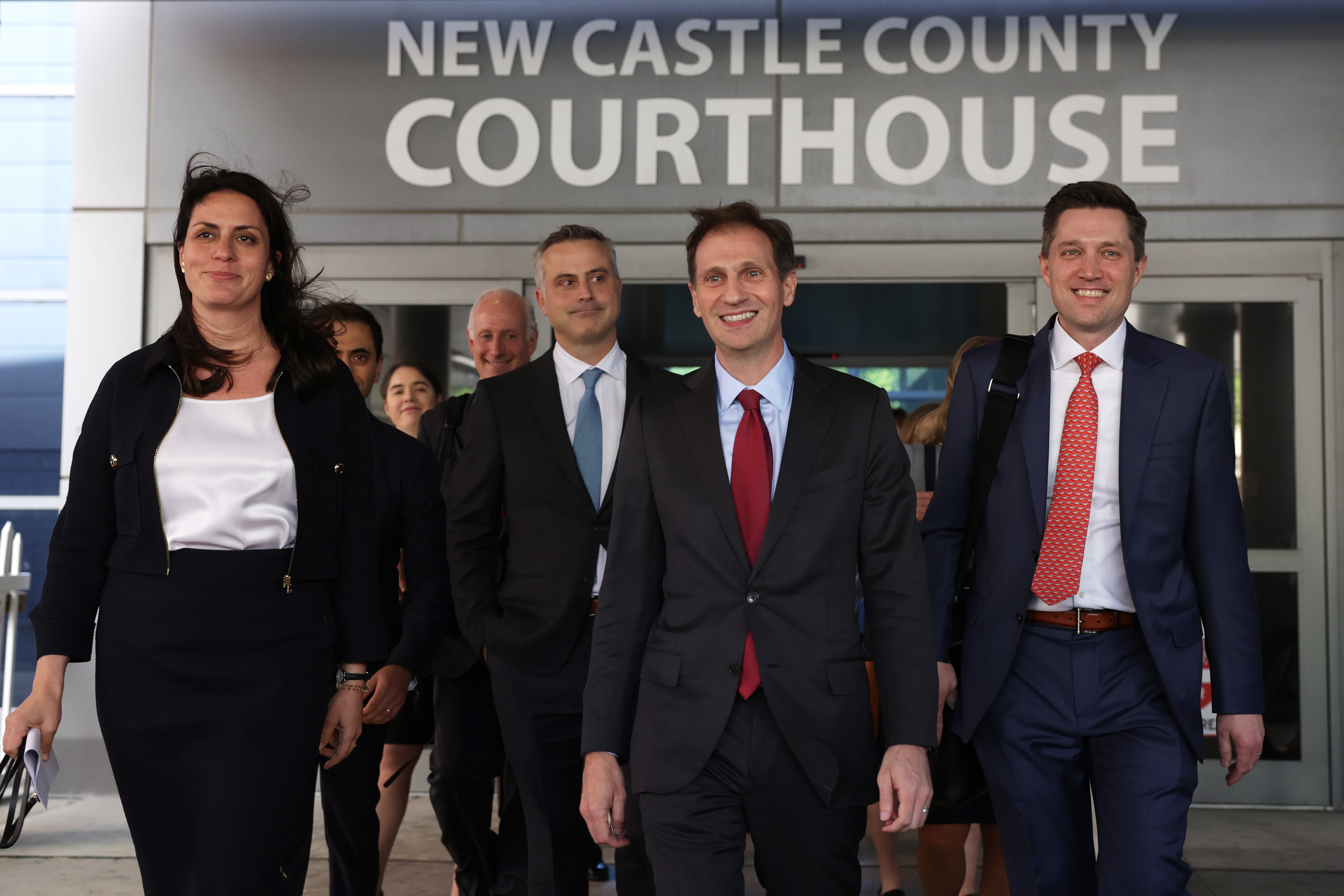
By April 18, 2023, the numbers attached to Dominion Voting Systems had acquired several more zeroes. Fox News agreed to pay the company $787.5 million to settle its defamation case over false claims about the 2020 election. Poulos stood outside the courthouse with his lawyers. A founder who had spent years selling the reliability of a count was now explaining the consequences of an accusation.
The photograph is an easy place to stop his story. A large payment makes a satisfying full stop. Poulos was less satisfied. Within a month, he was publicly warning that Dominion could eventually lose its business. Being vindicated and being welcome in the marketplace had turned out to be separate achievements.
A skeptic was supposed to be the customer
Poulos graduated in electrical engineering from the University of Toronto in 1997 and earned an MBA at INSEAD. He met his future co-founder, James Hoover, during an earlier business venture in Silicon Valley. Their ambition for voting technology was unusually demanding: build something whose accuracy could convince even a skeptic.
That ambition belonged to a period when the mechanics of voting had become news. The disputed Florida count in the 2000 American presidential election had made ballot design and counting procedures matters of national consequence. An engineer could look at that mess and see work to do. Poulos and Hoover entered the business in its aftermath.
Dominion's early work included an election in Quinte West, Ontario, in 2003. It is a useful detail to keep beside the later courtroom photographs. The company began with an actual local election to support, a place where equipment had to work and an election administrator had to answer for the result. Reputation accumulated one jurisdiction at a time.
His professional formation also helps explain his choice of problem. Electrical engineering asks whether a system behaves as designed. Business school asks whether anybody will buy it. Election equipment adds a third examination: whether the people who lose will accept what it says. The third examiner is rarely in a generous mood.
The engineer brings his paperwork
On January 9, 2020, Poulos appeared before the U.S. House Committee on House Administration. The presidential election was still ahead. He described Dominion as a company serving jurisdictions across 30 states and Puerto Rico and said it had assisted officials with nearly 300 elections during the previous year.
His opening statement spent its time on the things that usually disappear beneath a successful election: certifications, employee training, independent testing, paper records and audits. He called supporting elections a full-time proposition. The calendar may offer an election day; the supplier inherits all the days around it.
There was no promise of an enchanted machine. Asked whether any voting method was a hundred percent secure, Poulos answered no. He supported a coordinated process for disclosing vulnerabilities, better sharing of threat information and more workable certification procedures for updates. He was asking for systems that could be examined and improved.
He was also questioned about components made in China. He acknowledged their presence, named examples such as screens and small electronic components, and offered to provide further information. This was the unglamorous terrain of hardware: supply chains, manufacturing options and standards. The hearing treated his company as infrastructure to scrutinize, which it was.
“Supporting elections is a full-time proposition for our company.”
John Poulos · congressional testimony, January 2020
Those exchanges give a more useful glimpse of Poulos than a list of adjectives would. He could explain what his equipment did, accept a question about its limits and ask legislators for practical changes. The job required tolerating scrutiny. It would soon require answering claims that scrutiny had already disproved.
Paper was already in the picture
One irony of Poulos's career is how thoroughly the phrase “voting machines” can conceal the paper. In a 2016 briefing for Canada's electoral reform committee, he described optical scanners that read marked ballots and retained images with records of how the marks were interpreted. The purpose was to leave something an official could inspect.
The same briefing discussed ranked ballots, different electoral systems and ways to reduce the work of counting. This was his company's daily subject matter years before it became an American political catchword. Its customers included Canadian provincial and municipal election authorities, and it had supplied technology for both Liberal and Conservative party leadership elections.
A ballot, an interpretation and an audit record belong to a rather pedestrian sequence. That is part of their appeal. Each step creates something another person can check. Poulos's business depended on the proposition that a documented process could earn confidence, including from people who had no reason to take a vendor's word for it.
- MarkA voter completes a paper ballot.
- ScanA tabulator interprets the marks.
- ReviewRecords support checks and audits.
By 2018, Dominion had a new financial partner. Its management team and Staple Street Capital announced an acquisition in July. Poulos described the partnership in terms of resources for customers, demand and security investment. These were the concerns of someone planning to keep building. A public argument about whether the company should be believed was about to consume much of that attention.
A business becomes an allegation
After the 2020 presidential election, Dominion was falsely accused of helping steal the result from Donald Trump. Claims about switched votes and supposed foreign connections circulated through broadcasts and online discussion. Poulos was suddenly defending the existence and history of the enterprise he had built, alongside the operation of its equipment.
The accusations also affected employees and customers. A vendor's damaged name becomes an election official's problem when that official has to persuade local voters that the count deserves their confidence. Poulos could defend a machine with testing and documentation. A customer also had to contend with a roomful of people who had heard something else.
He responded publicly, took part in interviews and pursued litigation with his company. In a February 2021 television appearance, he described an approach grounded in evidence. The answer fitted the engineer. It also required an entirely different set of specialists: lawyers who could establish what had been said, what was known and what damage followed.
There is an awkward professional reversal here. A founder normally wants more people to recognize the company name. Poulos had acquired recognition under conditions that made it harder to sell the product. The fame arrived with a bill.
The cheque that could not buy yesterday
Before the Fox trial was due to begin, Delaware Superior Court Judge Eric Davis ruled that the challenged statements about Dominion and the 2020 election were false. The distinction matters: the settlement followed a ruling on falsity, while other issues had been headed for trial. The payment was a negotiated resolution, rather than a jury's damages award.
The agreement came on April 18, 2023. Outside court, Poulos said, “Truthful reporting in the media is essential to democracy.” The sentence was brief enough to survive the day's enormous numbers. His company had forced a consequential reckoning with the claims made about it.
Fox News settlement with Dominion Voting Systems.
A company settlement, not a personal payout figure.
Yet his subsequent assessment of Dominion's prospects was bleak. He warned that customers could find it easier to choose a supplier without Dominion's name. Money could compensate for damage. It could not oblige the next procurement committee to endure a political quarrel.
That is the uncomfortable part of the victory. A court can examine a defined set of statements and reach a finding. A company's reputation lives in many more places, including conversations where nobody brings the judgment. Poulos had won an answer to the allegations. Every future customer would still have its own decision to make.
Outside the argument
The litigation can make the rest of his public life seem like an appendix. It deserves more room than that. Poulos co-founded the Delian Project, a nonprofit concerned with using technology to support elections in emerging and post-conflict democracies. The aim extended his interest in election administration beyond the markets of his commercial company.
His public biographies also describe youth hockey coaching and mentoring young people interested in business. NEXT Canada lists him among its mentors. In those settings, the scale changes: a team, a student, a conversation. They offer a glimpse of a career that included explaining and encouraging long before it required rebuttal.
His Greek heritage remains part of his public connections. In April 2026, The Hellenic Initiative advertised him for a Los Angeles fireside chat alongside entrepreneur George Bousis and the organization's executive director, Mike Manatos. The listing called him Dominion's founder. It is a title that survives a change of ownership.
The name on the next chapter
On October 9, 2025, Poulos confirmed that Liberty Vote had acquired Dominion Voting Systems. The business passed to a company founded by Scott Leiendecker, a former St. Louis election director. Poulos was identified as Dominion's former CEO. For the founder, the company story and the current management story had separated.
For customers, the practical questions continued. Colusa County, California, told its public that the acquisition would bring no interruption to equipment, certification or software and hardware operation. It also pointed out that the county already used paper ballots. After years of extraordinary attention, the machinery of elections still needed ordinary continuity.
Poulos began with an ambition to make a skeptical person confident in a count. His career exposed the distance between providing a way to check something and persuading someone to check it. The paper remains available. The engineer's work can be inspected. Getting people to look is a job with no convenient election-night closing time.
Follow the paper trail
Interviews, public testimony and the next chapter.