Omer Keilaf has an unusual way of winding down: another problem. He has said that, when there is no good one left to solve, Sudoku will do. Most people would consider a day spent developing sensors for autonomous vehicles sufficient mental exercise. Keilaf apparently likes to leave a little homework for himself.
The habit offers a useful entrance to his working life. He is the co-founder and CEO of Innoviz Technologies, an Israeli company building LiDAR sensors and perception software. Its equipment has reached BMW production vehicles. Its customers and partners include Volkswagen, Mobileye and Daimler Truck. Behind those names sits a decade of engineering, negotiation and waiting.
There is an appealingly awkward question inside that career: how does someone who likes solving problems quickly build a business in an industry that takes years to decide whether an answer is acceptable? Keilaf has had to work on both clocks. The sensor can get smaller. The carmaker’s calendar is less easily miniaturized.
“I am a combination of vision and paranoid.”
Omer Keilaf, 2021
Three degrees, several kinds of school
Keilaf earned a bachelor’s degree and a master’s degree in electrical engineering, followed by an MBA, all at Tel Aviv University. The combination fits the job he eventually made for himself: enough technical depth to discuss the device, enough business training to argue about what it should cost. Neither subject politely stays in its own room.
He has described the value of university in practical terms. The lasting benefit was learning the fundamentals and how to approach unfamiliar problems. A particular technology could become dated; a way of learning could travel with him. His affection for the place also extends to the life around the coursework, including working and meeting people while studying.
Another part of that education came in Unit 81, the technological unit of Israel’s military intelligence corps, where he served as an officer and held project-management and system-architecture responsibilities. The work placed him among people building technology under demanding constraints. That shared background would later connect Innoviz’s founding team.
Before Innoviz, his civilian career included Anobit, bTendo, STMicroelectronics and ConsumerPhysics. These were jobs concerned with how complicated technology becomes a usable product. At ConsumerPhysics he led system and product-definition work on a handheld molecular sensor. At bTendo and Anobit, his responsibilities included architecture and engineering. The subjects changed; the need to make different technical disciplines cooperate remained.
A small company meets a very large customer
Innoviz was founded in 2016 by Keilaf, Oren Rosenzweig, Oren Buskila and Amit Steinberg. All four had served in the intelligence corps’ technological unit. Their first financing announcement, in August that year, reported a $9 million Series A and a team approaching 30 people. This was already a collective undertaking, rather than an inventor working alone at a bench.
The proposition was to make LiDAR practical for a much wider automotive market. Price and performance belonged in the same argument. An expensive sensor might demonstrate what was possible while still leaving a carmaker with nothing it could put into the intended vehicle. A cheaper one had to satisfy the customer’s technical demands, too.
Keilaf’s account of the early conversations contains a useful correction to the tidy startup origin story. The founders initially expected that making existing technology smaller and less expensive would answer the need. Customers wanted considerably more. Access to those customers changed the problem the engineers thought they were solving.
By the end of 2017, BMW had nominated Innoviz for its Level 3 production program. Magna was the young company’s manufacturing and supply-chain partner. Winning the attention of an established carmaker gave the project a destination, along with a lengthy list of obligations. A nomination was the beginning of the production work.
- 2016Innoviz founded
- 2017BMW nomination
- 2021Nasdaq listing
- 2024BMW i7 on the road
The years between yes and delivery
The BMW relationship makes Keilaf’s career easier to understand because it contains two quite different milestones. One was selection. The other was a customer vehicle on the road. Magna began series-production manufacturing for the BMW program in 2023. By May 2024, Innoviz was reporting that BMW i7 vehicles using its LiDAR and perception software were on German roads.
Those dates put some weight behind the word patience. The interval stretched across multiple product generations and the company’s public listing. For a founder, the tempting story ends when a famous customer agrees. For the engineers responsible for delivery, that is where an exceptionally detailed chapter starts.
The BMW work involved a resident team in Germany and extensive validation with Magna and BMW. There were functional-safety requirements to meet and integration teams to support. These are less photogenic achievements than an unveiling. They are also the work that lets a component graduate from a promising demonstration into a vehicle.
Keilaf’s business lives in that distinction. A sensor has to fit a larger system built by other people, with its own specifications and timetable. The company cannot simply ship an update and ask the customer to enjoy the experiment. By the time the equipment reaches a production car, a great many people have had the opportunity to object.
One part of a larger automated-driving system.
Getting closer to the decision
In 2022, Innoviz made a consequential change: it decided to become a Tier 1 supplier, dealing directly with automotive manufacturers. Volkswagen selected the company as a direct LiDAR supplier after more than two years of diligence and qualification. The commercial relationship changed along with the engineering assignment.
Working directly offered closer technical conversations with the people specifying the vehicles. It also meant taking on more of the responsibilities that come with supplying them. Keilaf’s role therefore expanded beyond persuading customers that the technology could work. He had to help build an organization capable of delivering it through the customer’s process.
This helps explain why an electrical engineer remains such a visible part of the selling operation. A conversation about LiDAR soon becomes a conversation about integration, cost and the conditions under which a system must operate. The person representing the business needs to follow that conversation wherever the engineers take it.
In January 2026, Keilaf returned publicly to the challenges of the first product, the shift to direct supply and the importance of sensor placement. Putting equipment behind a windshield, rather than asking designers to accommodate a conspicuous addition, changes the discussion. The packaging belongs to the product’s commercial life.
A listing does not shorten the calendar
Innoviz went public in April 2021 through a merger with Collective Growth Corporation. The transaction raised approximately $371 million. Keilaf now had public shareholders watching a business whose customer programs still advanced on automotive schedules. Access to capital and the timing of revenue remained separate questions.
The commercial uncertainty remains: a design win does not guarantee orders, revenue or profitability. Programs can change or be delayed. For Keilaf, that creates a demanding translation job. He must explain long engineering commitments to an audience that receives a fresh financial scorecard every quarter.
The August 2026 results showed both progress and the continuing expense of the effort. Second-quarter revenue was $18.1 million, compared with $9.7 million a year earlier. Operating expenses were $19.1 million. Those figures describe different accounting measures, but together they show why a larger sales number alone cannot settle the question of building a durable business.
The visitors at the office
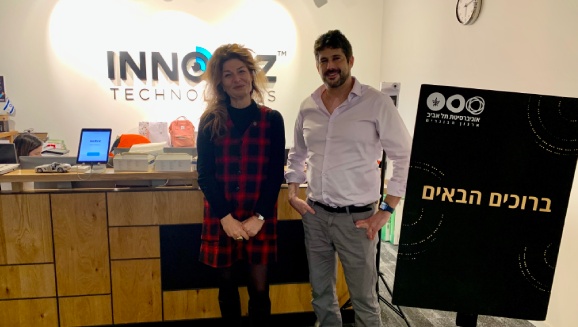
There is another Keilaf to be found among the demonstrations and earnings calls: the host. In January 2022, he welcomed about 20 Tel Aviv University alumni to Innoviz’s headquarters in Rosh HaAin. The visit included a personal conversation and a tour, launching a university series connecting young graduates with people already working in industry.
It is a concrete expression of his continuing connection to the university. The visitors came from engineering, management and humanities. The setting offered something a recruitment brochure cannot quite supply: a look at where the work happens, with someone available to explain how the company came into being.
In a separate public post, Keilaf described hosting Wikipedia founder Jimmy Wales during a high-school visiting program. Wales answered students’ questions about the encyclopedia’s beginnings and how its community works. Keilaf was particularly interested in the difficulty of protecting information while allowing people to contribute.
The subject is pleasingly close to his own professional preoccupation. An open encyclopedia and a vehicle sensor have very different jobs, but both become interesting when the conversation reaches trust: how information is gathered, checked and used. His account of the visit dwells on those questions, as well as the pleasure of having Wales there.
More places for the same eyes
Keilaf’s ambition has long extended beyond passenger cars. In 2022, he spoke about making the technology available to more entrepreneurs and developers, including people working in agriculture, heavy industry and security. The underlying attraction is straightforward: many machines need a useful account of the space around them.
In July 2026, Innoviz launched Perciz, a dedicated brand for defense and homeland-security applications. It is built around the company’s existing LiDAR sensors. The move takes technology developed for automotive requirements into settings such as perimeter monitoring and counter-drone systems. It also brings Keilaf’s civilian business back toward a field connected with his early technical training.
Alongside that expansion, Innoviz announced an engagement to develop and validate a LiDAR-based perception stack for highway driving with an unnamed top-10 global automotive manufacturer, using NVIDIA hardware. Development is the operative word: this is another program to execute, with the distance between an announcement and a finished deployment still ahead.
As of October 25, 2026, the next public financial checkpoint is scheduled for November 11. Meanwhile, the shape of Keilaf’s work remains recognizable: understand the problem, bring the disciplines together, persuade another organization to build with you, and keep going through the less glamorous years. There are plenty of puzzles left before he needs to reach for the Sudoku.