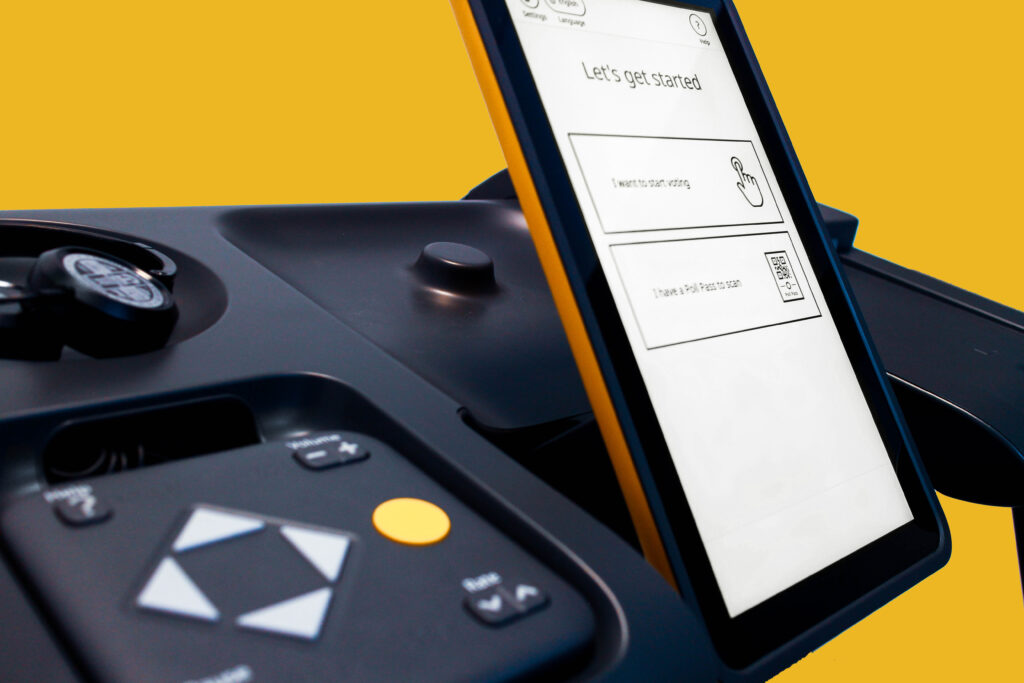
The yellow-rimmed screen looks approachable. Beside it sit headphones and a chunky controller, the sort of hardware that invites a hand rather than demands a manual. Yet this friendly object belongs to a $282 million assignment: help Los Angeles County deliver a voting system that more people could use independently. Smartmatic’s business lives in that gap between a simple gesture and an enormous public obligation.
The company manufactures voting equipment, develops election software and supplies the people and processes needed to deploy it. Its customers are election authorities; its ultimate users include voters who speak different languages, cannot see a screen or have never encountered the machine before. The purchase is technical. The consequences arrive in public, with a queue watching.
Los Angeles offers an unusually revealing way into the company. The county wanted more control over its voting technology and a better experience for its electorate. Smartmatic helped build the answer. The first election exposed the distance between a promising design and an operation ready for the rush.
The county bought an implementation, not an off-the-shelf box
Los Angeles had already done years of work before appointing Smartmatic. In 2013, it brought in design firm IDEO to develop concepts through research and repeated testing. The emerging system combined a touchscreen, audio output, a printer and a ballot box. The guiding question was how different people could complete the same act with dignity.
In June 2018, the county selected Smartmatic as prime contractor and systems integrator for Voting Solutions for All People, or VSAP. The $282 million contract value covered building, servicing and maintaining the system. That figure is a project commitment, not the price of a machine or an annual software subscription.
Smartmatic says it manufactured and programmed 31,000 ballot marking devices. The county owns the source code. That division of responsibility matters: public ownership of a design still leaves a formidable job of production, integration, certification and deployment. A prototype has to become thousands of dependable objects.
Contract value for building, servicing and maintaining VSAP.
This is the commercial shape of Smartmatic: large, tailored government contracts that combine equipment with services. Its expertise spans hardware, software, security and logistics. Buyers can purchase support for particular election stages or a broader operation. The company’s pitch has room for both the ballot scanner and the person answering a panicked support call.
The screen’s most important output is paper
For a Los Angeles voter, the machine provides ways to work through a ballot: change the display, choose a language, listen through headphones or use tactile controls. The county’s November 2020 materials described 13 languages and an adjustable screen. Accessibility features were brought into the same device instead of being confined to a separate booth.
The voter reviews a printed ballot before casting it. The ballot marking device does not itself tabulate the votes; counting happens later. That distinction often disappears when every piece of equipment is casually called a “voting machine.” It is a little like calling the check-in desk, aircraft and control tower an airplane.
The county also offers an Interactive Sample Ballot. A voter can prepare choices and bring a poll pass to the voting location. Preparation on a phone does not mean the phone has cast a vote. The VSAP remote ballot marking option likewise produces a ballot for physical return, rather than electronic submission.
- 01Check in
- 02Mark
- 03Review paper
- 04Cast
- 05County tally
The marking device and the counting system perform different jobs.
The queue found the weak points
The March 2020 primary was a bruising debut. Voters encountered long waits, and county registrar Dean Logan acknowledged the disappointment: “Obviously, this was not the rollout we had hoped for.” An inviting screen was only one part of getting a voter through the building.
The county’s subsequent review documented several failures. Its analysis identified a manufacturing defect in printer gears affecting ballot marking devices. Some faulty units had been isolated before the election, but the defect reached more machines than initially identified. The report also described insufficient help-desk capacity and support resources diverted toward deployment under a compressed schedule.
Check-in was another bottleneck. The operation had expected more voters during the extended early-voting period, leaving some locations under pressure on election day. Those failures should be examined component by component. A slow voter-registration lookup and a defective printer gear require different fixes, even when the public experiences both as the same long wait.
“Obviously, this was not the rollout we had hoped for.”
Dean Logan, Los Angeles County registrar, March 2020
The practical lesson is broader than voting. Test the complete service at peak demand. Include staffing, communications, spare parts and escalation paths. Public buyers can copy the county’s willingness to publish a detailed post-election review; contractors can copy the habit of treating the awkward handoffs between systems as part of the product.
A warehouse is part of the election
Smartmatic began in Florida in 2000 with Antonio Mugica, Roger Piñate and Alfredo Anzola. Its early work concerned cybersecurity and connected devices; its history dates its first voting machine to 2003. The company’s U.S. brochure credits the disputed Florida ballot experience of 2000 with prompting its shift toward voting. Elections turned that technical foundation into a business with physical deadlines and unusually demanding customers.
Today its operations software makes the less photogenic work explicit. Smart e-360 groups tools for recruiting poll workers, managing warehouses, tracking equipment, supporting field teams and handling incidents. A dashboard can help officials locate trouble, but someone still has to move the equipment or resolve the ticket.
That breadth is a meaningful part of its positioning. Smartmatic serves election authorities across different legal and operational settings rather than selling one universal voting experience. It reports work in more than 35 countries and more than 6.5 billion votes processed cumulatively. Those are company-reported totals across elections, not a count of individual customers or unique people.
The internal pitch matches the work: its careers materials stress civic purpose, candor, learning and inclusion. Those are employer promises. The observable business requirement is less abstract: engineers, designers and deployment teams must make their decisions fit together before the polls open.
Online voting needs more than a login screen
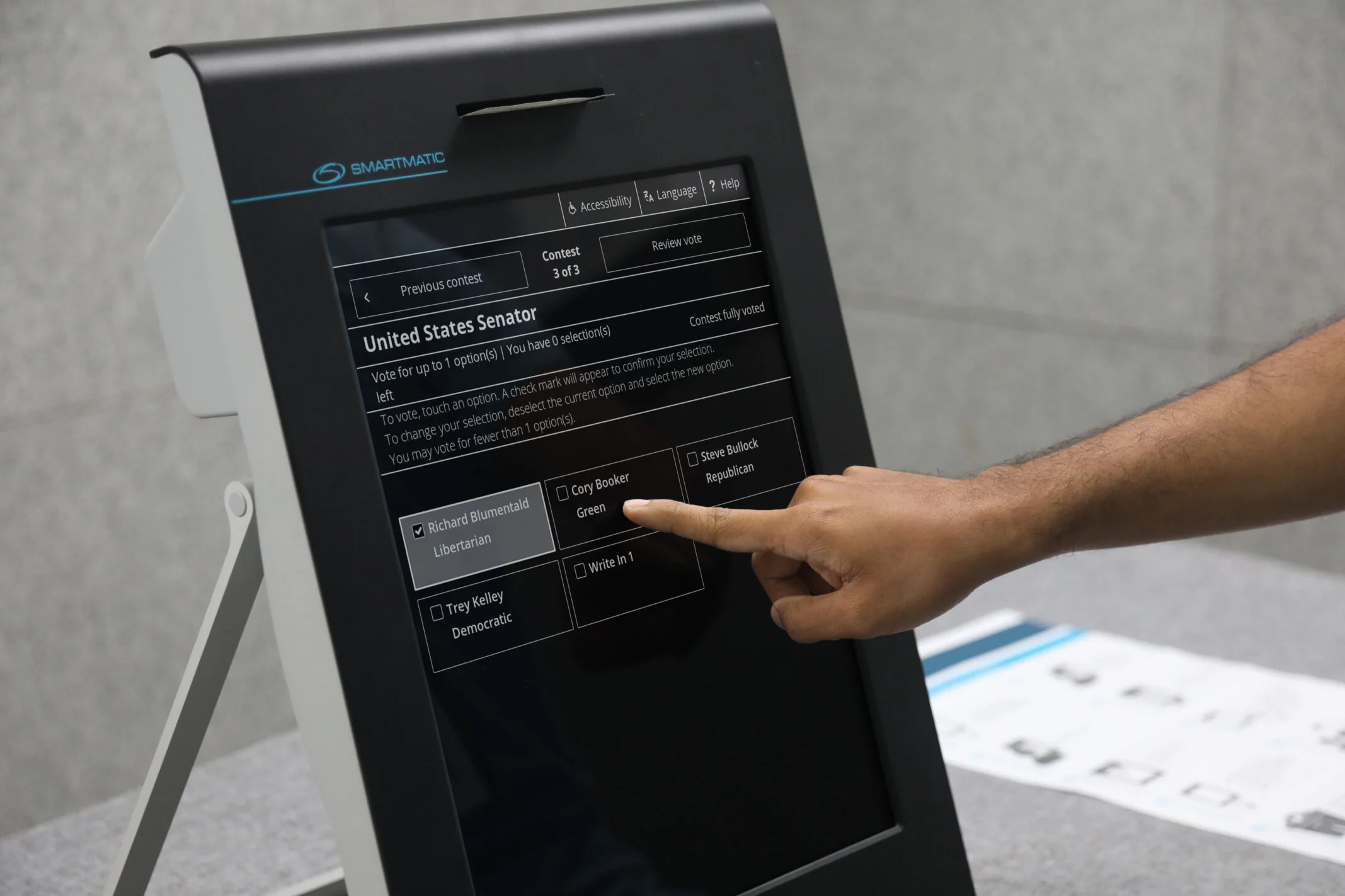
Smartmatic’s portfolio also includes TIVI, the internet-voting product launched with Estonian cybersecurity company Cybernetica in 2016. It addresses remote participation, including voters abroad. This is a different proposition from Los Angeles’s paper-producing ballot marking system.
In May 2018, Finnmark in northern Norway used TIVI for a regional referendum across 19 municipalities. Smartmatic reported that 85.5 percent of votes were cast online. That measures the channel voters chose; it does not mean 85.5 percent of all eligible residents participated.
Share of votes cast, as reported by Smartmatic.
The deployment used Norway’s ID-Porten public-service identity system. Online voters could vote again, with only their final electronic choice counted; an in-person paper ballot could supersede an online vote. These details matter more than a cheerful adoption percentage. Transplanting the approach requires suitable identity infrastructure, election rules and alternatives for people who cannot participate digitally.
When the supplier disputes the official number
Smartmatic’s sharpest institutional test came in Venezuela, an early election customer. In August 2017, the company said the announced turnout for the constituent-assembly election exceeded actual participation by at least one million votes. Venezuelan authorities rejected the accusation. The supplier was publicly challenging the institution that announced the result.
The episode marked a rupture in the relationship and illustrates a limit of election technology. Records can provide grounds to dispute an official account. Software cannot force authorities to accept that evidence. The lesson for buyers is to establish independent scrutiny and meaningful access to records before the result becomes politically inconvenient.
Smartmatic’s stated pledge includes “Remain impartial and independent.” That aspiration faces a difficult business reality: its customers control procurement, election rules and the official announcement. The product needs oversight arrangements that can withstand a disagreement with the customer.
Certification is one test. The courts are another.
In the United States, Smartmatic competes for work against established voting-system suppliers such as Hart InterCivic and Clear Ballot. The federal register records certification of Smartmatic’s VSR1 2.1 under VVSG 2.0 on November 26, 2025. Despite a first-place claim on Smartmatic’s history page, Hart’s Verity Vanguard 1.0 had already received that certification in July.
Approval also attaches to particular systems and versions. California’s March 2026 records include certifications for the county’s VSAP Tally 4.0 and Interactive Sample Ballot 4.0. These should not be confused with blanket approval of every Smartmatic product. For a buyer, the version number belongs in the conversation alongside the brand.
The company’s legal battles concern separate questions. Its 2020 U.S. work was limited to Los Angeles County, contrary to false claims of a nationwide vote-rigging role. Newsmax agreed to a settlement including approximately $40 million and a stock warrant in September 2024. In May 2026, a New York appellate court allowed further discovery in the Fox defamation case.
Separately, U.S. prosecutors charged parent company SGO in October 2025 over alleged bribery and money laundering connected to Philippine election contracts. Those are allegations, not convictions. Smartmatic sought dismissal in March 2026, alleging political retaliation; Piñate pleaded not guilty. Claims about procurement misconduct do not establish manipulation of election results.
The company therefore asks public buyers to assess several kinds of evidence at once: certified equipment, deployment records, corporate conduct and the ability to maintain an auditable process. The most useful question remains concrete. Can a voter arrive, make a choice independently, check the paper and leave knowing how that ballot enters the count? Every contract, screen and support call should help answer it.