A paper ballot is an awkward thing to make fashionable. It has no notifications, no subscription tier, and a disappointing capacity for disruption. Yet it sits at the center of Dominion Voting’s story. The company became famous for machines. Its most consequential product question is what people can inspect after those machines have finished.
- The job: help public officials prepare ballots, enable voting, count selections and report results.
- The buyers: election authorities. Voters use the equipment, but do not choose the supplier.
- The turn: Dominion was acquired and renamed Liberty Vote in October 2025.
- The test ahead: a new brand and a new certification application must earn their own credibility.
In Colusa County, California, the acquisition announcement contained a beautifully deflating parenthesis. Liberty Vote enabled paper ballots, the county explained. Colusa already used them. The notice also promised continuity of staff, equipment, certification and operation. To a clerk with an election approaching, continuity is a more useful noun than transformation.
That small county notice is a good place to begin. It separates the story on television from the business in the warehouse. Dominion made tools for a public process. Under Liberty Vote, that process still has to happen on time, with voters who deserve privacy and results that officials can check.
One ballot, several quite different jobs
Dominion’s business joins hardware and software across an election. Democracy Suite, its election management system, organizes the election definition and results. ImageCast X helps voters mark a ballot. ImageCast Precinct scanners count ballots at polling places. ImageCast Central handles batches at a counting facility. ImageCast Evolution combines precinct scanning with accessible ballot marking.
These distinctions matter. A device that helps a voter express a choice performs a different task from one that interprets marks. A central-count operator faces batches of paper rather than a line of voters. Treating every component as “the voting machine” makes for brisk conversation and poor understanding.
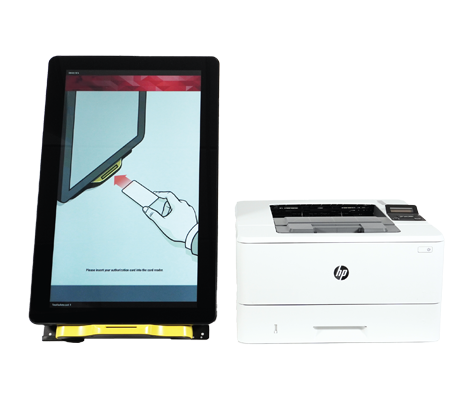
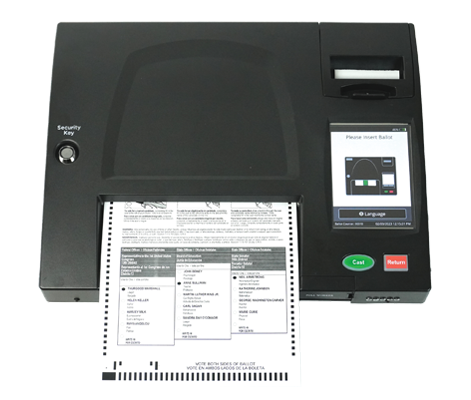
ImageCast X offers adjustable text, screen contrast, audio and alternative inputs, including sip-and-puff controls. The practical aim is a private, independent vote for someone who cannot comfortably read small type or hold a pen. Accessibility here belongs in the main product specification. A voting booth is a particularly bad place to discover that the interface assumes too much about its user.
- 01PrepareDefine contests and ballots
- 02MarkBy hand or accessible device
- 03ScanInterpret and tabulate
- 04ReviewCheck records and paper
The scanner leaves an explanation
AuditMark is one of the more revealing details in the product family. It appends a record of the scanner’s interpretation to the stored ballot image. An official can compare the marks visible on the image with the selections the tabulator recorded. When a ballot is digitally adjudicated, an additional AuditMark records that review.
Think of a voter whose mark requires closer inspection. A tally alone tells you the final answer. An image plus the recorded interpretation exposes the intermediate decision. That is useful evidence, although it remains a digital record produced within the system. Keeping the original paper and running the jurisdiction’s audit procedures supplies a separate basis for checking the count.
The company also offers automated test decks: marked ballots with known expected outcomes. Officials scan them and compare the result with what should have happened. It is an appealingly literal software test. The system is asked a question whose answer the administrator already knows.
“The first check was from my sister for $50,000.”John Poulos, recalling Dominion’s beginnings in a 2023 Axios interview
A public customer with a very hard deadline
John Poulos and James Hoover co-founded Dominion in Toronto. Its incorporation dates to 2003, the year Poulos uses for its founding. It later established its headquarters in Denver. The 2018 acquisition by management and Staple Street Capital brought private equity into a business selling hardware and software to government customers in the United States and Canada.
This is a procurement business. Authorities purchase systems and associated services; workers learn them; voters encounter them. Implementation, maintenance and support matter because elections are scheduled events. A customer cannot postpone election day while a vendor works through the backlog.
Georgia’s 2019 statewide voting-system contract. A system-level purchase, not the price of a scanner.
Georgia’s $107 million contract illustrates the scale of that commitment. It also illustrates the unglamorous risk of rollout. During the November 2019 pilot, reporting described check-in-pad glitches and ballot-selection screens switching off. Dominion and KNOWiNK equipment were both part of the deployment. The first reported friction in that pilot was operational: getting people through a working process.
For another buyer, the useful lesson is to rehearse the whole polling place. Test check-in, power, printing, scanning and worker instructions together. Buying individually capable devices does not automatically produce a capable queue. That is an editorial inference from the pilot, and a sensible procurement question.
Alternatives include ES&S, Hart InterCivic, Clear Ballot and Unisyn. Which can actually compete for a contract depends on the systems a jurisdiction approves. Dominion’s recognizable offer is an integrated product family, ballot-image interpretation through AuditMark, and central-count options using commercial scanners. Those features invite comparison; they do not establish that every rival lacks an equivalent.
The name became another piece of equipment
After the 2020 election, false claims that Dominion had helped steal the election made the company a political target. In April 2023, Fox News agreed to a $787.5 million defamation settlement. That payment belonged to a legal dispute. It was neither customer revenue from voting equipment nor a certificate of future technical performance.
On October 9, 2025, Scott Leiendecker’s Liberty Vote announced its acquisition of Dominion. Leiendecker had served as a Republican election director in St. Louis and founded the electronic poll-book company KNOWiNK. The purchase price was undisclosed. Shared leadership and familiar equipment are useful context, but they do not establish that KNOWiNK and Liberty Vote became one company.

Liberty Vote describes its mission in terms of secure, transparent, accessible and reliable elections. Its owner’s published approach stresses service and listening to officials. These are statements of intent. The interesting measure will be how that intent appears in support, approved products and elections people can administer.
The new ImageCast X brochure promotes a Uniform Ballot without barcodes or QR codes. Older certified configurations can differ. An advertised feature is not permission to alter every machine already in the field. For the buyer, the exact configuration and its approvals matter more than the freshness of the brochure.
Read the status line
Liberty Vote submitted Frontier 1.0 to the U.S. Election Assistance Commission on November 25, 2025, for testing under VVSG 2.0. The application was accepted on February 19, 2026. The regulator’s September entry lists an approved test plan and “Systems Under Test.” Those words describe progress through testing, not completed certification.
Testing application submitted
Application accepted
Test plan approved; system under test
Technical scrutiny also predates the new name. In June 2022, CISA disclosed vulnerabilities affecting ImageCast X and called for mitigations. It said it had no evidence those vulnerabilities had been exploited in elections. Both parts deserve to survive the retelling. A disclosed vulnerability requires action; it does not supply evidence for an unrelated claim that an election was stolen.
Hardware alone cannot deliver the promised result if access controls, handling of ballots, training or audit procedures fail. An integrated system also becomes a poor fit where its particular configuration lacks the necessary approval or cannot meet local accessibility and operational requirements. Election technology earns its usefulness inside those conditions.
For voters, the immediate benefit is practical: an accessible way to mark a ballot and a paper record to inspect before casting. For officials, it is a connected set of preparation, counting and review tools. For anyone building a business whose output must be trusted, the copyable idea is to preserve evidence of the decision. Arrange for inspection before the argument starts.
Dominion’s new name can open a conversation. The ballot, the interpretation and the public process have to finish it.
Meet the machines, hear the pitch
Visit Liberty Vote, browse the product family, or follow the legacy LinkedIn, X and Facebook profiles.
Explore the company’s news, the founder’s retrospective, and Frontier’s federal testing status.