Before John Olajide had a company to run, he had money to count. As a boy in Lagos, he helped bundle the cash from his parents’ trading business after finishing his homework. The following day brought a trip to the bank and a receipt. It is an unfashionable beginning for a technology entrepreneur: paper, physical goods, arithmetic. Yet the receipt belongs in this story. Someone had handed him a responsibility, and he had to bring back evidence that he had carried it out.
His parents distributed and wholesaled consumer goods, including products from Unilever. Their work made commerce visible at close range. Goods moved through warehouses to retailers; money had to be collected, counted and deposited. For a child who would eventually study telecommunications engineering, this was an early introduction to systems with very human consequences. A misplaced number could cause trouble long before anyone had the pleasure of blaming the software.
The family firm, before the software firm
Olajide was the middle child of five boys. His parents’ formal schooling ended early, but they built a business that supported the family. That distinction matters to his account of his upbringing. Practical knowledge had authority in the household. His first models of enterprise were people who could make something work, keep it working and provide for others through it.
He became interested in computers while at boarding school. Later, he made his way to North Texas, first attending Richland College and then transferring to the University of Texas at Dallas. He graduated in 2004 with a degree in telecommunications engineering. The sequence brought together two kinds of preparation: an understanding of how a business operates and the technical skills to change its machinery.
Axxess followed in 2007. By then, he had spent time consulting and learning about clients’ operations. The route from student work to a company was gradual enough to give him something a degree alone could not provide: repeated exposure to the people who would actually use what he built. There is a practical advantage in hearing the same frustration more than once. Eventually, it starts to sound like a product brief.
In 2016, nine years after the founding, Axxess was still describing its growth as organic and without outside investment money. Bootstrapping has a pleasingly rugged sound. The less picturesque part is the obligation to make a business support its own progress. Customers, spending and execution become closely related subjects.
- 2004Engineering degree
UT Dallas - 2007Axxess
founded - 2020Dallas Regional
Chamber chair - 2024Corporate Council
on Africa chair
Seven years in, a different office
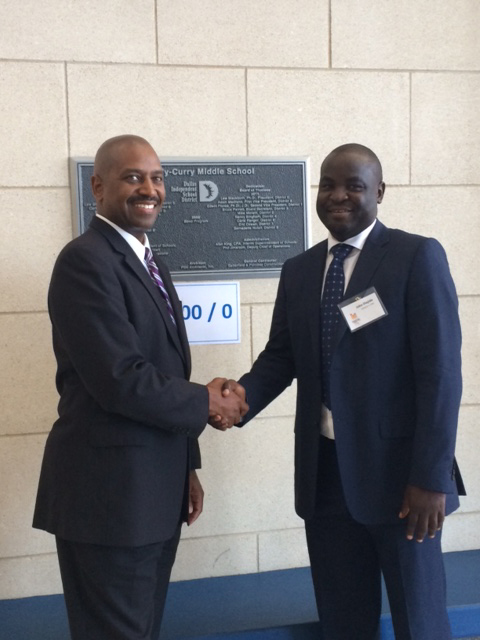
On October 14, 2014, Olajide reported to Kennedy-Curry Middle School in Dallas as principal for a day. He shadowed Dennis Taylor, the school’s principal. Taylor had an engineering background and experience in corporate America. Both men were UT Dallas alumni. The visit brought two people with some similar preparation into a workplace where Taylor knew the job.
The program invited business leaders to understand public schools and form relationships with them. That is a more demanding proposition than posing beside a building. A school contains its own management problems, obligations and expertise. A visiting executive gets a useful reminder that knowing how to lead an organization does not mean knowing how every organization works.
His involvement with students continued. At UT Dallas’s 2016 business idea competition, where he served as a judge, he offered a framework called REACH: build relationships, educate yourself, ask for help, communicate and stay hungry. The advice makes room for dependence on other people. Even the most determined founder needs somebody to answer a question honestly.
It is also advice suited to someone whose own career joined several worlds: a Nigerian family business, an American college education, engineering and entrepreneurship. Each transition required more than knowledge. Someone had to make a connection, offer a chance or help him understand the next room.
An alumnus puts money behind the word opportunity
In April 2016, UT Dallas recognized Olajide with its Distinguished Alumni Award. He credited the education, connections and guidance he had received there. The acknowledgment was specific enough to suggest that he viewed the university as part of the company’s history, even though the company had a different address.
Three years later, Axxess established a $500,000 endowed scholarship for students in the university’s Erik Jonsson School of Engineering and Computer Science. By January 2021, four students had been selected as the first Axxess Scholars. They came from four countries. A founder who had crossed a border to study was now helping students with international backgrounds pursue their own work.
An endowed scholarship at UT Dallas.
Four inaugural Axxess Scholars announced in 2021.
An endowment works on a different clock from a gala speech. It is intended to support future students, including people the original donor may never meet. That gives the gesture a practical patience. The money has a job beyond marking the donor’s success.
“If they succeed, we all succeed.”
John Olajide, on supporting UT Dallas students
He also became a co-chair of the university’s $750 million New Dimensions campaign. The movement from graduate to donor to campaign leader expanded the scale of his involvement. It kept returning him to an institution that had helped him start, this time with an ability to help determine what came next.
A larger table in Dallas
In January 2020, Olajide became chair of the Dallas Regional Chamber. He was 38, the youngest person to hold that position in the organization’s 111-year history. A business founded thirteen years earlier had given him a place in the civic life of the city where he had studied.
The appointment placed an entrepreneur among people responsible for representing a region’s business interests. Running a company gives an executive a particular set of incentives. A chamber asks him to consider employers and workers whose circumstances may differ considerably from his own. The constituency gets bigger; the answers tend to get less convenient.
That June, he was among the donors supporting the Revive Dallas Small Business Relief Fund. The initiative sought to help small companies, with a focus on businesses owned by women and minorities. The list of supporters included banks, foundations and individual business leaders. It was a concrete way to put resources behind a public commitment.
His civic work later earned another kind of recognition. In 2024, Junior Achievement of Dallas inducted him into its Business Hall of Fame, alongside fellow honorees including Cynt Marshall and Anne Chow. By then, the local story had become difficult to separate from an international one. Dallas was a base from which he worked, invested and convened.
The return journey has an investment portfolio
Through Cavista Holdings, which he founded and chairs, Olajide’s interests extend into agriculture, hospitality, technology, manufacturing and financial services. The portfolio includes Agbeyewa Farms and the hospitality business associated with Ikogosi Warm Springs Resort. Software is one part of a collection of businesses whose work can be seen in fields, factories and places where people stay.
Those activities give his ties to Nigeria an operating dimension. A farm needs people and equipment. A hospitality property needs guests and staff. A payment business needs customers who trust it to work. Each comes with its own demands. The broad statement that business can improve communities acquires specific responsibilities when there is a payroll to meet.
His role at the Corporate Council on Africa adds another scale of work. After serving as a vice chair from 2022, he became chairman in January 2024. The organization promotes commercial relationships between the United States and African countries. His own biography already connected those places; the position gave him a formal role in helping others build connections.
In February 2024, he led a council delegation to Nigeria for meetings about trade and investment, including discussions with President Bola Tinubu and government officials. Florizelle Liser, the council’s president and CEO, participated in the mission. The work involved understanding the conditions in which companies would be asked to commit capital and operate.
LagosFamily enterprise
and Nigerian investments
DallasEngineering studies
and Axxess
Family, education and business connect both places.
What keeps earning its keep
Olajide’s public reflections on leadership return to collaboration and the need for people to speak openly. On LinkedIn, he has warned about the cost of ego and argued that ideas deserve a hearing regardless of where they originate. It is an easy principle to applaud. Its real test comes when the useful suggestion belongs to someone with a less impressive title.
Outside work, he enjoys meals with friends and golf. He has said he ought to play more. His reading includes Alice Schroeder’s biography of Warren Buffett, The Snowball. He also tells a small story about reading British adventure books as a boy: he assumed that marshmallows roasted over a fire were meat. Arrival in America corrected the menu.
On October 21, 2026, Afe Babalola University in Ado-Ekiti conferred an honorary Doctor of Letters on him. The ceremony recognized a career whose investments now include businesses in Ekiti State. It added another university occasion to a life repeatedly shaped by education, enterprise and the connections between them.
The boy who brought home a bank receipt now has many more ways to account for his work. There are companies, scholarships and commercial partnerships. Each asks a familiar question in a different form: what happened to the opportunity somebody placed in your hands?
Continue the conversation
Explore Axxess and Cavista Holdings, or follow John Olajide on LinkedIn and X.