Eight thousand tapes make a peculiar calling card for a software entrepreneur. They occupy shelves, need returning, and have a distressing habit of being the very thing somebody else wants on a Friday evening. When David P. Cook opened the first Blockbuster in Dallas on October 19, 1985, he brought a computer programmer’s experience to that physical problem. The movies were the attraction. Keeping track of them helped make the attraction work.
Cook is also the founder and former chairman and chief executive of Zix, the email-security business. Between those two names sits another enterprise, Amtech, associated with electronic toll tags. A video rental, a toll payment, a confidential message: put them beside one another and an interesting career emerges. Each involves something passing between people or places, with a system working out what belongs where.
That connection is a way of reading Cook’s work, rather than a grand theory he has announced. His businesses supply the evidence. The familiar blue-and-yellow sign is only one entrance into the story.
A software business walks into a video store
Before the movies came software for the Texas oil and gas industry. Cook’s earlier enterprise, David P. Cook & Associates, and the publicly traded Cook Data Services provided the business background for his move into retail. He arrived with experience in handling information at scale, an unusually useful qualification for a shop full of individually rentable objects.
Sandy Cook, his wife at the time, helped steer the move toward video rentals and researched the market. Her part matters. The business began with both a customer’s interest in movies and a programmer’s interest in how a rental operation could function. Entrepreneurship occasionally looks less like a solitary revelation than a conversation that gets expensive.
The Cooks first entered the Video Works franchise. A disagreement over a blue-and-yellow store design preceded their departure and the launch of Blockbuster. It is an appropriately domestic detail in the origin of an international brand: before a company can argue over expansion, somebody has to settle the decorating.
The first store offered roughly 8,000 tapes and computerized checkout. The scale gave customers a broader choice than the small rental shops common at the time. Software helped make that choice manageable. A store could offer many movies, but it also needed to know which copies were available and which customers had taken them home.
The pleasant side of inventory control
For the customer, the changes were tangible. Tapes appeared on shelves rather than requiring an attendant to fetch every selection from behind a counter. Barcodes on tapes and membership cards helped shorten checkout. The experience borrowed something from a bookstore: browse, choose, carry the selection to the desk.
There is a small but consequential distinction between having a large inventory and letting people enjoy it. A stockroom can contain thousands of things without being a place anyone wants to visit. Blockbuster made the selection visible. The database and the shelving served the same purpose from opposite ends of the shop.
Cook also invested in distribution infrastructure in Garland, Texas. The warehouse supported the early stores and the prospect of opening more. Behind the apparently simple act of renting a film sat a business that needed stock, records and replenishment to agree with one another. The cassette case did a fine job of hiding the machinery.
Seen from this angle, Cook’s oil-industry background was less of a detour than it first appears. He had moved into a different market while carrying a useful skill: making information about a complicated collection accessible enough to act on. Customers could remain blissfully uninterested in the database. That was part of the appeal.
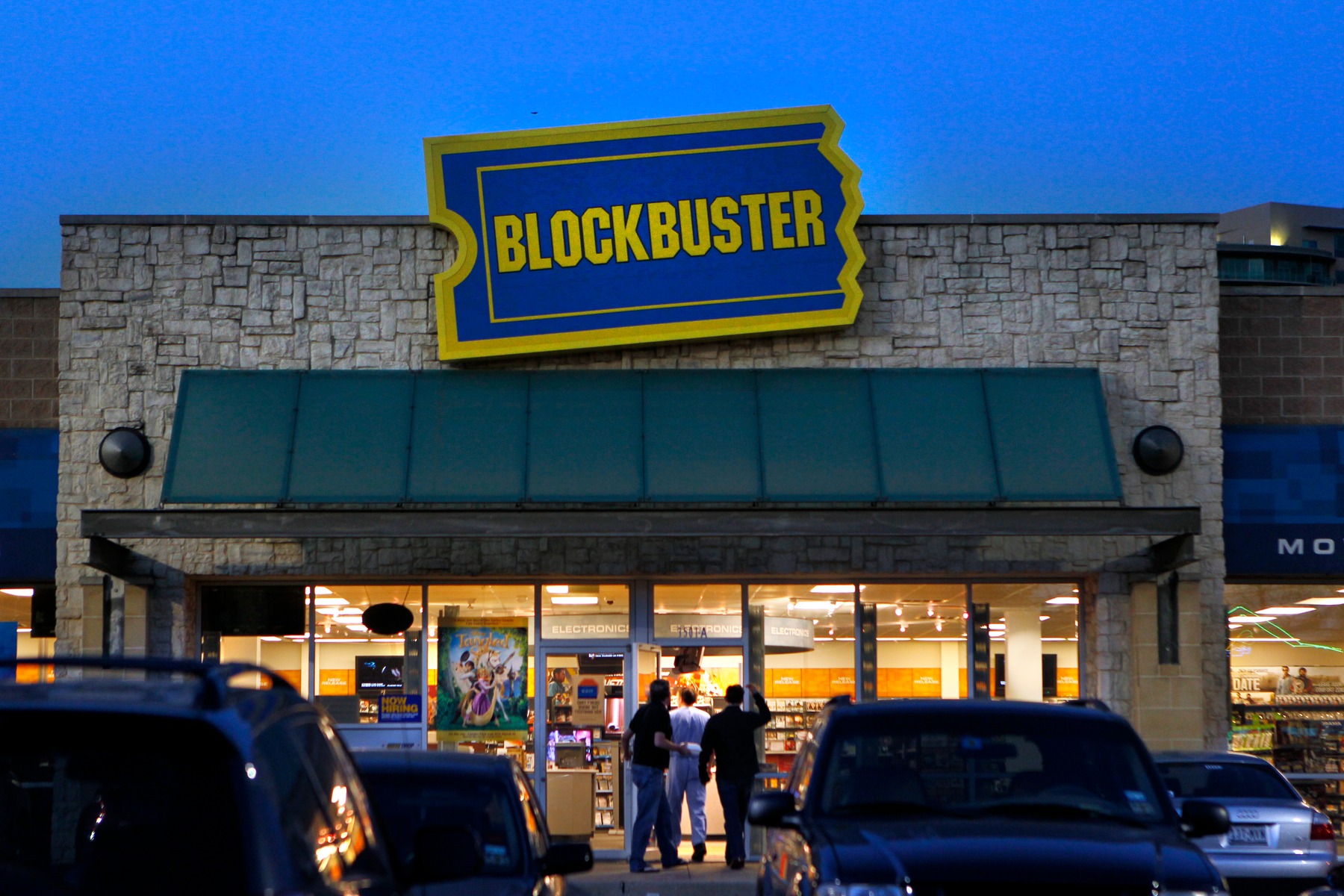
Leaving before the long second act
In 1987, Wayne Huizenga and his investment partners entered the business. Cook left that year. Huizenga brought experience building Waste Management and pursued expansion through acquisitions as well as new stores. The chain’s subsequent growth belongs to that next chapter of management.
The separation is essential to understanding Cook. Blockbuster’s eventual bankruptcy in 2010 came more than two decades after his departure. Its later encounters with Netflix, online rentals and streaming are often allowed to swallow the founder’s own story. A business name can remain constant while its leadership, ownership and problems change completely.
Cook’s personal timeline had already carried him elsewhere. The question worth following is what he chose to build after the first video stores. Another entrepreneur might have spent years repeating the opening scene. Cook’s next work took him toward vehicles passing electronic readers, with rather less need to rewind anything.
Next stop: the tollway
Cook launched Tag Systems, later renamed Amtech Systems, among the public companies he led. The toll-tag business put electronic identification to work in transportation. His early Blockbuster colleague Kenneth Ward Anderson also became involved in Amtech, extending a business relationship beyond the video shelves.
At the Dallas North Tollway’s introduction of electronic toll payment, Cook was dealing with a problem that comes before widespread adoption: explaining the product. People were calling with questions about how the system worked. The underlying idea involved a tag containing an electronic chip, roadside readers, and a charge to the driver’s account.
The point of that arrangement was practical. Drivers could pay electronically, reducing the transaction that otherwise took place at a tollbooth. The reader and account system took over part of the work. A person in a car had little reason to admire the identification technology in detail; getting through the tollway was a sufficient ambition.
The resemblance to the rental counter is useful, with limits. The products and engineering differed. In both settings, however, an ordinary transaction depended on identifying the right object and connecting it to the right account. Cook’s career repeatedly placed computing at such everyday junctions.
An editorial comparison of the problems his businesses addressed.
Email acquires a delivery problem
Zix’s corporate history includes a change of direction. The company sold its existing wireless-data and security businesses in 1998 and entered secure electronic messaging in 1999. Cook chaired the company from 1998 to 2000 and served as chief executive before John Ryan succeeded him in November 2001.
Email presented a different kind of queue. A confidential message could be easy to write and awkward to deliver securely, especially if the recipient lacked the sender’s software or cryptographic setup. A useful service had to accommodate the person at the other end. The recipient’s technical preparations were not necessarily going to match the sender’s enthusiasm.
Cook’s work reached beyond the executive office into the inventions. A secure-message-forwarding patent announced in June 2004 credited him with a method for reaching recipients without their own public-and-private-key pair or desktop client. The system determined an appropriate delivery method and handled differences between encryption systems.
Another patent, announced the following month, involved Cook and Zix chief scientist Gary Liu. Its secure-transmission system retrieved recipients’ public keys when needed and used transaction certificates. These details addressed some of the preparation otherwise required to exchange encrypted messages. The engineering worked on the distance between wanting privacy and successfully using it.
These were specific attempts to make a difficult transaction easier. They also make the title “founder” more informative. Cook helped establish the company and contributed to the technology it sold. His connection to Zix sits in the product’s workings as well as its corporate family tree.
The founder returns to the table
In August 2009, Zix announced Cook’s return to its board. He had served earlier stretches as a director, and the appointment reunited the company with someone who knew its technical beginnings. At the time, he was pursuing independent intellectual-property work and research.
“ZixCorp has made remarkable progress over the last several years, both in terms of financial stability and market presence.”David Cook · August 2009
There is another detail from his Zix years that deserves space beside the patents. During 2000 and 2001, Cook reallocated vested options covering 807,127 shares to certain employees and a director. The number describes options, rather than a cash gift. It records a transfer of potential ownership from a founder to other people involved in the business.
By December 23, 2021, Zix had reached another change of ownership: OpenText completed its acquisition. The announced purchase price was approximately $860 million, including cash and debt. That was a corporate transaction many years after Cook’s executive tenure, a later outcome for an enterprise whose technical history still included his inventions.
Cook’s career offers several endings, depending on where one stops reading. The video store leads toward a famous chain. The toll tag leads toward a transaction performed in motion. The secure message leads toward a recipient who can actually open it. Follow Cook through all three, and the work becomes more personal than the corporate labels suggest: a programmer keeps finding places where people would rather get on with their evening, their journey, or their correspondence.