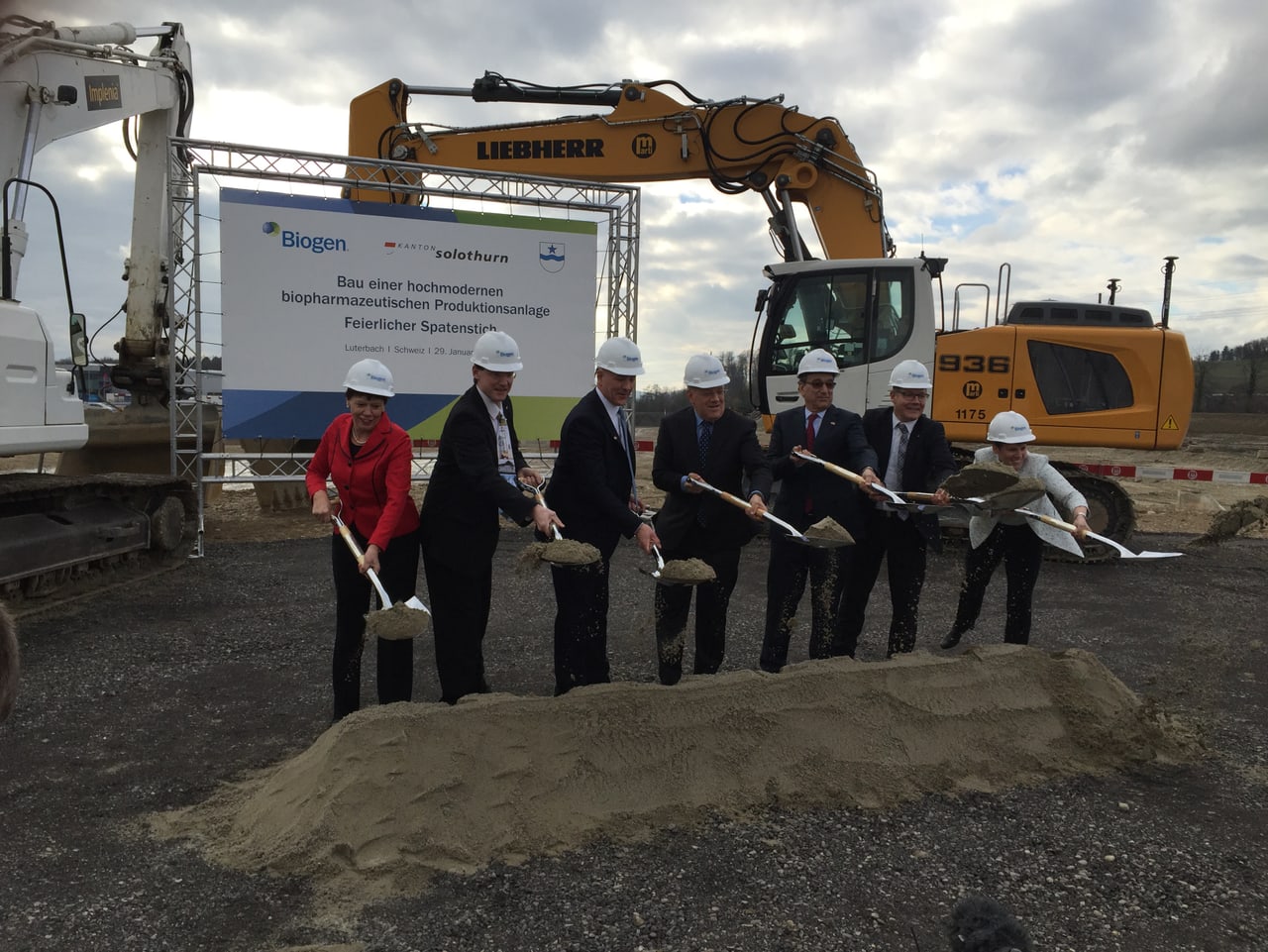
On January 29, 2016, John Cox stood third from the left in a row of people holding shovels in Luterbach, Switzerland. There were hard hats, dark suits and a mound of earth obligingly waiting to be disturbed. Behind them sat construction machinery large enough to make the ceremonial tools look rather optimistic. Biogen was breaking ground on a manufacturing site. Cox, then an executive vice president, had come to mark the beginning of something that would take considerably longer than a photograph.
A year later, he would be running Bioverativ as it became an independent public company. In January 2018, Sanofi would agree to buy it for approximately $11.6 billion. Those are the events that fit neatly into a business biography: a launch, a listing, a sale. The shovels offer another way into his story. Long before the transaction, Cox had been occupied with the awkward business of making an organization capable of delivering on its plans.
He is now president and chief executive officer of Dyne Therapeutics, based in Waltham, Massachusetts. His career connects the people who design a process, the people who operate it and the people who finance its expansion. Follow that route and the acquisition price becomes one chapter in a much longer education in how companies work.
A career learned from the inside
Cox’s early professional record is full of words that rarely make a dazzling conference introduction: technology transfer, validation, purification. From 1993 to 2000, he worked in those areas at American Home Products, later associated with Wyeth. Between 2000 and 2003, he held operational roles at Covance Biotech, which was acquired by Diosynth. These were jobs close to the mechanics of production, where an idea has to survive contact with equipment, schedules and repeatable procedures.
He joined Biogen in 2003. His responsibilities grew through manufacturing management, leadership of its Research Triangle Park operations in North Carolina, global manufacturing and technical operations. By June 2010, he was executive vice president of Pharmaceutical Operations & Technology. The remit covered facilities, supply chains, technical development, quality and engineering. Each title widened the same basic question: what must happen inside the company for the outside promises to hold?
His education crossed a similar boundary. He earned a bachelor’s degree in biology at Arizona State University, a master’s in cell biology at California State University and an MBA at the University of Michigan. LinkedIn lists his Michigan years as 1991 to 1993. Science and finance appear together on the résumé. Later, his work would repeatedly require both: understanding a technical possibility and deciding how much infrastructure to commit before the future had become obliging enough to arrive.
The steel mill in the biotech executive’s head
In 2015, Cox described an influence from outside his own industry: steelmaking. He was interested in Nucor and the way smaller mills had changed the economics of an established business. “I look at other industries, like steel,” he said. It is a useful glimpse of his working interests. He was looking beyond the familiar peer group for an answer to an industrial problem.
The choice he discussed was concrete. Large stainless steel installations offered volume; smaller disposable systems offered flexibility. Cox favored combining them, using different configurations for different production requirements. The question was how to prepare for uncertain demand without committing unnecessary capital to rigid facilities. In his account, the design of the factory belonged in the same conversation as the strategy of the business.
That way of thinking explains why the Swiss photograph belongs here. A manufacturing network is a decision about the future, expressed in land, machinery and people. At the groundbreaking, the announced project involved an investment of one billion Swiss francs and plans for as many as 400 initial jobs. Cox stood alongside company executives and public officials. The scene joined local government, international business and engineering in a single muddy frame.
Large corporate plans can sound strangely weightless until someone has to build them. On this occasion there was an excavator available to restore a sense of proportion.
How much future do you build today?
Smaller, disposable systems for changing requirements.
Stainless steel systems for sustained volume.
A new name, an existing business
In 2016, Cox took on the work of separating a business from Biogen. Bioverativ launched independently on February 1, 2017; regular trading under the symbol BIVV began the following day. This was a spin-off with an operating inheritance. It arrived with two marketed products, an experienced management team and $325 million in cash. The new letterhead had a substantial business behind it.
The mechanics mattered. Biogen shareholders were allocated one Bioverativ share for every two Biogen shares they held on the record date. Ownership was being redistributed along with responsibilities. A business that had operated inside a larger organization now had its own public identity and its own expectations to answer for. Cox’s assignment placed him at the junction between continuity and independence.
The story also changes the usual picture of a new chief executive. He was leading an organization whose assets and capabilities had already been developed, while giving it a separate structure and direction. That requires a different kind of beginning from an empty office and a first hire. There is something to preserve, something to change and a calendar that keeps moving while both are negotiated.
Under his leadership, Bioverativ reached approximately $1.1 billion in global sales and nearly 500 employees. These figures describe a company with international operations and an established commercial base. They also help explain why his manufacturing experience remained relevant as his responsibilities widened. An independent business still has to coordinate all the functions that made the business possible.
The number everybody remembers
On January 22, 2018, Sanofi announced an agreement to acquire Bioverativ for $105 a share in cash. The approximately $11.6 billion equity value became the number attached to Cox’s name. Both boards had unanimously approved the transaction. In roughly a year, the newly independent company had moved from its own launch to an agreement with a larger international owner.
“This transaction delivers tremendous value,” Cox said in the announcement. It was the language of a chief executive addressing shareholders at the end of a concentrated period of company building. The transaction was a proposed acquisition when announced, a distinction easily lost when a career is compressed into a sentence. The price records what the buyer agreed to pay for the company. It says little by itself about the daily work required to operate it.
For Cox, the next career decisions are revealing. He returned to leadership roles in younger organizations. In January 2019 he became executive chairman of Torque Therapeutics, then its chief executive in September. Repertoire Immune Medicines followed, bringing Torque together with Cogen. The operating problem had changed again: after separating a business, he would help combine two.
This sequence gives his career its unusual rhythm. He has worked inside a large organization, led a business out of one, and taken charge when two organizations came together. The corporate diagram keeps changing. The need to make the parts work together persists.
“This transaction delivers tremendous value.”
John Cox · January 2018 acquisition announcement
Two companies, one operating plan
Repertoire’s public launch came in March 2020, with Cox as chief executive. Flagship Pioneering had brought together two of its companies and their complementary capabilities. His appointment put an executive with a manufacturing and commercial background at the head of another integration exercise. A combined organization needs shared decisions about investment, leadership and priorities, however persuasive its initial logic may be.
In April 2021, Repertoire closed a $189 million Series B financing. Participants included founding investor Flagship Pioneering, SoftBank Vision Fund 2, PSP Investments, Alaska Permanent Fund and Invus. The round brought together investors with different institutional backgrounds around the same company. Cox served as Repertoire’s chief executive through November 2022.
Capital provides room to work. It also adds another set of commitments to a chief executive’s desk. Seen beside the Bioverativ spin-off, Repertoire gives a fuller picture of Cox’s experience: allocating resources within a company, establishing a separate company and assembling a combined one. Each setting asks different questions of the same executive. There is no reason to expect an answer that worked in one setting to transfer untouched to the next.
- 2003Joins Biogen
- 2010Becomes an executive vice president
- 2017Leads independent Bioverativ
- 2020Leads combined Repertoire
- 2024Takes the helm at Dyne
Back in Waltham, another handover
Cox became Dyne’s president, chief executive and a director on March 25, 2024, succeeding Joshua Brumm. Brumm agreed to serve as an adviser during the transition. The appointment brought Cox back to a Waltham leadership role with experience across global operations, independent company building and commercial management. He also appears on Atlas Venture’s team as an adviser, connecting his operating career with the investment community.
At Dyne, he spoke about building additional capabilities and creating value for stakeholders. The language fits the work that has followed him through successive roles: an organization must acquire the capabilities its next stage requires. Hiring, investment and coordination become part of the story alongside the chief executive’s public appearances. The transition itself also reminds us that a company’s development spans more than one leader’s tenure.
By July 2026, Cox was still signing Dyne’s quarterly certification as president and chief executive. In September, he appeared with chief financial officer Erick Lucera at a Morgan Stanley investor conference. It is the public side of the job: explaining decisions, answering questions and representing the organization to people who have committed capital or are considering doing so.
The route to that stage began much closer to production. The early roles, the North Carolina operation, the Swiss construction site, the spin-off and the merger all belong to the same professional history. Its recurring subject is the organization behind the announcement. Look again at the row of shovels in Luterbach. The ceremony occupies an afternoon. The work that makes it worth holding occupies years.