John Castle chose an unusually small vessel for an unusually large American journey. In 2006 and 2007, the Wall Street investor retraced the Lewis and Clark water expedition from St. Louis toward the Pacific in a 15-foot dinghy. The itinerary ran to 3,100 miles. Anyone seeking a vacation with a drinks trolley would have chosen poorly.
There were other trips. His Hinckley sailboat left Palm Beach in April 1993, passed through the Panama Canal, crossed the Pacific and Indian oceans, and worked its way through the Red Sea into the Mediterranean. It returned to Florida on December 16, 1995. He landed at both poles in a small plane and trekked to Everest’s base. The dinghy, however, is the detail that lingers: a financier associated with substantial pools of money, moving across a continent at water level.
It offers a useful way into his professional life. Ownership puts you close enough to make decisions, and close enough to experience their consequences. A small boat makes that arrangement rather literal. Castle’s business career has repeatedly returned to the same question: how much can you improve when you have the ability, and the responsibility, to act?
The first assignment was already a buyout
Castle arrived at Donaldson, Lufkin & Jenrette on July 1, 1965. His first project involved ITE Circuit Breaker, a Philadelphia business whose depressed shares had attracted a group of Chicago businessmen seeking control. Castle was the junior member of the team, helping with the business and its financing. He encountered private equity through an actual company, with actual work to do.
Four years later, he was running DLJ’s private equity activities and had formed the Sprout Fund. Institutional investors included insurers and a pension fund. The vehicle was a limited partnership, a structure that allowed large pools of capital to participate in private businesses. Castle helped establish an arrangement that would become familiar throughout the investment industry.
The mechanism matters as much as the milestone. An institution could commit capital to a fund; an investment team could select and work with companies. Each acquired business still had customers, costs, employees and competitive problems. The financial structure connected those separate worlds. It gave professional investors a means of putting money to work beyond publicly traded shares.
Castle had come through MIT and Harvard Business School, where he earned an MBA as a Baker Scholar with High Distinction. Scientific training and business training make a plausible pairing for someone who would spend years assessing companies. Neither degree, of course, removes the inconvenience of dealing with people. That part of the education continues long after graduation.
The banker who remembered the person
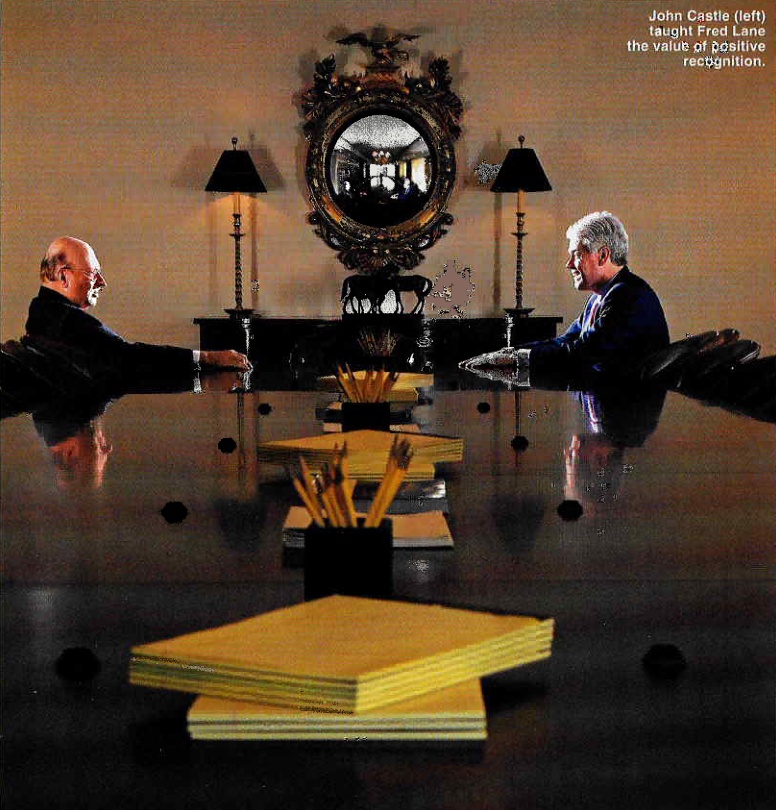
In the mid-1970s, Fred Lane was a young accountant looking for a change. An introduction brought him to Castle, then leading investment banking at DLJ. Castle helped him join a banking operation that still numbered roughly a dozen people. Their association lasted through bigger responsibilities, new firms and the familiar alterations of age.
When Lane wanted to move back to Boston in the early 1980s, he expected resistance. Castle accepted the decision. The episode is modest, which is precisely its value. Trust in a colleague becomes more convincing when it survives an inconvenient request. A manager can profess respect at almost no cost; making room for another person’s judgment costs something.
Castle also gave employees awards that recognized contributions to the firm. Lane remembered the importance of receiving recognition from peers alongside a financial bonus. This was a banker’s office in which money could be counted accurately, yet apparently could not account for everything.
Their later conversation included Castle’s recollection of Lane’s once-brown hair and his own vanished supply. Beneath the joke sat a serious observation: he thought Lane’s character had remained consistent. The attention was to a person over time, rather than a résumé at a moment. For a career built around transactions, that is an interesting unit of measurement.
A business need not be fashionable
Castle and Leonard Harlan founded Castle Harlan in 1987. The partnership carried experience from DLJ into investments in established middle-market businesses. Its portfolio history ranges across furniture, restaurants, industrial components and packaging. A person could encounter these businesses during an ordinary day without ever encountering their owner’s name.
The firm’s stated criteria have a restrained appeal: an established business, a strong position in its market, moderate growth, a partnership with management and a sensible price. None is an especially glamorous phrase. Together they describe a demanding exercise. A company must have something worth preserving, room to develop it and a purchase price that leaves the investor room to be wrong.
This approach also changes what counts as interesting. A familiar product can sit inside an unfamiliar business with valuable distribution, dependable demand or specialized know-how. The task is to understand those details. An investment presentation may look splendid; the customers still have to come back.
Castle Harlan’s record includes failures. It bought Sharon Steel out of bankruptcy in 1990, only to see steel prices fall and the investment fail. The loss is a necessary part of the story. A preference for established companies cannot make an industry stand still. Careful ownership remains exposed to changes beyond the owner’s control.
The house with unusually famous former owners
In 1995, Castle bought the Kennedy family’s former Palm Beach estate. The Mediterranean-style house had an extraordinary history and an unpromising physical condition. He saw a property worth restoring. It was a purchase with an obvious emotional attraction, but he approached it with the familiar concern for price and practical work.
The house required more than two years of renovation and over 300 inspections by local building authorities. Castle even replaced palm trees close to their original positions. The restoration turned a celebrated address into a very specific project: permissions, construction, preservation and details that could not be settled with admiration alone.
His description of his investment habits came with a dry admission: “We’re sensible people, but we’re cheap.” At the house, thrift coexisted with the willingness to undertake an expensive restoration. Buying carefully and spending carefully are related skills, although neither necessarily means spending little.
Castle and his wife, Marianne, sold the property in May 2015 for $31 million, after twenty years of ownership. That number marks the end of the holding period, rather than a complete calculation of the investment. The more revealing feature is the work between purchase and sale. An acquisition is one decision. Caring for what has been acquired is a succession of them.
A steakhouse is an economic instrument
Castle’s attention to operations could become wonderfully concrete. He questioned Morton’s leadership about why fewer steaks had been sold in Minneapolis during a particular month. The question collapses the distance between Wall Street and a dining room. A portfolio company has a valuation; a restaurant also has a refrigerator and a Friday evening.
In 2011, Castle described reviewing order rates at portfolio businesses every week. Packaging companies and restaurants supplied clues about the economy as it was being lived. His example was a salesperson deciding whether a good week justified dinner out. The observation was plain enough to survive without a chart full of acronyms.
He also remembered an Australian television investment that emerged through a colleague’s church connection with the company’s finance chief. Local knowledge and a conversation helped reveal a possibility. An investment team still had to investigate and execute it. The anecdote gives serendipity its proper size: an opening, followed by work.
His answer about the part of the job he liked was equally plain: “I like building companies. I like growing businesses.” That is a statement of preference, rather than a guarantee of outcomes. It explains why the operating details held his attention. A stock quote can tell an investor what a market thinks. An order book gives an owner a different sort of conversation.
“If you miss one bus there will be several more.”John Castle, 2015
A firm can change its route
Castle Harlan decided against raising a sixth fund in 2015. That decision generated reports of a wind-down, although the firm continued managing investments and pursuing transactions. By 2020, family offices were backing deals individually, and Castle Harlan had co-invested with independent affiliate Branford Castle in Titan Production Equipment and Sunless.
Branford had begun in 1986 to manage Castle family money. It later raised outside funds, with John S. Castle and David Castle taking leading roles. The firms remained separate while collaborating on investments. In 2020, their executives were meeting weekly to discuss potential transactions. A shared surname and a working relationship did not erase the distinction between the organizations.
Today, Branford lists the elder Castle as chairman and John S. Castle as president and chief executive. Castle Harlan’s public biography continues to list John K. Castle as chairman and CEO. The roles describe a career that now stretches across several generations of private equity.
The sequence invites a more careful reading of institutional change. Fundraising, managing an existing portfolio and making another acquisition are different activities. They need not all proceed on the same timetable. Castle’s response to a change in one part of the business was to keep pursuing the parts that remained available.
Recognition beyond the closing dinner
Castle’s institutional commitments extend into education and New York civic life. He is a Life Member Emeritus of the MIT Corporation and a trustee and executive committee chairman at St. Patrick’s Cathedral. Those posts involve organizations whose purposes and time horizons differ from an investment fund’s.
In 2017, the Alfred E. Smith Memorial Foundation presented him with its Happy Warrior Award. The dinner brought him onto the program with House Speaker Paul Ryan and actress Patricia Heaton. It is a setting in which political and business figures are expected to tolerate a little humor. Even a seasoned dealmaker must occasionally submit to an audience that cannot be acquired.
A later appearance of his name belongs to a university classroom rather than a closing document. In July 2025, Yale appointed philosopher Luciano Floridi the John K. Castle Professor in the Practice of Cognitive Science. Floridi directs Yale’s Digital Ethics Center. The appointment places the name of an investor associated with industrial and consumer businesses beside scholarship about the digital world.
Castle’s own recreational ambitions were expressed more simply. He wanted to keep finding places to explore. That wish fits a life whose destinations have ranged from institutional investing to polar landings and American rivers. The scale changes, and so does the equipment. The pleasure seems to lie in staying involved long enough to discover what the next stretch requires.