The future of spaceflight keeps arriving in very ordinary-looking boxes. They are gray or black, drilled for mounting screws, labelled with part numbers and utterly indifferent to romance. Inside them, however, power is converted, batteries are protected, commands are handled and torrents of payload data are turned into something useful. John Bevilacqua has spent the public portion of his career making those boxes smaller, tougher and easier to put on a spacecraft.
His company, Ibeos, began life in Virginia in 2013 as Cubic Aerospace. The founding aim was specific: develop high-reliability spacecraft electronics without accepting the traditional cost and schedule as laws of nature. Bevilacqua had studied at MIT from 1998 to 2003, according to his public profile, and emerged in company records as the engineer at the center of the technical work. Early event listings called him chief technology officer. By 2023, he was being introduced as founder and CEO.
This is not a business where a confident demo can outrun the product. Space hardware must tolerate radiation, vacuum and hundreds of thermal cycles. It must perform after launch vibration has tried to rearrange it. Then it must keep performing where the returns department is 400 kilometers away on a good day. Bevilacqua chose a field in which reliability is less a virtue than the price of admission.
Begin with the expensive clock
In 2017, Bevilacqua appeared in the federal Small Business Innovation Research record as principal investigator on a $138,473 Air Force award. The problem hid inside a celebrated advance. Electric propulsion can sharply reduce the fuel a geosynchronous satellite needs, but its gentle thrust can leave the spacecraft climbing toward its final orbit for months. Time saved in launch mass can return as time lost before service begins.
Cubic Aerospace proposed using solar-array power that was available at the beginning of a mission but not fully exploited. Its architecture paired a power converter with a controller so more energy could reach the electric thruster during orbit raising. The Phase I description estimated that the approach could shorten the transfer period by as much as 40 percent. A $747,037 Phase II award followed in 2018 to mature the design, build representative prototypes and conduct environmental testing.
It was a revealing choice of problem. Bevilacqua was not trying to invent a new destination. He was trying to reduce the billable months between launch and arrival. The engineering lived in voltage, controls and qualification; the value lived on a calendar.
“We align our research and development efforts based on feedback from our customers to deliver mission-enabling products that support their internal roadmap.”John Bevilacqua, 2023
A company learns to productize
Over the following years, the company widened its shelf. Ibeos built power conversion and distribution equipment, command-and-data-handling systems, batteries and payload computers. The common idea was not merely miniaturization. Smaller satellites wanted much of the capability of far larger spacecraft, but without the corresponding mass, volume or budget. Every improvement had to survive the old environment while fitting the new economics.
Bevilacqua described the job through customer requirements. Ibeos engineers had experience designing full satellite subsystems, he said in a 2020 product note, and that wider view helped them understand how a component supported the mission rather than simply meeting an isolated specification. The distinction became tangible in a 50-volt, one-kilowatt-hour battery program. Ibeos delivered seven units within seven months of contract signing: four flight units, two engineering-development units and one qualification unit. The first flight unit went out in less than six months.
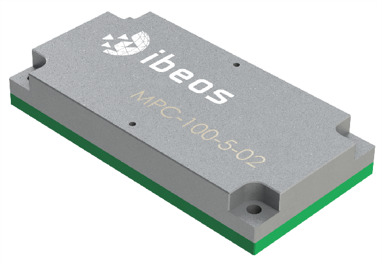
A year later, Bevilacqua presented Ibeos work at The Aerospace Corporation's Space Power Workshop. The MPC-500 used gallium-nitride technology to convert solar-array input as high as 130 volts into a spacecraft bus voltage between 28 and 100 volts. One module handled 500 watts; units could be run in parallel into the tens of kilowatts. Modularity made the same engineering idea useful across missions of very different scale.
The company's work also moved in the other direction: from power toward computation. Its EDGE-1100 payload processor put an AMD Ryzen system-on-chip into a radiation-tolerant 3U SpaceVPX format. The board combined a four-core, eight-thread x86 CPU with 512 GPU cores and mitigation against single-event upsets. Ibeos said it could exceed 1.1 trillion floating-point operations per second, or reach two trillion in single precision, while an industry profile put its typical appetite at roughly 40 watts.
The slyly practical feature was familiarity. Developers could use AMD's ROCm software and common machine-learning frameworks such as PyTorch and TensorFlow. Algorithms developed on ordinary hardware would need less refactoring before moving to the flight computer. In space, even convenience has to pass a radiation test.
Margins on top of margins
Bevilacqua's technical writing offers a glimpse of the engineering temperament behind the company. In white papers co-authored with Renesas, he examined power systems for radiation-tolerant FPGAs. Modern chips demand several low-voltage rails, substantial current and carefully ordered startup sequences. An interface, memory device or housekeeping controller that wakes at the wrong moment can spoil the performance of the expensive processor beside it.
A 2024 paper noted that space engineers tend to add margins on top of margins to protect reliability. Yet excessive voltage can threaten the FPGA it is supposed to protect. The useful solution is not simply more caution. It is a system view: every rail, sequence and interacting device considered together. This is where Bevilacqua's career as engineer and operator converges. Both jobs require respect for dependencies.
The same logic shaped Ibeos's use of commercial technology. Advanced packaging, gallium-nitride semiconductors and processors designed for Earth offered tempting gains in density and performance. Ibeos subjected candidate parts to radiation, outgassing and environmental tests before trusting them in space. Innovation here meant borrowing speed from the commercial market without borrowing its assumptions.
A satellite may be judged by its mission. It survives by its margins.
The seams become the strategy
By 2024, Ibeos described many of its core products as Technology Readiness Level 9 and operating on orbit. It had delivered electronics to NASA, Defense Department and commercial customers. The company also recruited John Moberly, a veteran of national-security space programs, as chief growth officer and general manager of government programs. Bevilacqua framed the hire around anticipating customer needs and putting the company's avionics in front of a larger market.
Then, on March 9, 2026, Trident Solutions announced that it had acquired Ibeos. The price remained private. The industrial logic was public. Ibeos brought qualified power systems, dense batteries and flight computing; Trident brought mission-data processors, networking, production capacity and a larger operating platform. Together, the companies could offer more of a spacecraft's electronic nervous system through one supplier.
Supplier count sounds like a procurement concern until every boundary becomes an interface to define, test and debug. A battery has to speak sensibly to the power-distribution unit. The processor has to live within the thermal and electrical budget. Networking has to move what payload computing produces. Fewer seams do not eliminate complexity, but they can place more of it inside one engineering conversation.
Bevilacqua called the combination a chance for the two companies to use their core strengths, scale together and respond more quickly to changing national-security and commercial requirements. Existing Ibeos customers and programs were to continue. The founder's language had moved from making a component support a mission to making two organizations support a wider product system. The underlying habit was the same: understand the adjacent requirement.
The useful lesson in the gray box
There is a clean operating idea inside Bevilacqua's record. Start with a customer constraint whose cost can be measured. Prototype the risky portion early. Use commercial technology where it earns its place, then qualify it for the environment it will actually face. Turn bespoke learning into modular products. Finally, put those products beside their natural complements.
None of this has the easy sparkle of a rocket launch. It offers a sterner satisfaction. A power converter is valuable because a propulsion system reaches orbit sooner. A battery is valuable because the payload wakes again. A processor is valuable because useful information can be produced before the downlink. The component disappears into the mission it enables.
That disappearance may be the point. For thirteen years, Bevilacqua built the electronics that other space ambitions could take for granted. When Trident came calling, it was not buying a single dramatic invention. It was buying a connected body of proof: power handled, data processed, units delivered, hardware qualified and customers served. In an industry fond of looking up, he made a career by looking inside the box.