Two people came to Joe Robinson’s first Designers + Geeks gathering. He had picked a bar in San Francisco called John Collins. Another meetup, for an online gaming community, was there too. The groups combined, and the evening went on. Both of Robinson’s original attendees became good friends. As beginnings go, it had the advantage of making introductions quite manageable.
There is something useful about that little scene when considering his subsequent career. Robinson now leads Hummingbird, which builds software for financial-crime investigations. His work involves banks, fintech companies, information scattered across systems, and people who need to cooperate. Years earlier, he was already giving people a reason to gather, then attending to the practical arrangements that made gathering worthwhile.
A host who preferred having a job to do
Robinson describes himself as introverted. Running an event gave him a defined role, something to do in a room where unstructured mingling could feel uncomfortable. The host could be busy making everyone else comfortable. An efficient little bargain.
Designers + Geeks began in 2010. Its interests were broad enough to accommodate art, design, and technology under the same roof. Robinson’s LinkedIn account records more than 300 events and nearly 50,000 tickets sold across San Francisco, New York, Chicago, Los Angeles, and Boston. Those figures describe the community’s history, rather than an attendance forecast for its next meeting.
There had been other gatherings before it. He organized Live Music SF for people who wanted company at concerts, then led Silicon Valley NewTech. Later, he would describe these communities as places where new ideas and collaborations became possible. His interest in a network was rooted in what its members could actually do together.
That gives his career a certain continuity. Product work, community organizing, and company building all require an appreciation of other people’s circumstances. A clever idea has limited usefulness until someone can find a comfortable way to participate in it.
The dashboard was an education
Robinson entered the technology industry at Brightcove in 2006. His career then moved through Square, Circle, and consulting work with IDEO.org. These were different vantage points on how products reach people: online video, merchant tools, digital currencies, and design.
At Square, where he arrived in 2011, he worked on products including Dashboard and Online Stores. He has described helping design and build the first merchant dashboard as an experience that sharpened his sense of utility. The person managing a business deserved the same consideration as the person making a purchase.
His later writing makes that argument concrete. Enterprise products sit inside constraints: old infrastructure, established procedures, and obligations that a designer cannot simply wish away. He advocates understanding the industry, listening to the people doing the work, and offering improvements that can fit into an existing system.
This is a fairly demanding version of design. Attractive screens are welcome. The harder achievement is making a complicated working day less cumbersome. A merchant has to run a business after the product demonstration ends; an investigator has to finish a case.
- 2006Brightcove
Online video - 2011Square
Merchant products - Before HummingbirdCircle
Product, risk & data science - 2017 onwardHummingbird
Financial-crime investigations
The route back ran through other people
At Circle, Robinson’s responsibilities moved from product into risk and data science. Financial crime became an operational problem he had to work on himself. Payments technology could make moving money easier. It could also expose a company to people with rather different intentions for that convenience.
His path to founding a company included an interlude in Europe, running conferences and consulting with IDEO. By late 2016 and early 2017, he wanted to start something, although the precise business remained unsettled. At SXSW, he reconnected with Matt Van Buskirk and Jo Ann Barefoot. He had also been exploring ideas with Jesse Reiss and Ryan Gerard.
Those conversations helped bring Hummingbird together. Its founding circle combined technology experience with regulatory experience. Robinson’s account places the commitment to fighting financial crime before the final choice of product. There was a purpose to agree on, then a practical question about where the team could be useful.
The order matters. A team with that purpose might build any number of things. Hummingbird concentrated on the investigation itself: the work people perform after something has attracted attention and needs an explanation.
A detective story with an inbox
Robinson has pushed back against the cinematic picture of investigation as one detective absorbed in one case for months. In a 2021 description, he put a typical investigator’s workload at 50 to 100 cases a week. The exact workload varies; his point was the volume, and the need to assemble information quickly.
An investigator may need transaction records, customer information, device activity, and material from other tools. A suspicious pattern must become an intelligible account. If a report is warranted, the information needs to reach the people who can act on it. Every awkward handoff makes that task harder.
Hummingbird’s focus gave Robinson’s design interests a particular home. The customer was a professional with specialist judgment, an accumulating queue, and an obligation to document the reasoning. Software had to respect all three. The person clicking through the case deserved tools designed around the actual job.
The commercial response became visible in December 2021, when Hummingbird announced a $30 million Series B led by Battery Ventures. The round brought its announced funding total to $41.8 million. Its customer list included Stripe, Coinbase, Evolve Bank & Trust, and Upgrade.
That funding was company capital, intended to expand its team, products, and markets. The underlying proposition remained quite workaday: give compliance professionals a coherent place to conduct their investigations. There is a useful modesty in the unit of progress. Another case understood. Another handoff completed.
Buying a way through the data problem
In September 2024, Hummingbird acquired LogicLoop, adding technology for connecting data and automating work without requiring users to write conventional application code. The acquisition addressed a problem Robinson had been describing for years: the information exists, but reaching it and putting it to use can be surprisingly difficult.
His stated ambition was to let institutions connect data sources, access information with queries or AI, and move it into automated procedures and investigations. The acquisition made sense as an extension of that ambition. An investigation platform depends on what investigators can bring into it.
By September 2025, Robinson was discussing new customer-screening and transaction-monitoring capabilities as well. Hummingbird’s territory had expanded across more of a compliance program. The question connecting those additions was familiar: how can the parts work together, rather than leave people to bridge the gaps by hand?
The optimist keeps an audit trail
Robinson calls himself a technology optimist, an interesting disposition for someone whose work requires considering how new tools might be misused. He is comfortable holding both thoughts at once. AI can help investigators, and criminals can find uses for it too.
In June 2026, Hummingbird introduced Research and Review Agents. The company described tools that gather information and help complete routine casework, operating with shared context, procedures, and an audit trail. They were offered within Hummingbird and through an API, allowing institutions to use the capabilities alongside existing systems.
Robinson’s accompanying argument emphasized the challenge of making AI useful under internal scrutiny and regulatory examination. Producing an answer is one task. Preserving the surrounding evidence, controls, and decision process creates a much more exacting assignment.
His public comments return to specialization: agents with defined jobs, clear inputs, and clear outputs. He wants human judgment retained at consequential points. An investigator should be able to understand how the work arrived at a decision, even when several tools contributed along the way.
“The speed and summaries are the easy part. The coordination is where the value lives.”
Joe Robinson
Security occupies a similarly persistent place in his thinking. He describes it as a commitment requiring ongoing attention, and says Hummingbird accepted extra work early to make it foundational. The position fits the product: a system holding sensitive investigative material has to earn its place in the working day.
Leaving room for people
Inside his own company, Robinson has described using AI to make employees more capable while hiring carefully. He ties that approach to a company value called “Focus on the Journey”: the daily quality of the work matters in its own right. That is an aspiration about how a company should feel to the people building it.
He is also wary of reducing a person to a professional topic. In one LinkedIn complaint, he objected to an algorithm that kept feeding him compliance content while crowding out the broader interests and connections of his career. Even a financial-crime software founder occasionally wants the conversation to move on.
His advice about building companies leaves room for uncertainty too. Experience, inspiration, timing, work, and luck all have a part. Investors can contribute introductions or operational help as well as money. He credits supporters including Satya Patel, Kabir Kumar, and Michael Brown, rather than presenting company building as a solitary performance.
The two-person meetup belongs in that account. It offers a small, rather appealing measure of success: the people who came stayed in his life. Years later, Robinson is still occupied with the arrangements that let others do something useful together. The rooms have become more complicated. He continues to care about how people find their way around them.
Continue the conversation
- Hummingbird - company website
- Joe Robinson on LinkedIn
- Get Together - Robinson on building meetups
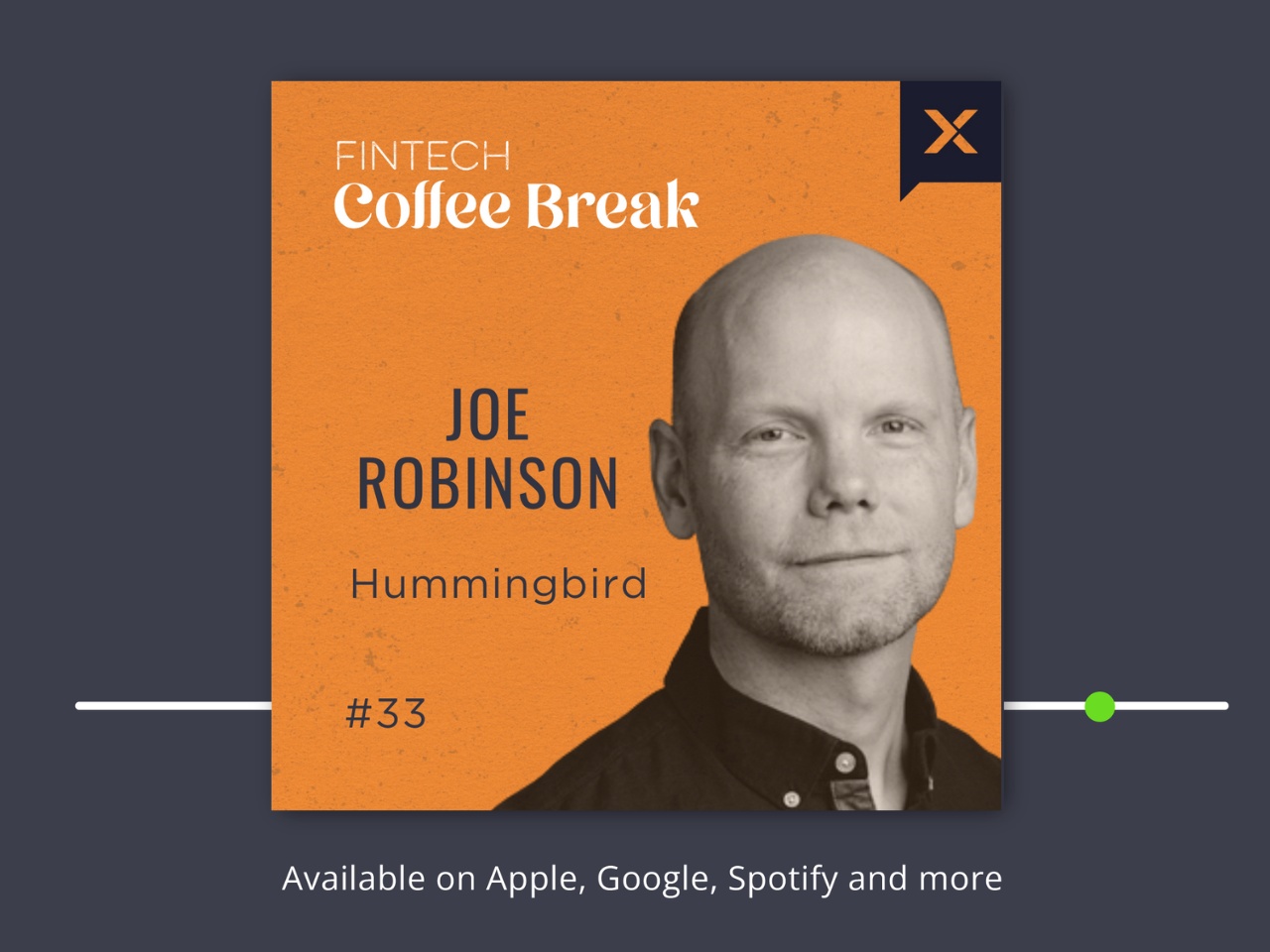
- Fintech Coffee Break - AI and financial crime
- Fintech Business Weekly interview, September 2025
- Kauffman Fellows - the power of networks
- Read Robinson’s essay on enterprise design
- Hummingbird’s June 2026 AI announcement