The supplier gave Joe Hessling a choice: buy the checkout business or watch it close. He had brought the technology into his Detroit foodservice operation to help customers spend less while keeping food available at work. Now the company behind it wanted out. Hessling collected the equipment in a truck and took it home. The garage became the next address for a business he had originally needed as a customer.
It is a useful correction to the usual garage story. There was already a customer, already a problem, already a reason for the machinery to exist. Before Hessling became the founder and CEO of 365 Retail Markets, he was an operator trying to make workplace dining add up. His route into technology ran through the lunch bill.
That distinction has followed him. Software, payments and kiosks now sit inside the company he leads, but the recurring question is familiar: how do you keep a little shop working when there is no shopkeeper behind the counter?
A food business before a technology business
Hessling grew up around people who sold things people needed. His grandfather owned a hotel. His father worked in foodservice. As a child, he accompanied his father on early trips to Detroit’s Eastern Market, buying supplies for restaurant deliveries. He later bought his father’s business in 1997. A brief attempt at retirement eventually gave way to Abe’s Deli, a corporate catering venture he started with partners in 2000.
The work put him on both sides of a changing workplace: the restaurants serving workers and the cafeterias serving offices. By the time he began 365 in 2008, he understood the buyer’s problem from inside the operation. Employers wanted convenient food without the staffing expense of a conventional service counter. An unattended market offered a way to keep the shelves stocked after a cashier had gone home.
There is something pleasingly unromantic about this beginning. A sandwich has to get delivered before it can become a technology opportunity. Hessling’s earlier businesses gave him experience in distribution, restaurants, catering and corporate dining. The checkout screen arrived late in that education.
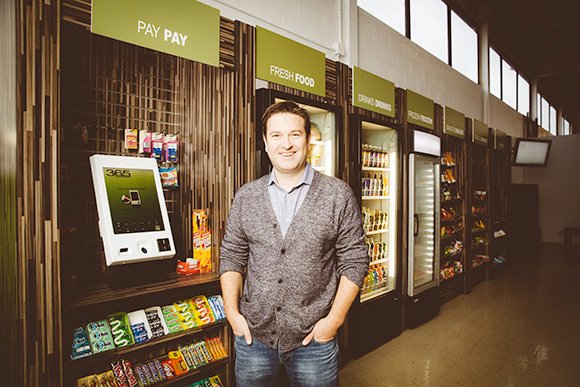
The shop gets smaller. The job gets bigger.
A micro market compresses familiar shopping into an unfamiliar setting. Shelves and coolers offer food and drinks; a self-checkout point handles the sale. An operator supplies and services the location. The workplace gets a little store, and the operator gets another stop to manage.
For Hessling, selling to vending operators made practical sense. They already knew how to deliver products, maintain equipment and visit locations on a route. The new format changed what they could put in front of customers. The surrounding work remained recognisable. There was no need to teach an entire industry that drinks needed replenishing.
The apparent simplicity concealed a growing list of jobs. Behind the checkout were product records, price changes, inventory reporting and payments to reconcile. By 2019, Hessling was describing a cloud system supporting those tasks and a 40-person call centre providing round-the-clock help. A machine could remove the need for a cashier at the point of sale while creating quite a lot of work elsewhere.
That helps explain why the business became broader than a kiosk. A small terminal, a vending payment device and a dining checkout serve different spaces. The operator needs the pieces to cooperate. Hessling’s company developed around that daily operating problem, where an attractive screen is only the beginning of the purchase.
- 01 / STOCKThe operator fills shelves and coolers.
- 02 / CHOOSEThe customer picks food and drinks.
- 03 / PAYSelf-checkout records the purchase.
- 04 / MANAGESoftware supports prices, stock and reporting.
A simplified view of the model - the people and systems behind an unattended sale.
An expensive way to prevent a cheaper problem
Early 365 systems used RFID tags on individual products. Hessling later described an awkward discovery: tagging the food cost more than the products lost to theft. The protective measure had become the more expensive problem. The business changed its approach.
This was a lesson with limits. A workplace market depends on its setting; Hessling has explicitly cautioned that the model does not suit every location. Trust is an operating decision, with costs attached. The useful question was how much protection a particular market needed, rather than how much technology could be fitted into it.
His early hardware stories have a similarly practical flavour. Some kiosks left the garage with the dollar used to test the bill validator still inside. Customers were effectively receiving a tiny, accidental rebate. Later designs reflected requests for different payment options and equipment that could be serviced more easily in the field.
The pattern matters more than any individual feature. Hessling was learning from a business that had to function after installation. A checkout can work beautifully during a demonstration and still be a nuisance to the person maintaining it. His operator background gave that person a place in the design conversation.
The numbers outgrew the Post-it
In 2014, Hessling kept a worn Post-it beside his laptop with the company’s annual revenue figures. It began with $42,000 for 2009 and ran through roughly $10 million in 2013. The final entry was a forecast: $15 million for 2014. The distinction between money earned and money expected deserves to survive the telling.
*2014 was a projection reported that October. Bars use a common $15 million scale; rounded historical figures.
The company’s premises told the same story in less numerical terms. By 2012, employees were working behind an auto body shop. Later came an office and assembly building in Troy, Michigan, with software development and manufacturing under one roof. The fashionable startup accessory was present, but Hessling’s description was economical: “We have the typical ping-pong table. That’s about it.”
A company producing physical checkout equipment cannot grow entirely inside a laptop. Someone has to assemble, test, ship and support what the software team makes possible. The offices and workshop belonged in the same story. Rapid growth meant expanding that whole arrangement, rather than simply adding more accounts to a screen.
A founder takes a seat among peers
Hessling’s responsibilities widened beyond his own company. He attended his first executive forum in 2016 and returned to programmes where founders could compare problems with other business leaders. He valued the chance to develop professionally while surrounded by people carrying similar responsibilities.
At KPMG’s QuantumShift programme, returning participants also helped newcomers find their feet. Hessling described that obligation as part of being a fellow. The founder accustomed to answering questions inside his own organisation had found a room in which asking them was useful.
Recognition followed. NAMA named him its 2018 Industry Person of the Year, an award tied to professional leadership and service to the convenience services industry. That June, he received EY’s Entrepreneur Of The Year award in the Business Services category for Michigan and Northwest Ohio. The regional category matters: it was a specific award, presented at the Detroit Institute of Arts, rather than a national title.
In 2021 he became chair of NAMA’s board. His association work included industry education and advocacy, extending a career spent serving workplace customers into representing the businesses that served them. Goldman Sachs later recognised him among its 2022 entrepreneurial honorees at the Builders and Innovators Summit.
Buying the pieces, joining the people
The truck journey was an early acquisition in a career that would involve many more. In December 2020, Providence Equity Partners announced a majority investment in 365. Hessling stayed in charge and retained a significant ownership stake, alongside existing investor McCarthy Capital and management.
The following year, 365 combined with Avanti Markets. Hessling and Avanti founder Jim Brinton announced the deal together in Seattle. The company also acquired LightSpeed Automation, which addressed product picking in operators’ warehouses. The scope now reached further back from the checkout into the work required to supply it.
“Our focus will be to provide operators with security, uptime and innovation.”
Joe Hessling, on the 2021 Avanti combination
Bringing businesses together introduces a different kind of operating challenge. Research budgets, product choices and established customer loyalties all enter the same conversation. Hessling’s argument was that combined development efforts could better serve operators. Delivering that promise would depend on the work after the announcement, when customers still needed their systems to run.
A bigger company, a familiar test
In May 2026, 365 announced completion of its acquisition of Cantaloupe. The combined business brought Cantaloupe’s payments, telemetry and device network together with 365’s self-checkout, smart-store and software operations. Hessling spoke of introducing nearly 40,000 new customers to 365’s products and services, with Scott Stewart and Jeffrey Dumbrell joining the executive team.
The $848 million transaction also brought competition conditions. The Federal Trade Commission required the divestiture of Cantaloupe’s Three Square Market business to Seaga Manufacturing. Its final consent order required reasonable, non-discriminatory terms for integrations between software and hardware. Those requirements addressed concerns about the loss of competition and the ability of rival systems to keep working together.
For a founder whose business began with the consequences of a supplier’s decision, that question of access has particular resonance. Operators rely on the technology companies behind their checkout equipment. As those companies grow and combine, the continued usefulness of the equipment remains a very local matter: one location, one operator, one purchase at a time.
Hessling has stated an ambition for 365 to become a global standard for self-service. It is a considerable distance from collecting someone else’s checkout equipment in a truck. Yet the original test remains a good one. Someone wants lunch. Someone else has to make the economics work. Between them sits the small shop he has spent years helping to build.