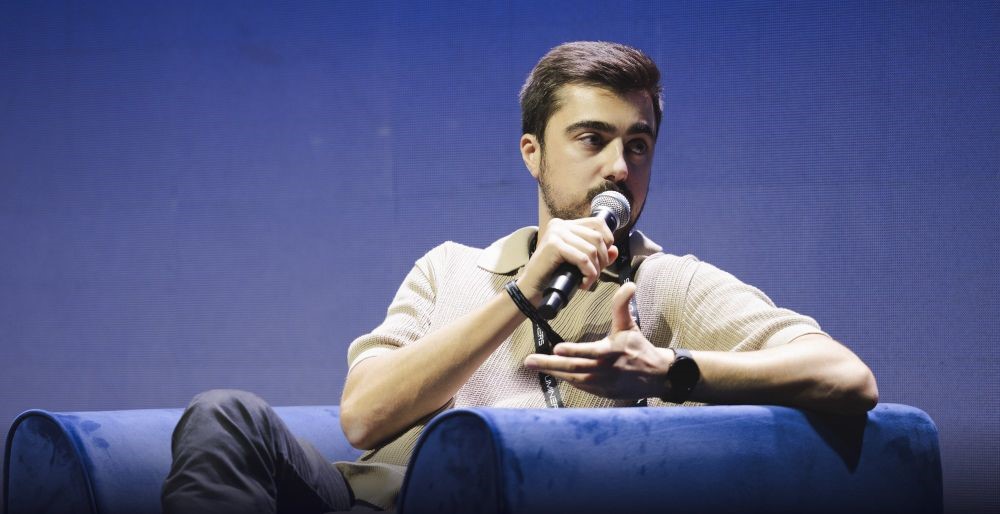
The man at the tap
A hotel shower is a confession. It tells you how much someone cares, how long they linger, how much water vanishes down a drain nobody is watching. João Machado decided to listen.
As founder and CEO of Savearth, Machado runs a Portuguese climate-tech company built on a deceptively small idea: a device that recognizes the sound frequency of running water, converts that noise into a precise liter count, and nudges the person under the showerhead before the waste piles up. It installs in under a minute. No plumber. No drill. No torn-up bathroom. It just sits there and pays attention.
The pitch lands because the numbers are absurd. The average hotel guest uses roughly 120 liters in a single shower - about three times what Savearth considers a sustainable run. Multiply that by every room, every night, across an entire industry, and you arrive at the figure Machado likes to quote: excessive shower use costs hotels worldwide more than $7 billion a year. He found a way to turn that leak into a line of business.
Based between Barcelona and Porto, where Savearth is incubated at the University of Porto's UPTEC science park, Machado is doing the unglamorous work of scaling hardware in a famously cautious industry. In May 2026 he closed a €400,000 round from ten investors and set a target that would make most founders sweat: 8,000 hotel rooms wired to listen, across Portugal and Spain, by the end of the year.
A study, a statistic, a company
Savearth started with a sentence Machado could not put down. He read a study warning that by 2050, close to five billion people could struggle to access drinking water. Most of us file that under things-too-big-to-fix and move on. He went looking for the smallest place to start.
That place turned out to be the bathroom. Hotels are water-hungry, profit-conscious, and full of people who behave differently away from their own utility bill. If you could make the invisible visible - show a guest exactly how much they were using, in real time - maybe you could change the behavior without lecturing anyone. The conviction underneath it all is almost a manifesto:
We believe sustainable behavior is encouraged, not imposed.- João Machado, founder & CEO, Savearth
So Savearth doesn't shame. It rewards. The model is called Save-to-Earn: stay within an efficient range and you collect points redeemable for spa vouchers, free drinks, dining discounts, the small luxuries that make a stay feel generous. The guest gets a perk. The hotel gets lower bills and a sustainability story it can actually prove with data. Machado is allergic to the alternative.
The difference between intention and action lies in the data.- João Machado
How a shower becomes a number
The device picks up the sound frequency of running water - no invasive plumbing, no flow meter cut into the pipe.
AI sound recognition converts that frequency into a precise, real-time count of liters used.
Guests get alerts as they approach the limit; staying efficient earns Save-to-Earn points. Hotels watch it all on a room-by-room dashboard.
The 120-liter problem
From pilot to playbook
Hospitality is a hard room. It is conservative by instinct, allergic to anything that touches the guest experience, and skeptical of hardware that promises miracles. Machado's answer was to let the pilots argue for him. At the PortoBay Teatro Hotel the device cut shower consumption by 46%. At the Palácio do Governador it reached 48%. For a 150-room property, Savearth estimates that adds up to roughly €100,000 in annual savings.
Those results pulled in names. Savearth has run pilots with major groups including PortoBay, Numa and Hilton, pushed into the water-stressed Algarve, and built a waitlist of properties stretching from Portugal and Spain to Italy and Dubai. The company officially launched its Eco Shower device in November 2025 at the Hospitality Innovation Summit in Lisbon.
One of the most defining moments for us was seeing our technology deployed in real hotel environments - realizing that a small device could generate measurable environmental impact.- João Machado
What separates Savearth's pitch from the usual climate gloss is that Machado refuses to treat green and profitable as a trade-off. He calls the company a rare thing in its field - a climate-tech that lowers costs and raises revenue at the same time. In a sector drowning in good intentions and sustainability badges, he keeps pointing back at the dashboard.
Blockchain to bathrooms
Machado did not arrive from the world of water utilities. He came from the other end of the room. Before Savearth he worked in the crypto and blockchain startup scene and completed a Blockchain Strategy Programme at the University of Oxford. The throughline isn't the technology - it's the obsession with verifiable, tamper-proof records of who did what. Trace it and you can see why a man who once thought in ledgers now thinks in liters.
The recognition has stacked up quickly. Savearth won the Portuguese edition of ClimateLaunchpad, the world's largest cleantech competition, which earned it a spot at the Climate Innovators Fair among startups from more than 45 countries. It was named a finalist in the 2025 Ocean Community Challenge, picked up a German acceleration programme, and put Machado on the speaker list at Web Summit Lisbon.
Past the showerhead
The hotel bathroom was always the wedge, not the destination. Machado talks about taking the same behavioral-intelligence approach into smart homes, gyms and student housing - anywhere water runs unwatched and someone, somewhere, is paying for the waste. The five-year vision is blunt: thousands of properties in water-stressed regions, millions of liters saved a day, and water efficiency treated as standard practice rather than a marketing line.
What motivates us most is the urgency of the water crisis.- João Machado
It is a big claim for a small device. But that has always been the shape of Machado's bet - that the way to face an impossibly large problem is to find the smallest honest place to begin, and then refuse to look away. He read about five billion thirsty people and, instead of despairing, went and learned how to make a shower talk.