A truck sitting beside a charger can look like progress. For Joachim Lohse, the more interesting question is when it leaves. The vehicle may be electric, the charging equipment installed, the corporate announcement neatly written. There is still a delivery to make. A depot that cannot get its vehicles out on time has acquired a rather expensive collection of parked objects.
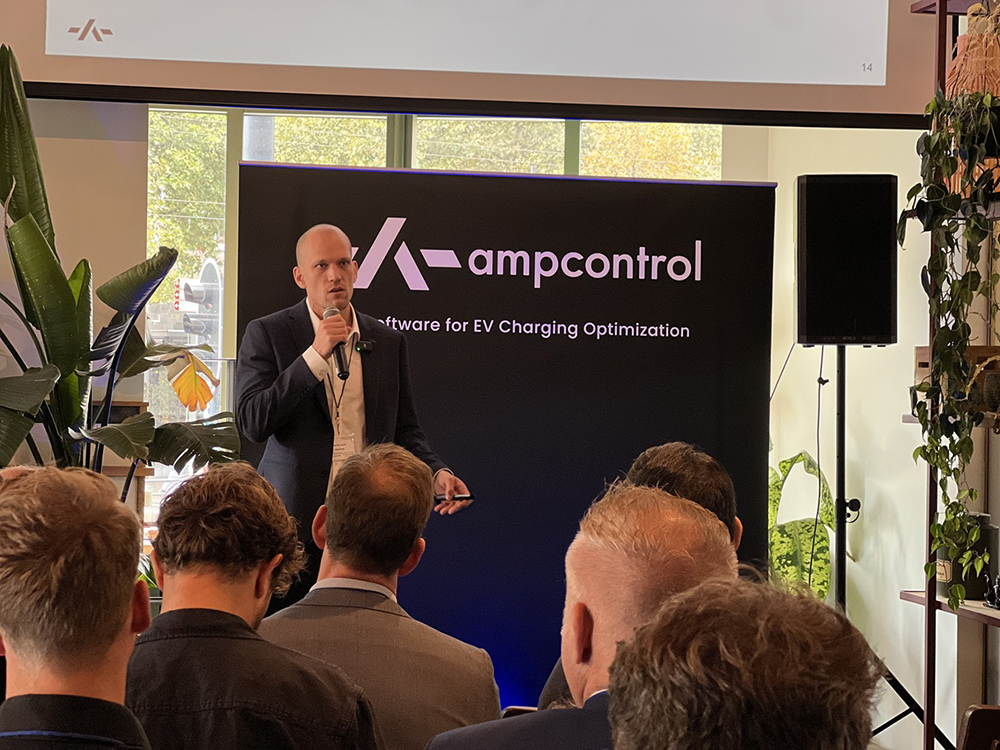
Lohse has built his working life around the gap between buying electric vehicles and running them. As founder and CEO of Ampcontrol, he deals in power limits, charging schedules and the stubborn practicalities of transport. His customers have freight to move, passengers to collect and shifts to begin. An elegant algorithm receives little applause if the bus misses its departure.
The appeal of his story lies in how it started: a young consultant writing about technologies he was trying to understand. Before there was a fleet software business, there were questions, conversations and an electricity grid that was about to acquire some demanding new customers.
Before the trucks, a steering system
At the University of Erlangen-Nuremberg, Lohse studied subjects that placed engineering beside economics and management. His bachelor's studies ran from 2010 to 2014; his master's followed from 2014 to 2016. It is a useful pairing for someone whose eventual customers would need both a functioning charger and a business case.
He also worked with High-Octane Motorsports, the Formula Student team. His public account of that period includes business team leadership, sponsorship and public relations, followed by development of a steering system for the 2014 season: concept, manufacture and testing. The work brought together a vehicle's physical behavior and the people needed to get it built.
There were roles at Siemens and Mercedes-Benz, too. By 2016 he was an energy consultant at PwC, working with utilities. A presentation introducing him years later would describe that work as helping energy companies plan their transition. He had become familiar with the organizations responsible for keeping power available, long before charging a fleet became his daily concern.
A blog post can be a business plan in disguise
While consulting, Lohse began researching emerging technologies and writing about them on LinkedIn. The writing drew him into utility workshops. Discussions about new software led to a practical question: how would electricity networks cope with vehicles arriving in numbers and expecting to charge?
He left his job in 2018 and began building a company. Early New York investment helped get the work started. Ampcontrol's own history dates its founding to 2019, when the business began establishing the operations that would follow. The useful distinction is between the decision to start and the company taking shape.
By late 2019 and early 2020, his published articles were deep into the details: charging protocols, time-of-use electricity rates and grid connections. A founder could choose more glamorous subjects than OCPP 1.6. Lohse was already spending time on the questions that would matter when somebody tried to plug in a real vehicle.
“Building a company does not come with a playbook.”
Joachim Lohse
That observation, made in Ampcontrol's funding announcement, suits the beginning. Writing had opened a door; it had not supplied a map. The subjects he kept returning to were becoming a product rather than remaining a consultant's recommendations.
Three problems, one departure time
Lohse describes the business through three recurring demands: work within the available grid connection, keep the equipment operating and control the electricity bill. Those demands overlap. Charging everyone immediately can push up costs or exceed a site's power limit. Waiting for a cheaper hour is little comfort to a driver due out before then.
His concern extends beyond whether electricity reaches a plug. Fleet operators have spent years refining routes, vehicle utilization and driver schedules. Electrification inserts a new timetable into that already crowded day. The business has to accommodate vehicles that may spend hours replenishing their batteries on its own premises.
“This shift of mindset is certainly the most challenging part,” he said in 2025. It is a more revealing answer than a complaint about batteries. He is asking customers to reconsider the operation around the vehicle, including the energy system that the fleet now depends upon.
Conceptual illustration of the inputs Ampcontrol coordinates. No simulated performance data.
Ampcontrol's product history follows that expanding responsibility. Its cloud software arrived in 2020. In 2023, it received UL 60730-1 certification for load management. AmpEdge, introduced in 2024, put a controller on site, including the ability to operate through a lost internet connection. The decisions were moving closer to the equipment they governed.
What a utility cannot promise all day
Fresno supplied a concrete example in June 2026. WattEV opened a heavy-duty truck charging depot while a permanent grid upgrade was still scheduled for mid-2028. There was about one megawatt of firm capacity available. Under PG&E's Flex Connect program, the site could draw up to 3.6 megawatts during most hours, provided its load responded to the power actually available.
Ampcontrol supplied the energy management system. The distinction matters: the software did not manufacture electricity or turn a limited connection into an unlimited one. It controlled charging against changing capacity. That arrangement allowed a working depot to open roughly two years before the permanent upgrade.
Variable access comes with operating limits. The permanent upgrade was scheduled for mid-2028.
For Lohse, it was an answer to the problem that had caught his attention as a consultant. There was a useful job for software between a utility's restrictions and an operator's timetable. Waiting for construction was no longer the only option available to that customer.
The supermarket has its own electricity bill
Another 2026 project brought the problem into Dutch grocery distribution. Lidl Netherlands chose Ampcontrol for energy management and charge planning at selected distribution centers, supporting its goal of supplying 440 stores with an electric fleet in 2027.
Here, the trucks share a site with other substantial electricity users. AmpEdge coordinates chargers, rooftop solar and battery storage while monitoring warehouse cooling loads. Charging plans draw on route information and live vehicle data. A refrigerated warehouse cannot politely switch off its responsibilities because a truck has arrived.
Ampcontrol reported a 22 percent increase in solar self-consumption and a 32 percent increase in available charging power in the Lidl project. These are project results, rather than a promise for every depot. They give Lohse's work a measurable setting: the same distribution business, with more careful coordination of the energy it uses.
Fifty trucks, ten plugs
By May 2026, Lohse was writing about a further constraint: charging spaces themselves. He described projects trying to serve 50 trucks through 10 charging ports in a day. Even with sufficient energy over 24 hours, the physical sequence still has to work.
A truck can return late. Another may need an earlier departure. A charger can become unavailable. The person dispatching vehicles is already dealing with routes, drivers and third-party carriers; adding several days of manual charging reservations is a considerable request.
Ampcontrol's AutoScheduler brings together route plans, telematics and charger information to arrange charging, then adjust as circumstances change. Lohse's account includes alerts when an unresolved conflict needs human attention. There is something pleasingly practical about that admission. A system earns its place by helping the dispatcher handle the day, including the moments when it needs to ask for help.
An AI founder who makes a case for patience
Lohse sells software that uses AI, yet his September 2025 essay on infrastructure resists the idea that every industry should change overnight. Writing from the New Mobility Conference in Katowice, he argued that ports and logistics systems have reasons to be cautious. Interrupting critical operations carries consequences well beyond a disappointing software demonstration.
He saw electrification as a setting more open to new automation because operators were already introducing new equipment and processes. His forecast was that charging decisions would become increasingly automated. The enthusiasm came with an understanding of what those decisions control.
That combination gives his public voice its character. He is willing to discuss the future, but keeps returning to equipment, integration and operating conditions. Even the ambition has a timetable attached.
A founder learns to share the difficult bits
Lohse's reflections on running Ampcontrol have become less solitary as the business has developed. In a public founder update, he described the contrast between early setbacks falling on him and later problems being worked through by a broader leadership team. The challenges continue, he said; the range of people handling them has changed.
That team includes chief product officer Jonas Schlund, chief technology officer Bela Patkai and chief operating officer Fadwa Kingsbury. In September 2026, Lohse and Schlund appeared together for a webinar about storage and fleet electrification. The question was familiar: how to combine energy resources so an electric operation can keep working.
The subjects in Lohse's life have changed from student racing components to utility workshops to commercial depots. A connecting interest remains: how separate parts behave when they have to function together. The steering system must turn the car. The charging plan must release the truck. The company must have people able to carry the work.
There is a quiet satisfaction in the outcome he keeps pursuing. A vehicle leaves the depot, charged and on time. For its driver, the day can proceed. For Lohse, that ordinary departure is the point.