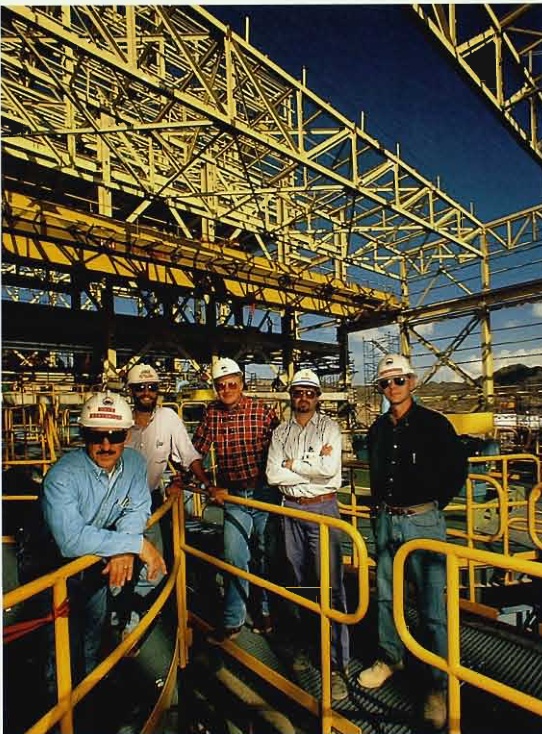
In the photograph, Jim Breuer is standing at the far right, wearing a hard hat and sunglasses, surrounded by yellow steel. There are five colleagues in the frame. The setting is a copper concentrator project in Argentina. The year is 1996. Breuer’s job title is field engineer. The chief executive’s office is still almost three decades away.
It is a useful place to begin with someone whose subsequent titles can make a working life look inevitable. General manager. Business line president. Group president. Chief operating officer. Chief executive. Read backward, a career becomes a staircase. Read forward, it contains an awful lot of scaffolding.
Breuer joined Fluor in 1993. By the time his appointment as CEO was announced in February 2025, he had spent half his career on assignments outside the United States. His engineering, procurement and construction experience stretched across four continents. For a business that must coordinate people, materials and money across borders, that was a fairly practical qualification.
A business measured in things that must work
The Argentine assignment put him inside a project for Minera Alumbrera: a copper concentrator designed for 80,000 tons per day, with associated facilities. Fluor Daniel was working with SADE, an Argentine engineering and construction company. The photograph’s caption names the chief field engineer, two superintendents and two field engineers. Breuer appears last.
That small detail gives the later story its proportions. A project is a collection of interdependent jobs, many performed by people who will never appear in the CEO announcement. An engineer may draw a clean line on a plan; making the line exist requires someone else’s materials, somebody’s sequence of work and a shared understanding of what happens next.
Breuer’s formal education crossed those same boundaries. He earned a civil engineering bachelor’s degree at the University of Illinois Urbana-Champaign, a master’s and an Engineer degree in construction engineering and management at Stanford, and an MBA at Cornell. The combination brings the structure, the building process and the economics into the same conversation. Each can spoil the other two’s afternoon.
His early Fluor work included mining and downstream construction, followed by project engineering, project management and operations. Assignments took him through the United States, Europe and Latin America. The progression gave him experience of the work before responsibility for larger portions of the business.
The lesson he was already teaching in Chile
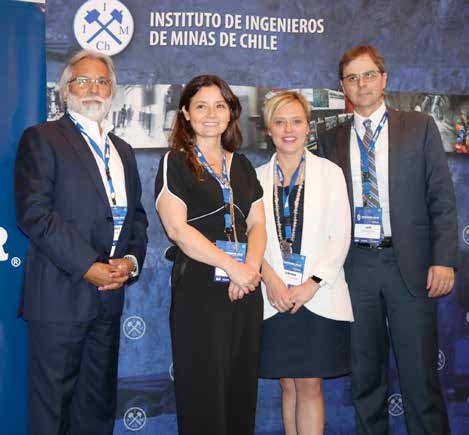
By 2017, Breuer was Fluor’s vice president and general manager for Mining & Metals in South America. At a Chilean mining convention covered in 2019, his concerns were recognizably those of the executive he would become: competitiveness, technology and the development of people.
Asked about mining’s challenges, he described innovation and talent as means of improving competitiveness. He also emphasized adapting to rising social and environmental expectations. Younger professionals, he said, needed to understand the forces affecting the industry and watch how experienced leaders communicated ideas in public.
There is something appealingly specific about that advice. Attend the discussion. Notice the argument. Watch someone explain a difficult thing clearly. Leadership development, in this account, includes paying attention while another person has the microphone.
He described staying close to clients so Fluor could understand their problems and offer economical project solutions. Years before the CEO title, the ingredients were present: understand the customer, improve the work and give younger people a chance to learn how the industry behaves.
Thirty-two years, then a new job
In 2019, Breuer became president of the Downstream business within Energy & Chemicals. In January 2021, he took charge of Energy Solutions. Those assignments widened his responsibility from regional mining operations into global energy and chemicals markets.
Energy was changing around him. In the business’s 2023 review, Fluor reported that energy transition projects represented 48% of Energy Solutions backlog, compared with 10% in 2022. These were segment figures, rather than a description of the whole company. They nevertheless show the mix of established industrial work and newer applications he was overseeing.
In August 2024, Fluor created the chief operating officer position and appointed Breuer. The assignment connected the company’s three segments: Energy Solutions, Urban Solutions and Mission Solutions. His brief included looking across markets and allocating talent where project delivery required it. That is a less photogenic task than a groundbreaking ceremony, though the ceremony’s eventual success may depend on it.
The CEO appointment followed less than a year later. David Constable moved into the executive chairman role when Breuer took over on May 1, 2025. Constable tied the succession to the company’s move from its repair phase into a period focused on growth and execution.
For Breuer, the promotion meant inheriting both the benefits and the obligations of continuity. He knew the company’s operations and had helped run them. A new title would bring greater authority, along with fewer places to send a problem upstairs.
Getting there before the concrete
Listen to Breuer explain the business in May 2026 and the sequence matters as much as the destination. Fluor’s preferred approach was to join a project early in planning and remain through execution. Early engineering helps define scope, cost and schedule before the client makes its final investment decision.
This is where an apparently dry contracting discussion becomes revealing. Before large amounts of capital are committed, the parties can decide what they are building, how to build it and who carries which risks. The opportunity for a contractor begins well before workers arrive at the gate.
He pointed to front-end assignments across nuclear fuel, gold, fertilizer, refining and data centers. These represented possible future business, dependent on clients proceeding and selecting Fluor. An opportunity can occupy a very large slide while still requiring someone else’s signature.
“Honest, two-way communication is critical”
Jim Breuer, message accompanying Fluor’s business conduct code
The same preference for surfacing questions appears in his message to employees on business conduct. He encourages people to ask when they are unsure and describes an expectation of speaking up about wrongdoing. The company states that good-faith reports must not invite retaliation. In a project organization, the practical test is whether a concern can travel upward while there is still time to act on it.
Growth, with the bill attached
By the second quarter of 2026, the company had numbers that supported the growth argument. Fluor booked $6.1 billion of new awards and ended June with $26.9 billion in backlog. Eighty-five percent of that backlog was reimbursable, a contract structure that matters when assessing who bears project costs.
The quarter also supplied a reminder of what execution can cost. Fluor reported $44 million in additional costs on the substantially completed Gordie Howe International Bridge, involving currency movements, a subcontractor bankruptcy and client changes. Its full-year adjusted EBITDA outlook was reduced after the sale of its Mexico joint venture removed an expected contribution.
On the August earnings call, Breuer described power generation as Fluor’s preferred opportunity within the data center ecosystem. He also stressed understanding and pricing risk before accepting lump-sum work. That distinction gives his strategy some texture: the demand for computing creates opportunities in the electricity system around it, and contract terms remain part of the decision.
None of this can be settled by the size of a new award alone. A contract signed today must still become a facility that works, with the financial result preserved along the way. The yellow steel in that old photograph has a way of returning to the conversation.
The energy work also complicates any tidy account of his career. While leading Energy Solutions, Breuer described a portfolio serving existing energy needs alongside projects intended to reduce emissions. The assignment required attention to both. Customers were making decisions about security of supply, changing technologies and the economics of long-lived facilities. A contractor had to be useful within those decisions.
The colleagues who stay in the picture
Breuer’s account of his first year as CEO includes a personal acknowledgment of Mark Fields, the longtime Fluor executive who advised and supported him during his career. He also credits teamwork and collaboration for meaningful achievement. The gratitude connects the executive to an organization in which experience passes between people over many years.
There is a broader institutional version of that idea in the inclusion statement he signed in January 2026. It commits Fluor to fair treatment and to providing mentoring and networking opportunities. Written promises acquire meaning through ordinary opportunities: who gets access to experience, who gets heard and who is prepared for the next assignment. Those are sensible questions to ask of a business that depends on accumulated expertise.
In a Fluor video reflecting on proud moments, Breuer spoke about working for a company involved in improving the world around it. That is the attraction of this kind of career: the work eventually exists outside the organization. A functioning facility has users, employees and a life beyond the team that delivered it. The responsibility travels with the satisfaction.
His public priorities for developing leaders now sit beside responsibility for project performance and growth. The pairing makes sense. A company selling the ability to complete difficult work must keep producing people capable of doing it. Promoting one engineer to the top only deals with one vacancy.
Return to Argentina in 1996. Breuer is one of five people, named in a caption beneath an industrial structure. Today his name leads the management team. The distance between those positions contains the real story: years of assignments, expanding responsibility and colleagues who helped him along. His next results will depend on whether thousands of other people can turn their own experience into completed work.