The important word in Jill Flaherty's new title may be “marketing,” but the revealing word is “chief.” To market banking technology well, she has had to understand where a product begins, how a salesperson explains it, why a client hesitates and what happens when software meets the complicated habits of real customers. Her promotion to senior vice president and chief marketing officer at COCC in January 2026 looks tidy on an announcement. The route to it was delightfully untidy: business development, digital banking, strategic products, sales, pricing, events, writing and interviewing.
Flaherty joined the Southington, Connecticut company in 2011, the same year she completed her bachelor's degree at Central Connecticut State University. COCC supplies core and digital technology to community banks and credit unions. It is client-owned, which gives every grand strategy a practical audience: institutions that are not merely customers but stakeholders. A weak sales pitch can be ignored. A weak partnership has to be lived with.
Her first classroom was Business Development. She later moved into the group now called Digital Banking, then began leading Strategic Products in 2016. The sequence mattered. It placed her near the spot where a capability becomes a decision. Bank executives do not buy an API because the acronym is charming. They buy because a customer expects a faster payment, a cleaner account opening or a safer connection to another service. Flaherty learned to translate between those worlds before she was asked to lead the message.
The product was only half the job
By 2021, when COCC promoted her to vice president, her brief had become visibly connective. She had spent five years growing strategic-product sales and building relationships across client organizations. Colleagues singled out her product knowledge, but knowledge alone was not the result. The useful trick was matching technology to a client's strategy, then keeping product teams, relationship managers and sellers in the same conversation.
Two years later, she became first vice president. COCC credited her leadership with doubling strategic-product sales and contributing to an unusually productive sales year. The figure deserves attention because it reveals what her version of marketing was doing. Branding, pricing communication and sales were not separate islands. The work was to build ferries between them.
- 2011Business Development
- 2011-16Digital Banking
- 2016Strategic Products
- 2026Chief Marketing Officer
This is not the glamorous theory of marketing in which a brilliant slogan descends from the ceiling. It is closer to civic engineering. Product managers know what can be built. Relationship managers know what clients complain about on Tuesdays. Sales teams know which promises survive a budget meeting. Clients know which inconveniences have quietly become intolerable. Someone has to make those truths intelligible to one another.
“As a technology partner, we are happy to bring guidance to our clients on how to navigate through these rapidly changing times.”Jill Flaherty, 2021
Flaherty said that while hosting a COCC technology symposium in 2021, when digital service had stopped being a polite item on a roadmap and become daily banking life. Her wording is revealing. She chose “guidance,” not spectacle. Community institutions were deciding how to make virtual interactions easy and secure without sanding away the personal service that justified their place in the market.
A microphone becomes market research
In 2024, Flaherty took on a more public role as host of Insights Ignited. Across six published episodes, she spoke with bankers and specialists about payments, a women-focused digital bank, branch-to-screen customer journeys, core-platform relationships, sponsor banking and the mutual model. The catalog is a map of the questions a community institution meets when its familiar world gains new rails.
Hosting is an apt job for a leader whose career depends on translation. The host needs enough fluency to press beyond a brochure and enough restraint to let the guest explain the tradeoffs. A conversation about sponsor banking, for example, quickly leaves the neighborhood of branding. Regulation, partnership selection, technology and profitability all arrive at the table. The interesting decisions live in their collisions.
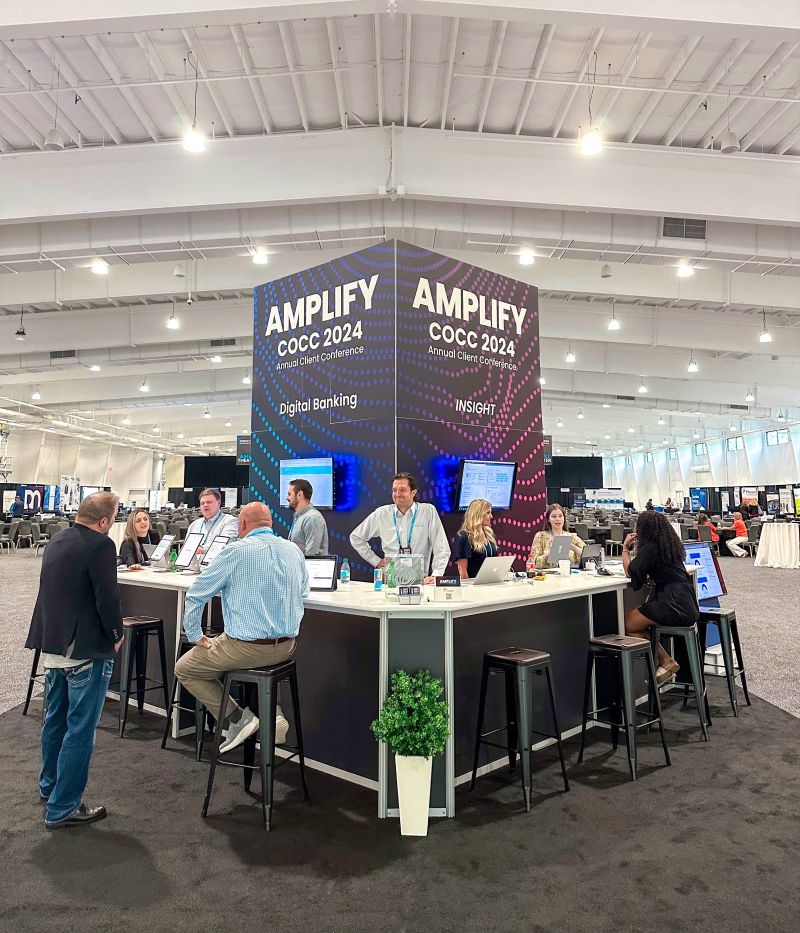
After the first day of AMPLIFY 2024, Flaherty described herself as humbled and grateful for the clients, employees and partners around her. One colleague replied with praise for a presentation she and a teammate had given on growth in digital banking. It is a small public exchange, but a useful portrait of her work: part stage, part reunion, part product discussion. Fintech may run on code; a client conference still runs on people recognizing one another.
She has a lighter register too. After a Bring Your Child to Work Day, Flaherty reported that her son was thoroughly sold on the job. His evidence was rigorous: her office was next to Target, there was free soda, there were Cheetos, and, worth repeating, the office was next to Target. Executive messaging rarely improves on a child's command of emphasis.
Trust, now delivered through a screen
Flaherty's recent writing sharpens the philosophy underneath the career. In a 2025 article about personalization, she argued that community banks face a double demand. Customers want tailored, intuitive digital experiences. They also value the local, relationship-led service that differentiates smaller institutions. Artificial intelligence and predictive analytics can help a bank anticipate needs, automate onboarding and make useful recommendations. The point is not to imitate a giant bank. It is to make local knowledge work at digital speed.
What her interview chair kept returning to
Her June 2026 essay on open banking extends the idea. Customers already scatter their financial lives among payment apps, budgeting tools, investment platforms and digital wallets. Banks cannot wish that ecosystem back into one building. They can, however, help make the connections permission-based, legible and secure. Her image is domestic rather than technical: why hand over the keys to an entire house when someone needs only one room?
Payments supplied an earlier version of the same lesson. In 2022, with the launch of the Federal Reserve's FedNow service approaching, Flaherty said real-time payments were a matter of when, not if, for banks and credit unions that intended to stay competitive. But urgency did not mean skipping comprehension. She identified education as the first practical step: explain instant payments, show credible use cases and let institutions see how peers were already using the RTP network.
That order is characteristic. A new rail may move money in seconds, yet adoption still moves through understanding. A bank must decide which customers need the service, how fraud controls behave, what employees will say and how the capability fits a broader plan. Speed in the product creates a need for patience in the explanation. Flaherty's work occupies that interval, after the technology is possible but before it feels inevitable to the people asked to buy, operate and trust it.
It is a marketer's metaphor doing serious work. Open banking is often filed under regulation or infrastructure, terms that can make a customer vanish from view. The house restores the human scale. Access should be limited. Consent should be understandable. Control should sit with the person whose data is moving.
“Why hand someone the keys to the entire house when they only need access to one room?”Jill Flaherty on permission-based data sharing, 2026
That framing also avoids a stale contest between banks and fintechs. Flaherty argues that financial institutions do not need to own every experience. They need to help customers connect the experiences they already value, while preserving the governance and security people expect from a bank. A fintech partner is useful when it solves a real customer problem, not when it merely decorates an innovation slide.
The title catches up
When the CMO promotion arrived in January 2026, it widened Flaherty's role in new core sales and COCC's growth strategy. It also confirmed the logic of the previous 15 years. A core system sits near the center of a bank's operations. Selling one demands more than a memorable campaign. It requires credibility across product, implementation, service and executive strategy. The message has to withstand due diligence.
Her career compounds because she stayed close to the handoffs. Business development taught her what institutions were trying to accomplish. Digital banking exposed her to changing customer behavior. Strategic products taught her the economics of adoption. Marketing turned those lessons into a common language. Podcasting made that language conversational. Writing made it portable.
At a 2025 gathering of more than 90 community-bank and credit-union leaders, she described the value of stepping back, looking ahead and letting peers share what was working. The comment sounds almost modest beside the industry's appetite for transformation. Its modesty is the point. Banking technology changes quickly; trust still accumulates at conversational speed.
Flaherty's story is therefore less about a sudden arrival in the C-suite than about the patient acquisition of context. The telling number is not the title, or even the doubled sales. It is the distance between 2011 and 2026, filled with enough product meetings, client questions and shifting expectations to know what a promise costs.
A good marketer can make technology sound new. A useful one can explain why it belongs in a relationship people are reluctant to risk. Flaherty has spent 15 years practicing the second craft. In community banking, where the software is complex and the emotional product is confidence, that may be the more durable job.